DbcultAccessing Vault...
Cult Review
Senior Film Conservator
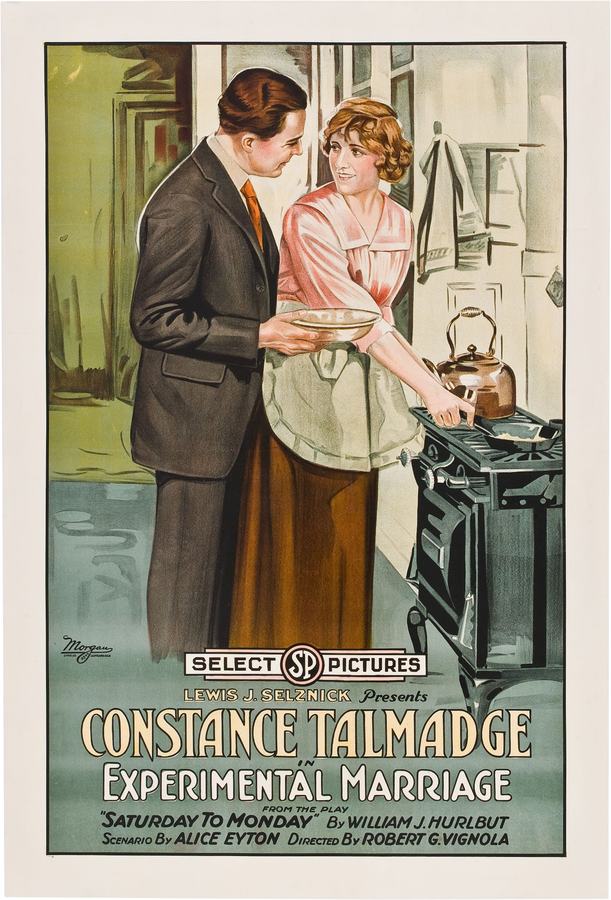
In the annals of silent cinema, where societal norms were often gently prodded rather than outright challenged, Experimental Marriage (1919) emerges as a surprisingly audacious and intellectually stimulating artifact. This film, a product of a transformative era, dares to dissect the very fabric of matrimony through a lens of burgeoning feminist thought and individual autonomy. It’s a compelling exploration of a radical concept – a marriage of convenience and conditional cohabitation – that, despite its century-old vintage, resonates with a startling prescience regarding the perennial tug-of-war between personal freedom and emotional intimacy.
At the heart of this narrative lies Suzanne Ercoll, portrayed with captivating conviction by the incandescent Constance Talmadge. Suzanne is no shrinking violet; she is the embodiment of the "new woman" – educated, independent, and fiercely protective of her intellectual and personal space. Her proposal to Foxcroft Grey, a lawyer played by the ever-reliable Harrison Ford, is less a romantic overture and more a legalistic proposition. Suzanne, unwilling to surrender her hard-won independence to the conventional strictures of marriage, offers a compromise: they marry, yes, but their cohabitation will be strictly confined to the weekends, from Saturday until Monday. The remaining five days are theirs to live as they please, unburdened by spousal scrutiny or obligation. Foxcroft, clearly smitten and desperate to secure Suzanne’s hand, reluctantly acquiesces, his acceptance tinged with an unspoken apprehension. This foundational premise immediately sets the stage for a dramatic conflict, not just between the characters, but between the ideal of absolute freedom and the inherent human need for connection and belonging. It’s a bold articulation of the era’s nascent discussions around women’s rights and the redefinition of traditional institutions.
The experiment, like many grand theories, begins to unravel almost immediately upon its practical application. The very first Monday morning, the fragile edifice of their "no questions asked" policy begins to crack. After Suzanne's departure, Foxcroft finds himself entangled in a seemingly innocuous, yet ultimately catastrophic, domestic predicament. His upstairs neighbor, Charlie Hamilton (Raymond Hatton), a figure of jovial mischief, has a guest, Dot Harrington (Mayme Kelso), lingering after an all-night party. Foxcroft, in a well-meaning but utterly ill-timed gesture of neighborly assistance, helps Charlie orchestrate Dot’s discreet exit. The irony is excruciating: Suzanne, unexpectedly returning for a forgotten item, walks in just as Dot is emerging from Foxcroft’s bedroom. The visual is damning, the implication inescapable, regardless of the innocent truth.
Here, the film brilliantly highlights the chasm between intellectual agreements and emotional realities. Foxcroft, perhaps adhering to the spirit of their "no questions asked" clause, offers no explanation. His silence, intended to uphold their unconventional contract, is perceived by Suzanne as an admission of guilt, a betrayal that punctures the very core of their arrangement. Talmadge, through subtle shifts in posture and a tightening of the jaw, conveys Suzanne's wounded pride and burgeoning suspicion without a single intertitle needed to voice her thoughts. Ford, in turn, masters the art of the stoic, conflicted male, his internal struggle palpable despite the outward calm. This pivotal scene serves as a stark reminder that even the most meticulously crafted agreements are vulnerable to misinterpretation, especially when human emotions – jealousy, insecurity, and wounded pride – are involved.
Suzanne’s reaction to this perceived infidelity is a fascinating study in early feminist psychology. Rather than direct confrontation, she resorts to a retaliatory maneuver, a calculated attempt to inflict the same emotional pain she believes she has endured. She orchestrates a scenario designed to provoke Foxcroft’s jealousy, arranging for him to "discover" her in a secluded bungalow with a playwright. This act is not born of genuine affection for the playwright, but rather a desperate bid to assert control, to make Foxcroft feel the sting of doubt and the threat of loss. It’s a testament to the film's nuanced understanding of human nature that Suzanne, despite her intellectual pursuits and demands for autonomy, still succumbs to the very emotional games that often plague conventional relationships.
Yet, Foxcroft, perhaps learning from the previous misunderstanding, or simply possessing a deeper insight into Suzanne's character, sees through her transparent ploy. He remains unmoved, his impassive demeanor frustrating Suzanne’s efforts and further highlighting the communication breakdown that plagues their union. Ford’s portrayal here is crucial; his quiet refusal to engage in the emotional theatrics underscores his underlying desire for a more genuine connection, one that transcends superficial games. This sequence brilliantly illustrates the futility of trying to control another’s affections through manipulation, especially when the foundation of trust has been eroded by silence and assumption. The screenplay, penned by Alice Eyton and William Hurlbut, demonstrates a remarkable sophistication in depicting these psychological intricacies without the aid of spoken dialogue, relying instead on visual cues, character reactions, and the well-placed intertitle.
The climax of Experimental Marriage is a poignant and deeply affecting moment that serves as the true emotional turning point. Suzanne, having been presented with an award by a feminist delegation, a recognition of her intellectual prowess and commitment to progressive ideals, is subsequently found by Foxcroft in tears. Her public triumph contrasts sharply with her private anguish. The weight of her "experimental" arrangement, the emotional isolation, and the constant psychological fencing have taken their toll. Her tears are not just a sign of weakness, but a profound acknowledgment of the human need for unconditional love, security, and a conventional partnership, elements that her carefully constructed marital contract had deliberately excluded.
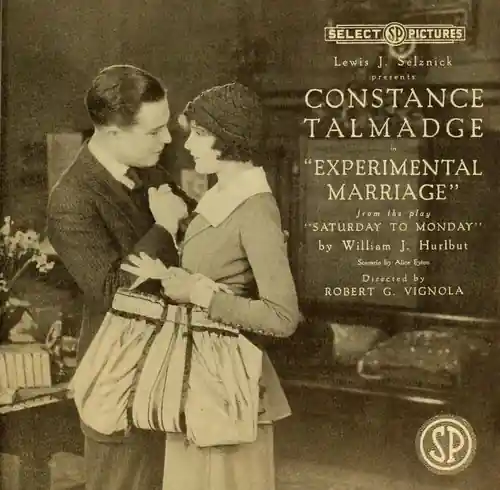
This scene is a masterclass in silent film acting, with Talmadge conveying a torrent of suppressed emotion. It suggests that while intellectual independence is vital, the human heart often yearns for a different kind of freedom – the freedom to be vulnerable, to be truly known, and to find solace in shared intimacy. Foxcroft’s presence in this moment is crucial; his quiet empathy, devoid of judgment, allows Suzanne to finally articulate her desire to end the experiment and embrace a conventional life. The film, therefore, doesn’t necessarily condemn feminist ideals, but rather explores the complex interplay between those ideals and the often-messy realities of human emotion and relationships. It asks: can true autonomy coexist with deep emotional connection, or must one always yield to the other?
Beyond its compelling narrative, Experimental Marriage offers a fascinating window into the social currents of its time. Released in 1919, a period marked by significant social upheaval and the burgeoning women's suffrage movement, the film taps into a collective societal anxiety and curiosity about changing gender roles. While many contemporary productions, such as The Spender, might have explored the financial strains and moral compromises within conventional marriages, or A Gamble in Souls delved into the psychological impact of societal pressures on individual choices, Experimental Marriage stands out for directly confronting the structural definition of marriage itself. It isn't just a romance; it's a social commentary, daring to ask what marriage could be, and ultimately, what it often needs to be for emotional fulfillment.
The performances are uniformly strong. Constance Talmadge, a star of the era, imbues Suzanne with a blend of intellectual strength and underlying vulnerability that makes her character deeply human and relatable. Her ability to convey complex internal states through pantomime is exceptional. Harrison Ford, while perhaps not the household name of his later namesake, delivers a nuanced performance as Foxcroft, portraying a man caught between his love for an unconventional woman and his own more traditional instincts. His quiet dignity and eventual understanding are key to the film’s emotional resolution. The supporting cast, including Raymond Hatton as the jovial Charlie and Mayme Kelso as the unwitting Dot, fulfill their roles with efficiency, driving the plot forward and adding texture to the domestic setting.
The direction, while not explicitly attributed beyond the writers Alice Eyton and William Hurlbut (who penned the compelling scenario), effectively utilizes the visual language of silent film. The staging of key scenes, particularly the "Dot Harrington" incident and Suzanne’s emotional breakdown, is carefully constructed to maximize dramatic impact. The use of close-ups to capture facial expressions, the strategic placement of characters within the frame to convey power dynamics or emotional distance, and the pacing of the narrative all contribute to a cohesive and engaging viewing experience. Intertitles are deployed judiciously, providing necessary exposition or dialogue without overwhelming the visual storytelling. They serve as narrative signposts, guiding the audience through the characters' evolving thoughts and motivations, especially in moments where subtle gestures might not be enough to convey the full depth of their internal conflict.
The film’s aesthetic, typical of its period, might appear simplistic to modern eyes accustomed to elaborate special effects and rapid-fire editing. However, within its own context, the cinematography is clear and functional, serving the story without unnecessary flourish. The sets, whether Foxcroft’s apartment or the playwright’s bungalow, are designed to reflect the characters' social standing and provide believable backdrops for the unfolding drama. There's a certain charm in the simplicity, forcing the audience to focus intently on the performances and the unfolding human drama rather than being distracted by visual spectacle.
Ultimately, Experimental Marriage is far more than a mere historical curiosity. It is a surprisingly profound meditation on the complexities of human relationships, the often-painful compromises required for love to flourish, and the enduring tension between individual aspirations and shared intimacy. It asks whether love can truly thrive under conditions of extreme intellectualized freedom, or if the emotional landscape of commitment necessitates a deeper, less conditional surrender. The film's conclusion, with Suzanne choosing a more conventional path, is not necessarily a defeat for her feminist ideals but perhaps a recognition of the emotional costs of absolute independence within a partnership. It suggests that while the structures of marriage can be questioned and reshaped, the fundamental human need for connection, trust, and mutual vulnerability often remains paramount.
For silent film aficionados, social historians, and anyone interested in the evolving discourse around gender and relationships, Experimental Marriage offers a rich and rewarding viewing experience. It reminds us that the struggles and questions we face in relationships today are not entirely new; they are echoes of conversations that began a century ago, beautifully captured in the expressive silence of early cinema. Its boldness in tackling such a progressive theme for its era makes it a compelling watch, demonstrating that even without spoken words, the screen could powerfully articulate the most intricate facets of the human condition. The film serves as a poignant reminder that while the societal backdrop changes, the core dilemmas of love, freedom, and commitment remain eternal.
IMDb —
1916
Community
Log in to comment.