DbcultAccessing Vault...
Cult Review
Senior Film Conservator
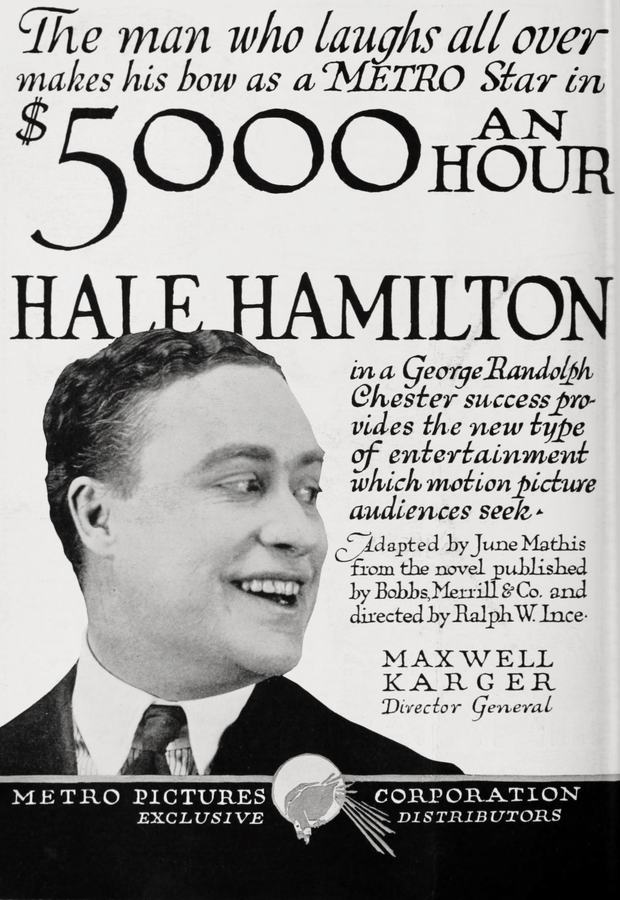
Step into the flickering luminescence of early cinema, a world where grand gestures spoke volumes and the fate of hearts often hinged on the relentless march of a clock. Released in 1918, "Five Thousand an Hour" emerges from the golden age of silent film as a vibrant testament to the era's storytelling prowess. This isn't just a film; it's a high-stakes romantic thriller cloaked in the charming aesthetics of a bygone epoch, a narrative that grabs hold and refuses to let go, even a century later. It posits a compelling question: what price, or what speed, must one achieve to win true love and reclaim lost honor? The answer, in this instance, is an astonishing five thousand dollars an hour, a challenge that sets the very pulse of the narrative.
At the heart of this exhilarating drama is Johnny Gamble, portrayed with a compelling blend of earnestness and steely resolve by Gilbert Douglas. Gamble is introduced not as a man of leisure, but as an industrious entrepreneur, the proprietor of an irrigation company built on hard work and trust. His world, however, is violently upended by the perfidy of his business partner, Paul Gresham. Gresham, a character embodying the most insidious forms of greed and betrayal, absconds with the company's entire treasury and its meticulously kept financial records, leaving Gamble to face the ruins of his enterprise and the crushing burden of his stockholders' claims. This initial setup is crucial; it establishes Gamble as a man of principle, willing to shoulder immense responsibility even when victimized. His integrity is his most valuable asset, one that will be tested repeatedly throughout his extraordinary journey.
Stripped of his fortune and left with literally his last dollar, Johnny's prospects seem bleak. Yet, as with many compelling narratives from this period, fate intervenes with a dash of serendipity. A seemingly desperate wager at the racetrack, a long shot against all odds, delivers an unexpected windfall of $15,000. This sudden influx of cash is more than just a financial reprieve; it's a symbolic turning point, a moment where luck aligns with a deserving spirit. More significantly, it is at this very racetrack, amidst the thrill of victory, that Johnny's path converges with that of the captivating Constance Joy, brought to life with an understated elegance by Lucille Lee Stewart. Constance is not merely a damsel in distress; she is the catalyst for Johnny's monumental undertaking, a woman whose circumstances are as peculiar and dramatic as his own.
It is through Constance that Johnny uncovers the extraordinary condition dictating her future: she stands to inherit a staggering one million dollars, but only if she weds none other than Paul Gresham, his deceitful former partner, within a mere six weeks. This revelation transforms a story of financial recovery into an electrifying romantic and moral contest. Johnny, fueled by a righteous indignation at Gresham's continued manipulation and a rapidly blossoming affection for Constance, conceives an audacious plan: he will earn a million dollars himself by the same deadline, at the incredible rate of $5,000 an hour, to win Constance's hand and thwart Gresham's avaricious scheme. This premise, masterfully crafted by writers June Mathis and George Randolph Chester, is the engine that drives the entire film, setting up a thrilling race against time and a battle of wits against a formidable foe.
Gilbert Douglas, in the role of Johnny Gamble, delivers a performance that transcends the limitations of silent film. His expressions, his physicality, and his very bearing convey a spectrum of emotions – from despair to determination, from burgeoning love to fierce resolve. He embodies the classic American hero: resourceful, honorable, and relentlessly optimistic in the face of adversity. Douglas doesn't merely act; he communicates a profound sense of character through every gesture, every tilt of the head. We witness his drive, his ingenuity as he navigates the complex world of finance and industry, striving to accumulate a fortune at an almost impossible pace. His portrayal ensures that Johnny is not just a plot device, but a genuinely engaging and sympathetic protagonist whose success the audience fervently desires.
Lucille Lee Stewart's Constance Joy is equally vital to the film's success. While the narrative places her in a position where her destiny is largely dictated by men and an inherited stipulation, Stewart imbues Constance with a quiet strength and an undeniable allure. She isn't a passive prize; her reactions, her growing affection for Johnny, and her subtle defiance of Gresham's machinations are all conveyed with graceful precision. The chemistry between Douglas and Stewart, though expressed without dialogue, is palpable. Their longing glances, their shared moments of understanding, all contribute to building a believable romantic connection that justifies Johnny's extraordinary efforts. Constance's predicament highlights a common trope of the era, where women's economic independence was often tied to marriage, yet Stewart's performance ensures she is more than just a pawn in a game of high finance and love.
Paul Gresham, the film's antagonist, is a deliciously despicable character whose consistent villainy provides the necessary dramatic friction. He is not merely an obstacle but an active force of malice, constantly scheming to double-cross Johnny and secure both Constance's inheritance and her hand. Without a compelling villain, Johnny's journey would lack its urgent tension. Gresham's efforts to undermine Johnny, whether through business machinations or direct interference, elevate the stakes of the narrative. The film cleverly uses his presence to showcase Johnny's unwavering moral compass, contrasting Gresham's deceit with Gamble's integrity. It's a classic battle of good versus evil, rendered with the heightened drama typical of silent-era storytelling.
The core of "Five Thousand an Hour" is undoubtedly the relentless race against time. The film masterfully conveys the urgency of Johnny's quest to earn a million dollars. While silent films often relied on intertitles to explain complex financial dealings, here, the narrative focuses on the visual representation of effort and progress. We infer the tireless work, the shrewd investments, the calculated risks Johnny takes. The pacing, though characteristic of silent cinema, builds effectively, accelerating as the deadline approaches. Each success is a small victory, each setback a moment of heightened tension. The film doesn't just tell us he's earning money; it immerses us in the sheer audacity of the task, making us feel the pressure of the ticking clock right alongside Johnny.
Thematic depth is surprisingly rich for a film of its time. Beyond the surface-level romance and adventure, "Five Thousand an Hour" delves into the perennial conflict between wealth and virtue. Johnny Gamble's pursuit of a million dollars is not born of greed, but of a desire to reclaim his honor and secure the woman he loves. Gresham, conversely, is driven purely by avarice. The film subtly suggests that true wealth lies not just in monetary accumulation, but in integrity, resilience, and the capacity for genuine affection. It's a classic American narrative of self-made success, but one filtered through a lens that values character above mere cash. The idea that money can be earned honestly, even at an incredible pace, stands in stark contrast to the illicit gains sought by the antagonist.
As a piece of silent film craft, "Five Thousand an Hour" demonstrates a confident command of visual storytelling. Intertitles are used judiciously, providing essential exposition without bogging down the narrative. The acting, while sometimes more overtly expressive than modern audiences are accustomed to, is perfectly suited to the medium, conveying emotion and intent without spoken dialogue. The camera work, though perhaps less dynamic than later eras, is effective in framing key interactions and conveying the drama. The film's overall production design, from the bustling cityscapes to the more intimate settings, helps to immerse the viewer in Johnny's world. It's a testament to the sophistication that early cinema had already achieved, proving that compelling stories could be told with immense impact even without sound.
Comparing "Five Thousand an Hour" to other films of its era reveals its unique blend of adventure and romance. While not a direct comparison, the theme of a protagonist striving to prove themselves against overwhelming odds and societal expectations can be seen in films like The Small Town Guy (1917), where a character seeks validation and success. The dramatic tension of a ticking clock and a clear winner-takes-all scenario, though in a vastly different genre, might even echo the palpable excitement surrounding events like the Jeffries-Johnson World's Championship Boxing Contest, where every second counted towards a decisive outcome. Similarly, the rapid-fire pacing and dramatic stakes might find a thematic cousin in the energetic storytelling of The Whirl of Life (1915), which often plunged its characters into dynamic, high-pressure situations. The ingenuity of Johnny Gamble's business dealings, however, finds a closer parallel in the comedic yet earnest business ventures explored in films like Broadway Jones (1917), where a man faces financial ruin only to find a new path to success, albeit with more humor. These comparisons underscore the film's place within a vibrant cinematic landscape exploring themes of ambition, romance, and the challenges of the modern world.
As the six-week deadline looms, the tension becomes almost unbearable. Johnny has succeeded in amassing all but $15,000 of the required million, an incredible feat. But with mere minutes left before Constance is bound to Gresham, the final hurdle seems insurmountable. It is in these climactic moments that the film truly shines, delivering a resolution that is both clever and deeply romantic. Johnny's final, desperate act – purchasing a kiss from Constance for the exact sum of $15,000 – is a stroke of narrative genius. It's a symbolic gesture that neatly ties together the film's themes of money, love, and the ultimate triumph of virtue. The kiss, given freely and with genuine affection, becomes the final, most valuable transaction, cementing his victory over Gresham and securing the hand of the woman he loves.
The resolution of "Five Thousand an Hour" is deeply satisfying, a testament to the power of a well-crafted romantic comedy-drama (though leaning more into drama for its stakes). Johnny Gamble's journey from destitution to millionaire, driven by love and honor, resonates powerfully. It's a narrative that celebrates individual ingenuity and the idea that true worth is not merely financial but moral. The film leaves the audience with a sense of exhilaration and the warm glow of a happy ending, a poignant reminder of the enduring appeal of stories where good triumphs over evil and love conquers all, even seemingly insurmountable financial obstacles.
In retrospect, "Five Thousand an Hour" stands as more than just a relic of the silent era; it's a vibrant, engaging piece of cinematic history that continues to entertain and inspire. Its clever plot, compelling characters, and timeless themes ensure its lasting appeal. For those seeking to explore the rich tapestry of early American cinema, or simply to enjoy a classic tale of ambition, romance, and a thrilling race against time, this film offers a delightful and surprisingly modern experience. It reminds us that some stories, like true love and integrity, are truly priceless, even if their pursuit involves an hourly rate of $5,000.
IMDb —
1936
Community
Log in to comment.