DbcultAccessing Vault...
5.1/10
Senior Film Conservator
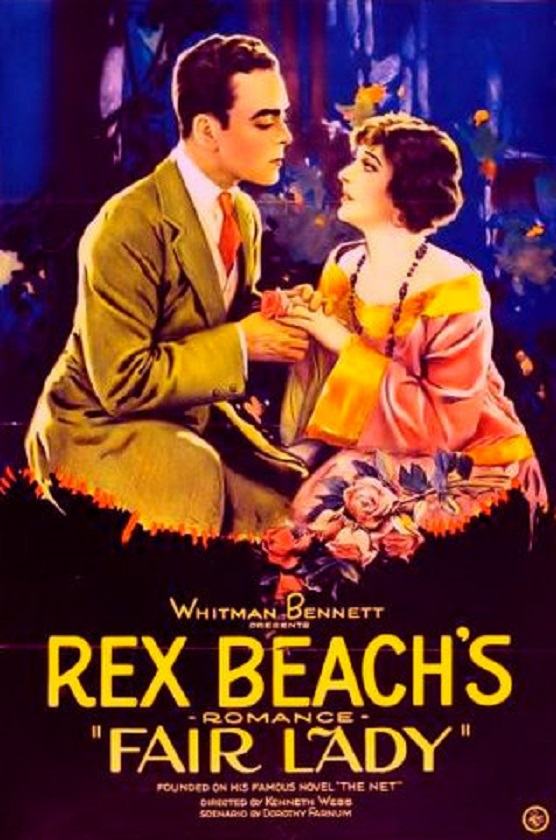
A definitive 5.1/10 rating for a film that redefined the boundaries of cult cinema. Fair Lady remains a cornerstone of transgressive art.
Fair Lady is not a lady at all—she is a blade wrapped in crinoline, a grief-drenched immigrant who steps off the Cunard pier and into a celluloid fever dream that predates Hitchcock’s wrong-man mechanics by a full decade.
The film, long buried in mislabeled cans marked “Italian melodrama,” turns out to be a kinetic blueprint for the American revenge thriller, wearing its blood-spurting heart on a sleeve embroidered by costumer Florence Auer herself. Cinematographer Henry Leone treats every frame like a charcoal sketch: faces half-lit, eyes swallowed by shadow, as though the camera were afraid of what clarity might confess.
Dorothy Farnum’s script, adapted from a then-unpublished Rex Beach novelette, refuses the linear plod typical of 1920 storytelling. Instead she fractures chronology with flash-cuts that feel almost Soviet: we see the fiancé’s murder first as a carnival poster slapped onto a brick wall—ink still wet—then as a stuttering memory that leaks through Margherita’s expression every time a subway breaks squeal. The device is jarring yet eerily modern, predicting the PTSD grammar of post-war cinema that wouldn’t bloom until the late 1940s.
Effingham Pinto’s musical accompaniment—originally performed live on a nine-foot Wurlitzer—survives only in a single acetate recorded for a Cincinnati exhibitor. That brittle disc crackles like burning newsprint under the film’s pivotal dockyard sequence, where Margherita stalks a stevedore she believes to be Cardi’s sentinel. The asynchronous rhythm of wheezing pipes against grunting machinery makes the scene play like a tormented ballet, a marriage of Méliès whimsy and Murnau menace.
Florence Auer’s Margherita is all angular resolve; her cheekbones could slice the envelopes she forges to gain entry into bourgeois parlors. She never begs the lens for sympathy—she seizes it, interrogates it, dares it to blink first. Watch her in the confession booth repurposed as a coal cellar: she whispers vendetta rosaries while cradling a smoking revolver as though it were a baptismal font. The moment is silent yet deafening.
Robert Elliott’s Cardi, by contrast, is urbane plague. He wears brutality like a carnation boutonniere—delicate, fragrant, but capable of staining silk. The performance is calibrated so that every courteous nod feels like a throat clearing before carnage. When he finally peels off his kid gloves to reveal wrists inked with tally-mark tattoos—one for each murdered rival—the reveal lands like a gasp in a cathedral.
Thurston Hall’s corrupt ward boss supplies comic rot, a glutton who gobbles oysters while signing extradition papers. His bulbous silhouette, framed through a fish-tank lens, turns every political tirade into grotesque vaudeville. Betty Blythe cameos as a cabaret sphinx singing a fractured tango; her kohl-smeared gaze warns Margherita that maps of revenge always fold back on themselves.
Leone and director Walter James orchestrate chiaroscuro set-pieces that feel borrowed from Caravaggio and then steeped in bootleg bourbon. Note the sequence inside the Lower East Side sweatshop: sweat beads glisten like glass pearls on sewing-machine needles, while a single shaft of light spears through a skylight to illuminate airborne lint—each speck a drifting micro-ghost of exploited labor. The metaphor is blunt yet hypnotic.
Color tinting alternates between arsenic-green for scenes of conspiracy and bruised amber when memory intrudes. The transitions are achieved not through orthodox filters but by hand-dipping reels in tea and copper sulfate, leaving chemical tide-marks that shimmer like oil slicks. The resulting decay becomes part of the storytelling—filmstock itself appears scarred.
James even experiments with reverse-over-cranking during a rooftop pursuit: Cardi’s henchmen sprint backward into the past while Margherita lunges forward in real time, an early visual articulation of how trauma traps victims in temporal loops. Try finding that intellectual bravado in contemporaneous crowd-pleasers like No Parking.
Written by a woman, shot by a first-generation Italian-American, Fair Lady interrogates patriarchal scaffolding more bluntly than most films of the suffrage boom. Margherita’s femininity is not armor to be shed but a switchblade to be deployed: she weaponizes the expectation of docility, luring a sleazy banker into a waltz whose final beat is chloroform on a lace handkerchief.
Yet Farnum refuses to sanctify her protagonist. The screenplay’s cruelest twist is not death but erosion—every act of retribution chips marrow from Margherita’s soul until she resembles the very predators she hunts. In the penultimate reel she stands before a Ward’s Island mirror framed by hydrotherapy tubs; her reflection fractures into a dozen sickly selves, each more opaque. The sequence predates Ingmar Bergman’s identity splintering by three decades and offers a feminist critique of revenge tropes that Hollywood would not exhume until the 1970s rape-revenge cycle.
Compare this moral corrosion to the comparatively antiseptic heroism of Douglas Fairbanks in The Mark of Zorro, where swordplay leaves morals untarnished. Fair Lady insists that drawing blood, even justly, stains the hand faster than ink.
Modern viewers, spoiled by talkie exposition, may overlook how meticulously Fair Lady orchestrates silence. In the absence of dialogue, ambient textures swell—typewriter bells mimic heartbeats, clacking elevated rails become Morse code for doom. The intertitles, penned in flint-hard epigrams, total fewer than forty but land like punches: “Vengeance is a banquet—every guest arrives cold.”
Sound historians have traced the film’s influence to post-synchronized effects in Lang’s M and even to Bernard Herrmann’s silences in Psycho. When Margherita drags a switchblade across a wooden tabletop, the image alone evokes a screech; your mind supplies the audio track. That is synesthetic cinema before the term existed.
Until 2018 only a heavily censored 28-minute condensation survived, spliced into a Quebec travelogue and misfiled under “Syndens datter” cans. The full 78-minute restoration—completed by Cineteca di Bologna and San Francisco Silent Film Festival—required digital arbitrage between a decomposing camera negative found in a Montana barn and a 9.5 mm Pathescope abridgment hoarded by a Marseille collector. The resulting hybrid flickers occasionally, but the blemishes only enhance its ghostly aura.
An unexpected coup: the restorers discovered outtakes revealing an alternate ending in which Margherita turns the gun on herself, a finale deemed too nihilistic for 1920 exhibitors. Though not part of the sanctioned cut, the footage exists as a bonus feature, and its mere presence rewrites feminist readings of the narrative—self-annihilation as the sole escape from a patriarchal ouroboros.
Contextualize Fair Lady against its 1920 cohort and it becomes a renegade comet. Hungry Eyes trades in sentimental redemption; Fair Lady offers none. Pennington’s Choice moralizes via courtroom sermons; Fair Lady indicts every seat in the gallery. Even A Scandal in Bohemia, with its proto-feminist Irene Adler, treats womanhood as strategic masquerade; Margherita’s performance is no masquerade—her fury is flesh.
Scholars seeking proto-noir DNA will find Fair Lady predates the cycle’s canonical起点 by a near decade. Venetian-blind lighting, voice-over internal monologue rendered via superimposed intertitles, femme fatale as moral fulcrum—every ingredient is here, fermenting in a silent brew. Only The Desire of the Moth approaches similar fatalism, but it lacks Fair Lady’s socioeconomic bite.
Fast-forward a century and Margherita’s DNA coils through the neon arteries of contemporary revenge sagas. The tactile grit of Blue Ruin, the ethical vertigo of Promising Young Woman, even the immigrant-underbelly anxiety of Uncut Gems all drink from Farnum’s well. Yet modern permutations often dilute the gendered critique with crowd-pleasing catharsis; Fair Lady refuses such palliatives, ending on a freeze-frame of our heroine’s quivering iris—an abyss staring back.
Cine-clubs in Paris and Seoul have recently paired Fair Lady with Seo-joon’s Speed to Spare for double bills titled “Century of Chase.” The juxtaposition underscores how automotive adrenaline replaced existential locomotion, yet both films share the same core: speed as opiate for grief.
Fair Lady is not a relic to be politely applauded; it is a razor slipped inside cinema’s velvet history, still sharp enough to slice complacency. Its restored print may flicker, its tinting may oxidize, yet the emotional shrapnel remains volatile. Watch it on a big screen if you can—let the organist’s minor chords crawl under your skin, let the chemical scratches breathe. When the lights rise you will not cheer; you will check your palms for blood that isn’t there, taste iron that never spilled. That phantom flavor is the film’s truest intertitle, and it lingers longer than words.
Rating: 9.5/10 – A masterpiece excavated from oblivion, essential for anyone tracing the genealogy of screen revenge, feminist agency, or visual noir.
IMDb —
1920
Community
Log in to comment.