DbcultAccessing Vault...
Cult Review
Senior Film Conservator
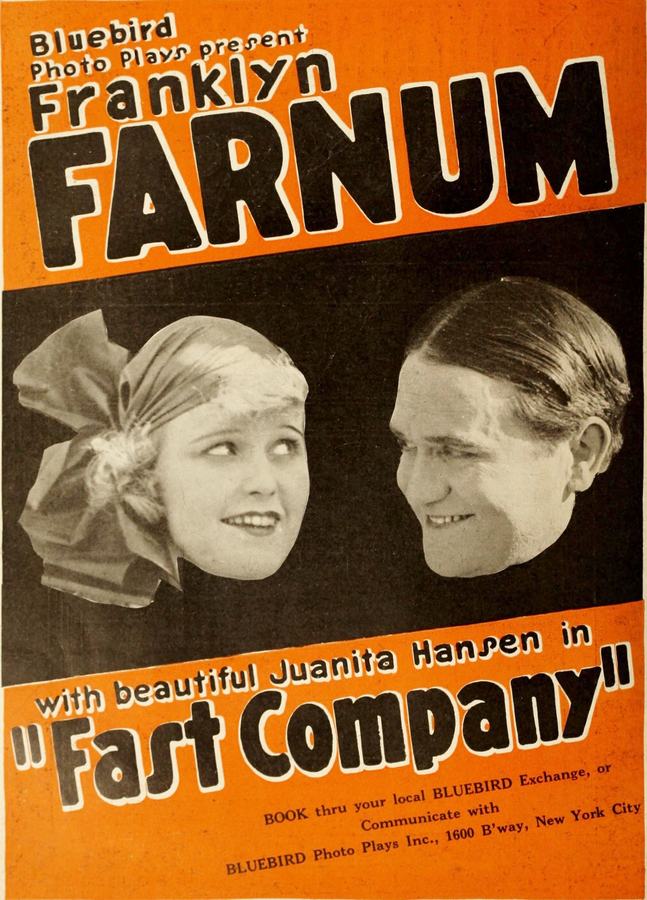
Fast Company (1918): A Spirited Dive into Self-Discovery and Societal Masks
In the annals of silent cinema, where grand gestures and expressive visages often conveyed the deepest human dramas, certain films stand out not just for their technical prowess but for their enduring thematic resonance. Lynn Reynolds' 1918 production, Fast Company, is precisely one such cinematic artifact. It’s a compelling narrative that, despite its century-old vintage, speaks with surprising clarity to contemporary anxieties about identity, authenticity, and the often-burdensome weight of societal expectations. This isn't merely a quaint relic from a bygone era; it’s a vibrant, character-driven piece that navigates the intricate dance between inherited status and genuine selfhood, all wrapped in a delightful package of comedic drama.
At its heart, Fast Company is the tale of Lawrence Percival Van Huyler, portrayed with a nuanced blend of initial timidity and burgeoning resolve by Franklyn Farnum. Lawrence is introduced as the archetypal society fop, a man seemingly ill-suited to the demands of a world beyond the manicured lawns and hushed drawing-rooms of his aristocratic lineage. His very being seems to chafe under the heavy mantle of his family's 'blue-blooded' traditions. He protests, perhaps too gently at first, against the perceived necessity of conforming to a life that feels utterly alien to his inner spirit. This initial portrayal of Lawrence is crucial; it establishes him not as inherently weak, but as a soul stifled, a spirit yearning for an authenticity that his inherited world denies him.
His predicament is compounded by the romantic entanglements that serve as the primary catalyst for his eventual transformation. Alicia Vanderveldt, played by the captivating Juanita Hansen, is Lawrence's fiancée, a woman seemingly swayed more by superficial bravado than by genuine affection. Her abrupt abandonment of Lawrence for Richard Barnaby, a character played by Edward Cecil, ignites the central conflict. Richard is a man whose entire persona is built upon a foundation of borrowed valor and exaggerated tales of derring-do from exotic locales. He embodies the very pretense that Lawrence is struggling against, and his relentless ridicule of the 'pampered' Lawrence serves to deepen the protagonist's self-doubt, even as it unknowingly pushes him towards a precipice of change.
The narrative's turning point arrives with a stroke of delicious irony and historical revisionism. While the venerable Van Huyler estate undergoes renovations, a hidden box is unearthed, containing a confession penned by the family's revered founder, Peter Van Huyler. This document, a veritable Pandora's box of ancestral secrets, reveals that the patriarch was, in fact, an Irishman of humble birth who amassed his considerable fortune not through genteel commerce, but through the daring, illicit enterprise of piracy on the high seas. This revelation is nothing short of an earthquake for Lawrence. It shatters the carefully constructed façade of his family's history, exposing the raw, unpolished, and utterly thrilling origins of his lineage.
The discovery acts as a profound liberation. The very 'blue blood' that had felt like a suffocating shroud now reveals itself to be, metaphorically, the turbulent, salty waters of the ocean—a lineage born of audacious defiance and self-made fortune rather than passive inheritance. Delighted and invigorated by this newfound understanding of his true heritage, Lawrence undergoes a radical metamorphosis. He sheds the trappings of his former life, takes a construction job, and, crucially, adopts a fighting attitude. This isn't merely a change in occupation; it's a fundamental shift in his psychological landscape, a conscious embrace of a more rugged, assertive masculinity. He begins to challenge those who had previously mocked him, his newfound confidence radiating from a place of genuine self-acceptance.
The film's resolution is both satisfying and morally resonant. Lawrence, now a man of substance and courage, learns that Richard's much-vaunted tales of derring-do were nothing more than plagiarized excerpts from a book. With this knowledge, he exposes Richard's intellectual and moral bankruptcy, stripping away the pretender's false glory. In doing so, he not only reclaims Alicia's love, now earned through authentic transformation rather than superficial charm, but also fully embodies the spirit of his pirate ancestor – not through lawlessness, but through a courageous embrace of his true, unvarnished self. This arc, from effete heir to self-made man, is the beating heart of Fast Company, making it a powerful fable of self-actualization.
The screenplay, credited to Waldemar Young, John McDermott, and Eugene B. Lewis, demonstrates a keen understanding of character development and comedic timing, crucial elements in the silent era where visual storytelling reigned supreme. The writers expertly craft a narrative that, while rooted in a comedic premise, delves into deeper psychological terrain. The transformation of Lawrence is not merely superficial; it feels earned, a direct consequence of a profound shift in his understanding of himself and his place in the world. This narrative sophistication elevates Fast Company beyond simple slapstick, positioning it as a thoughtful commentary on class, identity, and the performativity of social roles.
Performance-wise, Franklyn Farnum carries the film with an impressive range. His initial portrayal of Lawrence is convincingly meek, almost painfully so, making his later assertiveness all the more impactful. Juanita Hansen, as Alicia, navigates the delicate balance of a woman initially swayed by superficiality but ultimately drawn to genuine character. Her transition from being impressed by Richard's bluster to recognizing Lawrence's inherent worth is subtly conveyed, relying on the nuanced expressions and body language characteristic of the silent screen. Edward Cecil's Richard is suitably smarmy, a perfect foil whose eventual unmasking is both deserved and dramatically satisfying.
And then there's Lon Chaney. While his role in Fast Company is not central to the main romantic or transformative arc, his presence is always notable. Chaney, even in supporting capacities, possessed an inimitable ability to imbue his characters with a distinct, often unsettling, energy. Here, he is listed among the cast, and while the specific details of his character aren't highlighted in the plot summary, his very inclusion speaks to the quality of the ensemble. Chaney’s unparalleled skill in physical transformation and intense characterization, as seen in more prominent roles in films like The Devil-Stone or The Criminal, often meant that even minor parts became memorable. His ability to convey complex emotions without dialogue was a hallmark of his genius, and one can only imagine the subtle touches he brought to his performance here, contributing to the film's overall texture and depth.
The thematic exploration of identity is particularly salient. Lawrence’s journey is a microcosm of a universal human struggle: the conflict between who society expects us to be and who we truly are. The discovery of his pirate ancestor is a powerful metaphor for embracing the wild, untamed aspects of one's heritage, recognizing that strength can come from unexpected, even unconventional, places. It subverts the notion that 'blue blood' inherently confers superiority, suggesting instead that true nobility lies in courage, authenticity, and self-made character. This theme resonates strongly with other silent films that explored societal pressures and individual defiance, perhaps echoing the spirit of characters in The Foundling, where hidden pasts and challenging circumstances forge new identities, or even the struggles against rigid social structures seen in The Church and the Woman, albeit with a different focus.
The film also subtly critiques the superficiality of social climbing and the emptiness of borrowed prestige. Richard Barnaby, with his fabricated exploits, represents the antithesis of genuine heroism. His downfall, precipitated by Lawrence's newfound courage, is a satisfying comeuppance for pretense. It's a timeless message: true worth is not found in the stories one tells about oneself, but in the character one embodies through action. This contrasts sharply with the performative bravado that might be seen in other characters of the era, even those in more dramatic settings like La Salome, where characters often put on a show, but for very different, often tragic, ends.
Visually, silent films of this period often relied on clear, expressive cinematography and mise-en-scène to convey narrative. While specific details of the film's visual style are often lost to time or limited by surviving prints, one can infer that the contrast between the opulence of the Van Huyler estate and the grittiness of the construction site would have been a deliberate visual motif, mirroring Lawrence's internal journey. The shift in his attire, from tailored suits to work clothes, would have been a powerful symbolic representation of his transformation, easily legible to audiences of the era.
The film's title, Fast Company, itself carries a double meaning. It could refer to the 'fast' or perhaps morally dubious company Lawrence's pirate ancestor kept, or it could allude to the rapid pace of change and the quick wit required to navigate social circles and personal transformations. This clever titling adds another layer of interpretive richness to the viewing experience, inviting audiences to consider the multifaceted nature of the narrative.
In a broader context, Fast Company emerged in 1918, a pivotal year marked by the waning horrors of World War I and the onset of the Spanish Flu pandemic. While the film doesn't explicitly engage with these global events, the underlying theme of societal upheaval and the questioning of established norms might have resonated deeply with audiences grappling with a rapidly changing world. The idea of breaking free from old traditions and forging a new path, as Lawrence does, would have perhaps found fertile ground in the collective consciousness of the time. It’s a subtle reflection of a world in flux, a world where old certainties were being challenged and new forms of courage were being defined.
Ultimately, Fast Company is far more than a simple silent-era comedy-drama. It is a perceptive character study, a critique of social pretense, and an inspiring tale of self-discovery. The journey of Lawrence Percival Van Huyler, from a suffocated fop to a man of genuine substance, resonates powerfully, reminding us that true strength often lies in embracing our authentic selves, even if it means unearthing a few surprising secrets from the past. It's a film that, through its engaging narrative and strong performances, particularly from Franklyn Farnum and Juanita Hansen, continues to entertain and provoke thought, proving that some stories, like the pursuit of authenticity, are truly timeless. It offers a spirited reminder that the most valuable inheritance is often not wealth or status, but the courage to be true to oneself, no matter what 'company' one keeps.
IMDb 5
1935
Community
Log in to comment.