DbcultAccessing Vault...
5/10
Senior Film Conservator
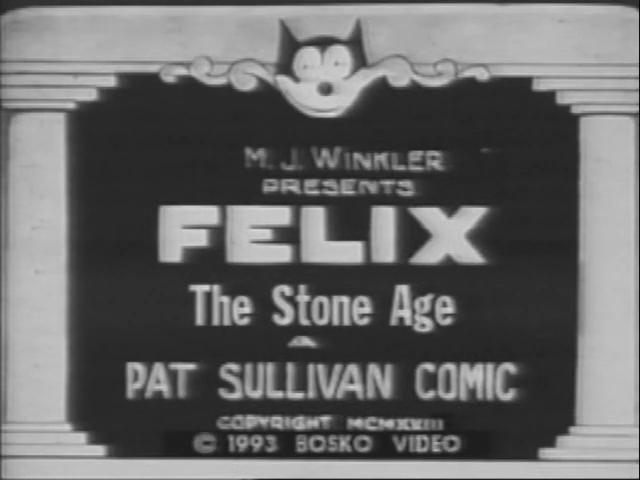
A definitive 5/10 rating for a film that redefined the boundaries of cult cinema. Felix in the Bone Age remains a cornerstone of transgressive art.
The flicker begins like a match struck inside a tar barrel—sudden, sulfur-bright, prehistoric. Out of the nitrate fog lopes Felix the Cat, tail curled like a question mark nobody asked. Otto Messmer’s 1923 one-reeler, Felix in the Bone Age, clocks a hair under ten minutes yet crams a Darwinian soap opera into every cel. Watch once and you snicker at the slapstick; watch twice and you realize the short is a cracked mirror held up to every love triangle since the Pleistocene.
Messmer’s pen scratches out a savanna that feels half Bêche-de-mer postcard, half fever dream. The sky is a smear of Prussian blue gouache; the ground, a jittery cross-hatching that jitters even when frozen. Into this parchment paradise saunters our ink-black protagonist, pupils dilated like a gambler who sees the future in every shadow. He stumbles upon a Neanderthal Romeo clutching a sobbing mate; her tears arc in perfect parabolic globs—tiny glass beads strung on invisible wire. When she points at Felix, the caveman’s brow-ridge clenches with the geological force of tectonic plates. Jealousy ignites; chase music—piano, clanging like pots—kicks in.
What follows is a masterclass in vertical escape. Felix pirouettes toward a cliff so sheer it might have been sliced by a guillotine for giants. Monkey tails dangle like jungle spaghetti; each twitching tail is a lifeline drawn by a benevolent cosmos. Felix grabs one, then another, Tarzan by way of Coney Island. The tails elongate, rubber-band physics defying biology, and the cat bounces downward in a helix of panic and grace. Messner times the gag to a nanosecond: every oscillation of tail-tension lands a laugh, yet the plummet feels perilous enough to spike the adrenal glands of even the most jaded flapper in the orchestra pit.
Safe at the base, Felix befriends a diapered baby monkey whose oversized head wobbles like a balloon on a string. Their camaraderie is rendered in gentle silhouettes—two orphans of evolution sharing a banana the size of a canoe. Sentiment, however, is temporary adhesive in Messmer’s universe. A colossal silverback barges into frame, his fur rendered with furious charcoal hash marks that seem to vibrate. The gorilla’s fist comes down like a piledriver; Felix responds with a flurry of feints, jabs, and tail-whips. The skirmish is silent but sonically suggestive—each pen-stroke implies a thud, a crack, a yowl. When the dust settles, the gorilla sits befuddled, Felix tip-toes away, and the baby monkey claps in gleeful schadenfreude.
End of story? Hardly. The final shot—Felix scurrying into a horizon that loops back onto itself—hints that the chase is a Möbius strip. The caveman’s wrath, the simian deus-ex-machina, the cat’s nine-lived ingenuity: all locked in eternal recurrence. Messmer, a cartoon Sisyphus, traps his characters in cycles of desire and evasion, yet gifts them gags so delirious they almost forgive the cosmos for its cruelty.
“The jungle is not backdrop but jury: every vine a verdict, every monkey tail a reprieve.”
Compared to the moralizing melodrama of The Greater Sinner or the urban noir of The Butterfly Man, Bone Age feels anarchically mythic. There is no city gutter, no pulpit, no courtroom—only the raw calculus of survival and slapstick. Still, thematic rhymes echo across Messmer’s wider celluloid neighborhood: the transactional desire of His Meal Ticket, the carnival humiliation of Screen Follies No. 2, even the sacrificial stoicism of The Martyrdom of Philip Strong. In every instance, characters barter dignity for sustenance, love for leverage, yet Felix alone thumbs his nose at consequence—his tail a metronome of insouciant revolt.
From a craft standpoint, the short is a Rosetta stone of early animation technique. Messmer’s use of rubber-hose limbs predates Disney’s refinement by half a decade; the monkeys’ elastic anatomy is both comic device and philosophical statement—bodies pliable enough to absorb brute force without permanent damage. Note the subtle chiaroscuro: charcoal dust smeared across the negative to create halos around moonlit clouds, a trick borrowed from German expressionists like Der Verächter des Todes but repurposed for laughs.
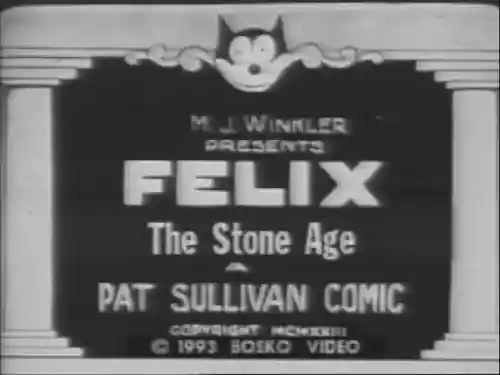
Sound, though absent on the reel, haunts the imagery. Contemporary exhibitors often accompanied Bone Age with improvised percussion—woodblocks for simian rib-cages, slide-whistles for plummeting felines. Today, one can’t un-hear those ghost rhythms; the tail-bounce syncs so perfectly with a boioioing it feels pre-scored. Such is the precision of Messmer’s timing that even silent, the cartoon sings.
The gender politics, admittedly fossilized, merit a sideways glance. The cave-girl functions less as character than as desire conduit; her pointing finger is a loaded gun, her tears lubricant for macho mayhem. Yet within the silent-era grammar of gesture, the moment reads less misogynist than mythic—Eve blaming the serpent, Helen launching a thousand pebble-stones. Messmer’s women seldom speak, but their eyes wield veto power over kingdoms. Contrast this to the flapper heroines of Oh, Baby! whose chatterbox agency upends patriarchal scaffolding; Bone Age chooses primordial archetype over modern emancipation, a creative decision both regressive and revealing.
Historically, the short premiered as a curtain-raiser for feature-length melodramas, sandwiched between newsreels of Teapot Dome scandals and fashion shorts on bobbed hair. Kids hooted at Felix; adults, half-watching, absorbed subliminal echoes of post-war anxiety—the fear that civilization is but a thin crust atop volcanic instinct. Seen today, the cartoon vibrates with new resonance: climate collapse, viral spillover, the thin membrane separating domestication from primal chaos. The jungle that shelters Felix might be the last jungle; the monkeys, a final evolutionary gamble.
Collectors covet 16 mm prints that surface sporadically at European fairs; most derive from a 1925 German distribution negative, hence intertitles sometimes read „Felix im Steinzeit-Abenteuer“. Restoration efforts confront vinegar syndrome, tinting fade, and the endemic scratches of projectionists who threaded the reel like butchers. Digital 4K scans reveal previously invisible subtleties: the glint in Felix’s eye as he calculates tail-traction, the caveman’s knuckle-worn scar shaped uncannily like the contiguous United States.
For the home-viewer, the best available edition floats on Internet Archive at 1080p, though contrast blooms like a nuclear sunset. Pair the viewing with a reading of Joseph Campbell’s Primitive Mythology and you’ll glimpse Messmer’s inadvertent monomyth: departure, trial, atonement, return—compressed into ten slapstick minutes, then looped ad infinitum.
Is Felix in the Bone Age a masterpiece? If masterpiece implies perfection, then no—its racialized tropes and gender semaphore are artifacts of an imperial century. But if masterpiece means a work whose every imperfection crackles with the kinetic urgency of innovation, then absolutely. Messmer’s celluloid bone fragments whisper across a hundred years, telling us that laughter evolved as both weapon and shield, that every chase scene is a love story in disguise, and that somewhere a cat with a prehensile tail still swings through the collective unconscious, thumbing his nose at entropy.
Watch it once for the gag, twice for the myth, a third time for the charcoal ghosts that refuse to stay extinct. And when the final loop restarts—Felix scampering back toward the caveman’s wrath—ask yourself: are we the cat, the tail, or the cliff? Messmer provides no answer, only the eternal bounce.
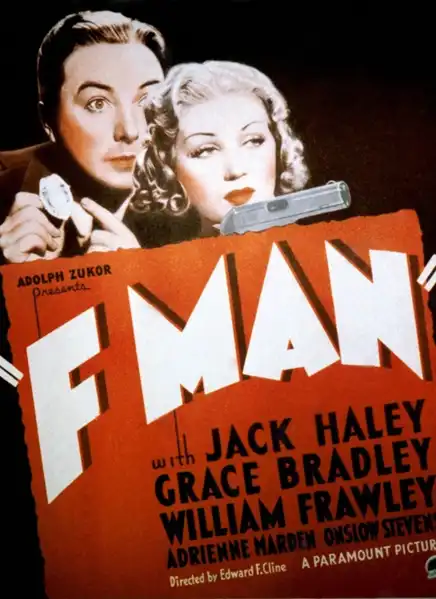
IMDb 3.8
1936
Community
Log in to comment.