DbcultAccessing Vault...
5.8/10
Senior Film Conservator
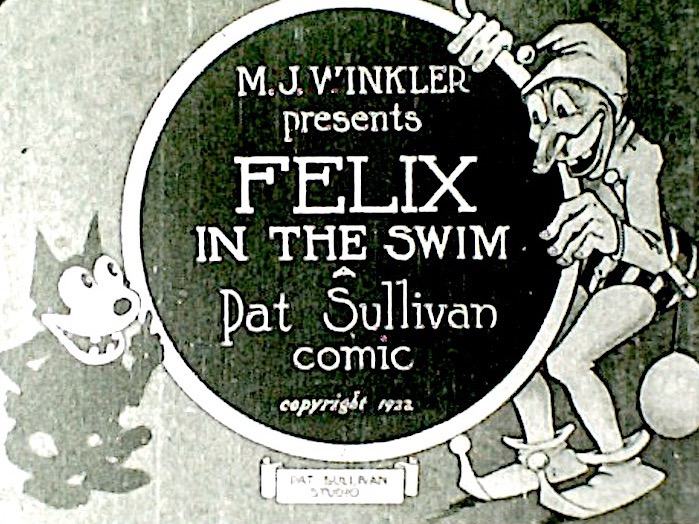
A definitive 5.8/10 rating for a film that redefined the boundaries of cult cinema. Felix in the Swim remains a cornerstone of transgressive art.
Ink, empathy, and the first splash of cartoon modernism
In the monochrome hush of 1922, when the cinematic world still flirted with flicker and flutter, Otto Messmer compressed a moral universe into four minutes of celluloid whimsy. Felix in the Swim is not merely an anecdote about a cat, a mouse, and a clandestine dip; it is a haiku of reciprocity, sketched in jittery ink lines that anticipate the graphic minimalism of mid-century modern art.
Felix—tail like a calligraphic flourish—saunters across parlor shadows, his silhouette carved by gaslight gradients. Messmer’s hand betrays no hesitation: each frame is a staccato ink-stain, yet the cumulative effect is liquid, as if the very parchment breathes. The moment Felix nudges the trap, the metallic snap is replaced by a hush so absolute we hear the mouse’s heartbeat. In that hush, a contract is signed without words: clemency for caper.
Narrative thrift as high art
Silent-era cartoons often gorged on gags, but Messmer diets on implication. The mouse’s offer—“I owe you one”—is pantomimed with a bow so crisp it could slice bread. No intertitles interrupt; the economy is ruthless, the payoff voluptuous. While The Love Swindle sprawls in narrative languor and Respectable by Proxy moralizes its plot into torpor, Felix in the Swim distills ethos into motion.
Consider the heist sequence: the mouse, now self-appointed mastermind, scurries along picture-rail catwalks, tail flicking like a metronome. Felix mirrors him below, paws padded against Persian rugs. Together they choreograph a diversion—an upturned vase, a startled terrier—so that the portly guardian trundles away from the garden gate. The swim, promised by the title, becomes a clandestine baptism, a submersion into freedom financed by mutual deceit.
Water as metamorphosis
When the final plunge arrives, Messner dissolves the frame into rippling reflections. Felix’s grin fractures across the pond’s skin; the mouse rides his tail like a mast. The water is not merely setting—it is liquefied ethics, a mirror where altruism and mischief coexist. Compare this to the barren backlots of Wild and Western or the cardboard horizons of Stardust: here, nature collaborates in storytelling, its every shimmer a silent chorus.
The geometry of character
Felix’s design—circles within circles—echoes Kandinsky’s cosmogony. The ears, twin sickle moons; the eyes, buoyant apostrophes. Messmer anticipates the graphic minimalism that will later define UPA’s mid-century rebellion against Disney baroque. Yet within simplification lies infinite nuance: a single ear-flick registers skepticism; the narrowing of two dots conjures guile. In contrast, the mouse is all angular velocity, a darting wedge that cuts through scenes like a paper cutout on a conveyor belt.
Comic tempo and the jazz of silence
Though jazz is never heard, the short’s rhythm is pure improvisation. A beat lingers—Felix suspended mid-pounce—then accelerates into triple-time scramble. Such syncopation prefigures the Looney Tunes anvil-staccato, yet remains rooted in the silent grammar of Keaton and Chaplin. Where Her Week-End milks situational irony till it whimpers, Felix in the Swim trusts the spectator to finish the joke.
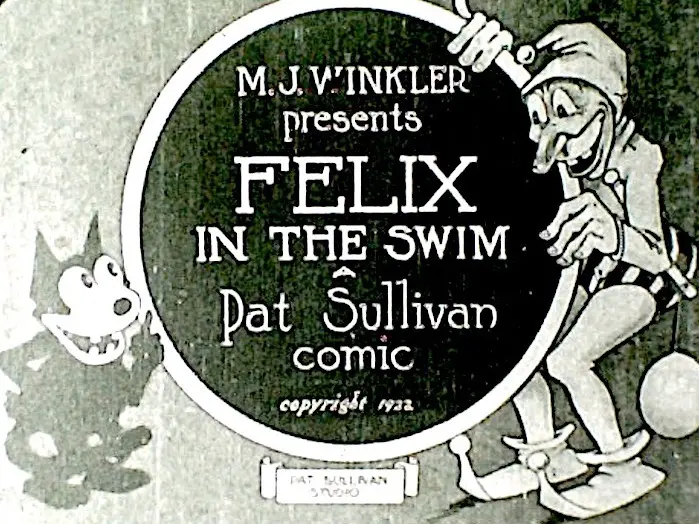
Ethical undertow beneath the giggle
Children guffaw at pratfalls; adults discern the karmic ledger. Felix liberates a life, and that life bankrolls his escapade—an early cinematic articulation of pay-it-forward, long before the phrase ossified into bumper-sticker sentiment. The mouse’s gratitude is not meek; it is entrepreneurial, a hustler’s covenant. In 1922, when Victorian moralism still clung like mothballs, such egalitarian barter felt quietly subversive.
Moreover, the heist targets not a banker’s vault but the tyranny of domestic supervision. The portly guardian—sketched in bulbous caricature—embodies post-Victorian parental paranoia: the fear that idleness spawns delinquency. Felix’s dash to the pond is therefore a miniature revolution, a splash against curfews and propriety. Compare this to the colonial condescension of The Country That God Forgot or the aristocratic shenanigans in Il Mistero dei Montfleury: here, rebellion is distilled into a ripple.
Visual economy: the blueprint for modern television animation
Messmer produced hundreds of Felix shorts for the newsreel market; budgets were shoestrings, schedules merciless. Necessity birthed invention: hold-cels, recycled backgrounds, smears that imply motion without redrawing. Sound familiar? These are the very cost-cutting vertebrae of Saturday-morning cartoons a half-century later. Yet economy never devolves into poverty; each frame is ink-wealth, every shortcut a stylistic signature.
Consider the pond itself: a single painted cell, overlaid by a transparent glint that slides across three frames. Our brain interpolates shimmer, liquidity, depth. The trick anticipates the limited-animation wizardry of Hanna-Barbera, but with artisanal swagger. Where Moonshine pads its runtime with bucolic filler, Felix in the Swim achieves transcendence through subtraction.
The persistence of Felix: from flapper fad to postmodern talisman
After sound eclipsed ink, Felix faded into thrift-shop memory. Yet his DNA persists: in the surreal alleyways of Mutt and Jeff in Paris, in the urban japes of Mutt and Jeff in London, even in the cosmopolitan cynicism of A Rich Man’s Darling. Animators from Miyazaki to Bakshi cite Felix as the first cartoon character to possess interiority, a soul rendered by the quirk of a line.
Let us not romanticize poverty. The short’s brilliance is inseparable from its constraints: meager budgets, a solitary animator, a distributor demanding novelty every fortnight. We admire not the conditions but the ingenuity they fermented. Modern viewers, spoiled by 4K restoration, may scoff at flicker and grain. Resist the impulse. Those imperfections are the patina of survival, the battle scars of a reel that dodged incinerators, landlords, and nitrate rot.
Comparative reverberations
Stacked against Putting One Over, whose slapstick is flaccid, or the expatriate bloat of Buffalo e Bill, Felix in the Swim feels lean, feral, caffeinated. Even The Scarlet Runner, with its serial cliffhangers, lacks the epiphanic compression of these four minutes. Only Hjertestorme matches its emotional density, though Danish melancholy is the antithesis of Felix’s effervescence.
Re-watch the short tonight—preferably on 16 mm, the whir of the projector a lullaby to modern anxieties. Observe how the final iris closes, not on a moral, but on a circle of ripples. Felix and his whiskered accomplice have vanished, leaving only water rewriting itself. The screen goes black; the room smells of emulsion and warm dust. Somewhere in that darkness, you’ll sense the covenant still pulsing: kindness released into the world, returning as moonlit freedom.
If this review floated your boat, plunge further into silent-era gems linked above—each a ripple in the endless pond of cinematic memory.

IMDb 6.4
1927
Community
Log in to comment.