DbcultAccessing Vault...
Cult Review
Senior Film Conservator
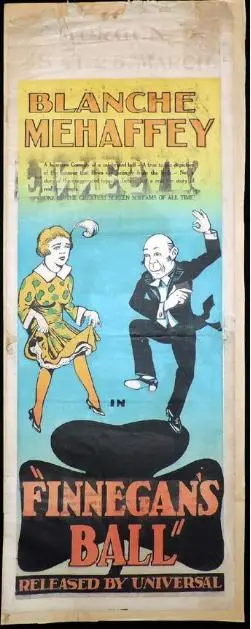
Does Finnegan's Ball offer more than just dusty silent-era slapstick? Short answer: Only if you are a dedicated student of early 20th-century social dynamics; for everyone else, it is a repetitive exercise in predictable irony.
This film is specifically for cinephiles who enjoy dissecting the 'shanty Irish' versus 'lace curtain Irish' tropes of the 1920s. It is definitely not for viewers who require nuanced character development or a plot that doesn't rely on a massive, convenient misunderstanding to resolve its conflict.
1) This film works because it captures the raw, unfiltered anxiety of the immigrant class during the late 1920s, using the inheritance plot as a proxy for the fear of losing one's identity to sudden wealth.
2) This film fails because the central 'inheritance error' is handled with the subtlety of a sledgehammer, making the Finnegan family look irredeemably shallow rather than sympathetically ambitious.
3) You should watch it if you want to see how silent cinema used physical comedy to mask a fairly dark commentary on how quickly people turn on their own community when a dollar is involved.
Finnegan's Ball is worth watching for its historical value but lacks the comedic timing of contemporary greats like Keaton or Chaplin. It serves as a fascinating time capsule of Irish-American stereotypes and the era's obsession with social climbing. If you are looking for a laugh-out-loud comedy, you will likely be disappointed by its slow pacing and telegraphed gags.
The film opens with a sequence that feels remarkably similar to other immigrant dramas of the time, such as Irish Eyes. We see the Finnegans following in the footsteps of the Flannigans, a dynamic that immediately establishes a hierarchy of 'who arrived first.'
When Danny Finnegan, Sr. takes a job under Patrick Flannigan, the power imbalance is palpable. The direction by Max Graf (who also wrote the piece) leans heavily into the physical disparity between the two patriarchs. There is a specific scene in the first act where Danny has to swallow his pride during a labor dispute that feels surprisingly modern in its depiction of workplace humiliation.
However, the film takes a sharp turn when the inheritance arrives. The transition from humble laborers to high-society pretenders is where the movie finds its most biting humor. The Finnegans don't just buy new clothes; they buy a new attitude. They treat the Flannigans with a level of disdain that is genuinely uncomfortable to watch. It is a bold choice. It makes the protagonists briefly the villains of their own story.
Mack Swain is the secret weapon here. Having worked with Chaplin, Swain knows how to use his bulk to convey both menace and absurdity. His presence elevates the material, especially during the titular 'ball' sequence where the Finnegans attempt to host a high-society event that inevitably descends into chaos.
The pacing, unfortunately, is where the film stumbles. Unlike the tighter narrative seen in Go Easy, Finnegan's Ball lingers too long on the 'nouveau riche' gags. We get it: they don't know which fork to use. We get it: they are wearing hats that are too big. By the third time a Finnegan snubs a Flannigan, the point has been made and beaten into the ground.
"The film's greatest tragedy isn't the loss of the money, but the realization that the Finnegans were only ever one check away from becoming the oppressors they once hated."
Visually, the film is standard for 1927. It doesn't have the experimental flair of something like The Rat's Knuckles, but it uses its sets effectively to show the contrast between the cramped immigrant quarters and the sprawling mansion they briefly inhabit. The lighting in the final act, when the 'error' is revealed, becomes noticeably harsher, stripping away the soft-focus glamour of their wealthy fantasy.
One standout moment involves a long shot of Molly and Flannigan, Jr. in a garden. It’s a rare moment of genuine emotion in a film that otherwise relies on broad caricatures. The chemistry between Cullen Landis and Blanche Mehaffey is serviceable, though they are often sidelined by the slapstick antics of the older generation.
The 'accidental inheritance' plot device was already tired by 1927. We see variations of it in Painted People and The Misfit Wife. What makes Finnegan's Ball different is the sheer nastiness of the snubbing. Usually, in these films, the family remains 'good at heart.' Here, the Finnegans become genuinely insufferable.
This leads to a debatable opinion: I believe the film would have been far more powerful if the inheritance was real. By making it an error, the script lets the Finnegans off the hook. They 'resume their modest way of life' because they have no choice, not because they learned a lesson. It’s a cowardly narrative escape hatch.
When compared to Help Wanted or Hit-the-Trail Holliday, Finnegan's Ball feels less like a character study and more like a vaudeville sketch stretched to feature length. It lacks the thematic weight found in Pilgrims of the Night, choosing instead to play it safe with a wedding-bell ending.
The film’s reliance on the 'feuding families' trope also calls to mind Border Law, though without the high stakes of a Western. Here, the only thing at stake is someone's pride, which makes the constant bickering feel small and occasionally tedious.
Most critics look at the 'Ball' as the comedic peak of the film. I see it as a horror sequence. The way the Finnegans are trapped in their uncomfortable formal wear, surrounded by people they don't like, trying to perform a class identity that doesn't fit them, is claustrophobic. It is the most honest part of the movie. It shows that even when they 'won,' they lost. They were more miserable in that mansion than they ever were in their tenement.
Max Graf’s writing is efficient, if not inspired. He knows how to set up a gag, even if the payoff is visible from a mile away. The film doesn't take the risks found in Lord Saviles brott, nor does it have the intensity of Someone Must Pay. It is a middle-of-the-road production that achieved exactly what it set out to do: provide 70 minutes of diversion for a 1927 audience.
The intertitles are surprisingly sparse, allowing the physical acting to carry the story. This is a testament to the cast's ability, particularly Aggie Herring, who plays the matriarch with a terrifying level of social ambition. Her performance is the anchor that keeps the film from drifting into pure nonsense.
Finnegan's Ball is a competent, if uninspired, silent comedy. It works. But it’s flawed. The film’s refusal to truly grapple with the Finnegans' betrayal of their friends makes the happy ending feel like a lie. It is a movie about people who don't deserve their happy ending, yet get it anyway because the genre demands it.
If you are exploring the era, it is a necessary watch to understand the landscape of ethnic comedies. If you are just looking for a good movie, look elsewhere. It is a fascinating relic, but a relic nonetheless. The ball is over, and the hangover is a bit too realistic for comfort.
IMDb 5.4
1922
Community
Log in to comment.