DbcultAccessing Vault...
Cult Review
Senior Film Conservator
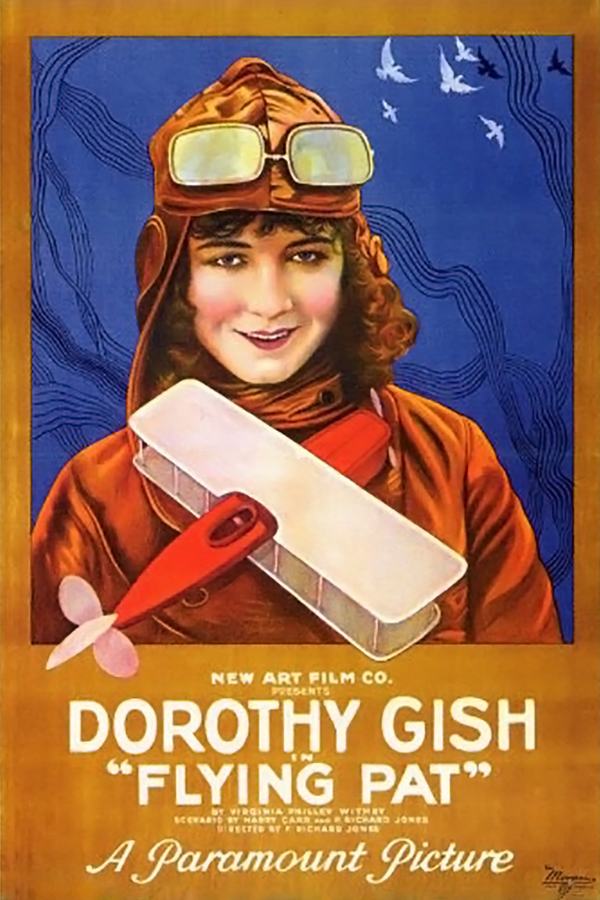
The first time Patricia Van Nuys taxis her spindly Curtiss down a cow-pasture runway, the frame quivers like a champagne flute on the lip of eruption. Dorothy Gish, all cheekbones and centrifugal grin, makes the camera fall hopelessly in love with velocity itself.
There is, of course, no synchronized dialogue in Flying Pat, but every intertitle crackles like a gin rickey: effervescent, tart, leaving your tongue numb with possibility. The film is a 1920 time capsule uncorked, its nitrate ghosts still drunk on the possibility that a woman might navigate rather than decorate. Gish, usually cast as waif or ingénue, here straps on jodhpurs, a wristwatch fat as a hockey puck, and a contempt for gravity that feels almost spiritual. When she snarls “I’ll cross the Atlantic in heels if I please,” the subtitle card might as well be etched in lightning.
Robert, played by James Rennie with the square-jawed complacency of a man who believes medals substitute for personality, begins the film already half eclipsed by his wife’s shadow. Their introductory two-shot is blocked like a chess problem: Pat foreground, wind whipping her fringe into semaphore; Robert background, arms folded, the vertical lines of the hangar struts boxing him into the patriarchal graveyard. The staging foreshadows every emotional power shift that follows, yet director F. Richard Jones refuses to demonize either spouse. Robert’s jealousy is rendered with almost documentary empathy—he fears obsolescence more than adultery. In an era when male aviators were treated like demigods, the notion that his wife might out-fame him feels emasculating in a way the film refuses to mock; instead it lingers, letting discomfort metastasize in real time.
The mid-air nosedive arrives with zero musical warning (modern prints are accompanied by a minimalist piano score that drops to silence the instant the nose tilts). Jones cuts from a medium shot of Pat wrestling the stick to a stomach-lurching POV: earth corkscrewing, clouds shredding like wet tissue. The crash itself is conveyed through negative space—an iris-in on a shattered landing gear, then a cut to black. When the iris reopens, we’re inside a roadhouse that looks borrowed from a Remington painting: moose head, player piano, a barkeep who could split rails with his chin. Pat’s silk blouse is torn at the clavicle; Endicott’s gaze lingers a half-second too long, not on skin but on the soot smear across her cheekbone, as though registering a new country on the map of desire.
What follows is the most electrically quiet sequence in silent cinema this side of Cheating Cheaters. Pat and Endicott share a candlelit stew, wordless except for intertitles that quote aviation weather codes—“Ceiling 300, visibility 2, emotions scattered.” The restraint is ravishing. When Robert bursts in the next morning, having tracked them via telegram triangulation, the film’s tonal tectonic plates shift: comedy of remarriage threatens to become tragedy of displacement.
The night-train sequence—a masterclass in geometric shadow—owes its chiaroscuro to cinematographer Tom Blake, who clamps arc-lights to the rails so each sleeper flashes beneath Pat’s fleeing heels like film sprockets. She boards in a velveteen cape the color of dried blood; by dawn it’s exchanged for a trench coat of city soot. Endicott appears in the club car as if conjured by her own paranoia, cigarette glowing like a cockpit indicator. Their dialogue is reduced to a single intertitle: “You can’t outrun a co-pilot who knows your heading.” The line is both flirtation and threat, and Gish answers with a smile so tight it could slice bread.
Jones crosscuts this with Robert back at the airfield, drunkenly test-piloting a spare Jenny biplane, the frame wobbling in sympathy with his booze-addled loop-de-loops. The montage is proto-Kubrickian: man, machine and moral vertigo fused into a single trembling handheld shot. When Robert crash-lands in a cabbage field, the vegetable carnage is played for laughs, yet the sight of him sobbing into muddy greens lands closer to Greek tragedy than slapstick.
Critics often slot Flying Pat beside Double Speed or Fools for Luck as another zany matrimonial farce. Yet the film’s sexual politics feel closer in DNA to The Embarrassment of Riches, where female appetite is treated not as aberration but as natural law. Pat doesn’t crave equality; she craves velocity, a faster vector than the kitchen or even the marriage bed can supply. When Robert demands she choose between “home or horizon,” her response is to strap on a parachute that might as well be a wedding dress redesigned by Tesla.
Jones and screenwriter Harry Carr pepper the mise-en-scène with sly reversals: Pat teaches Endicott how to read cloud formations; she repairs a clogged fuel line with a hairpin while he holds the flashlight. The phallus, quite literally, is passed to her gloved hand. Yet the film never succumbs to the empowerment clichés that would plague later “girl power” narratives; Pat’s triumphs are messy, contingent, often ridiculous. After successfully restarting the engine, she pumps her fist, loses balance, and slips on an oil slick—gravity reasserting patriarchy with comic vengeance.
Blake’s cinematography invents a vocabulary for altitude long before CGI or even steady aerial mounts. Miniatures? Yes, but integrated with such tactile conviction that you smell burnt castor oil. The Atlantic-fantasy montage—Pat superimposed over a spinning globe—uses a hand-cranked turntable and a paper lantern diffuser, producing a hallucination worthy of Max Ernst. Stars are pinholes in black velvet; the ocean is a sheet of agitated mercury. When the image dissolves to her sleeping visage, we realize the entire trans-Atlantic sequence has been her dream, a brazen narrative cheat that somehow feels ethically honest: ambition, after all, is only desire asleep.
Dorothy Gish’s performance is calibrated to the millimeter of silent readability: brows arching like biplane wings, nostril flares that telegraph panic faster than any subtitle. Watch her in the train corridor, weighing escape through a window: in a single close-up she cycles through calculation, fear, exhilaration—an entire silent novella in 24 frames. Porter Strong’s Endicott provides the perfect foil, all languid confidence until the final reel, when a storm forces him to copilot with Pat and we glimpse terror flickering beneath the swagger. Their chemistry is never allowed to resolve into romance; instead it remains a perpetual potential energy, like two magnets held just far enough apart to keep the toy spinning.
Where Before Breakfast traps its heroine in claustrophobic rooms, Flying Pat breaks windows and heads for cumulus. Where Mystic Mush drowns in pastoral whimsy, this film insists on steel girders and gasoline. Its closest tonal cousin among the listed comparators is Forget-Me-Not, another tale of wandering desire, yet Pat’s remembrance is forward-facing: she forgets the past precisely to remember the future.
The climax hinges on a barnstorming expo where Pat must substitute for a wounded pilot. Robert, humbled by cabbage-patch humiliation, volunteers to ride shotgun. Jones stages the sequence in full daylight, no tinting, the sun bleaching the frame to near-ivory—risky for 1920, when spectacle demanded noir shadows. The aerial waltz is authentic: barrel rolls, Immelmann turns, even an aborted outside loop that leaves Pat dangling from a wing strut, hair whipping like a battle flag. Intertitles cease; we get only engine pops and the wind’s howl, the film achieving that rare silent-era diegesis of sound.
Resolution arrives not with a kiss but with a hand-off: Pat relinquishes the stick to Robert mid-air, a gesture of trust that doubles as marital contract renewal. She doesn’t surrender ambition; she delegates partnership. The plane lands to applause, but Jones ends on an iris-out of Pat’s boot heel slipping on the same oil slick from act one—ambition and absurdity locked in eternal tango.
Nearly a century later, Flying Pat still swoops higher than most modern aviation romances, its flapper feminism more nuanced than many a 21st-century blockbuster. The film’s DNA—equal parts slapstick, social critique, and sky-struck reverie—makes it essential viewing for anyone convinced silent cinema spoke less because it had less to say. It spoke in velocity, and Dorothy Gish still outruns us all.
Where to watch: 4K restoration tours arthouse venues annually; digital DCP available via Criterion Channel under the title Flying Pat: Jazz-Age Sky Queen Edition. Warner Archive offers a serviceable DVD with commentary by silent aviation historian Dr. L. L. Nansen.

IMDb 6.3
1931
Community
Log in to comment.