DbcultAccessing Vault...
Cult Review
Senior Film Conservator
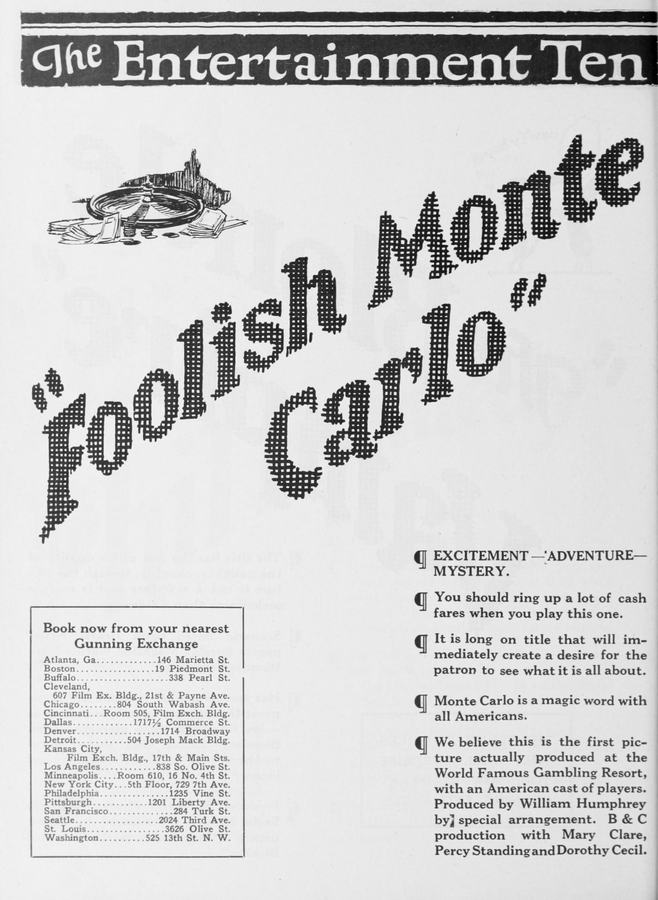
The opening frames of Foolish Monte Carlo unfurl like a sun‑drenched tableau, the azure expanse of the Mediterranean contrasting with the somber shadows of aristocratic expectation. Betty Hall, as the tormented ingénue, embodies a paradox: she is both the epitome of refined elegance and a restless spirit yearning for authentic connection. The film’s mise‑en‑scene, awash in the pastel palette of the French Riviera, subtly foreshadows the duality that will dominate the narrative: the luminous surface of high society versus the murky depths of illicit desire.
\n \nThe specter of "The Black Spider" looms over Monte Carlo like a dark cloud over a sunlit harbor. Unlike the flamboyant capers of The Vortex, where psychological turbulence drives the plot, the thief in this film is a literal embodiment of the city’s anxieties about wealth and morality. The director employs a chiaroscuro lighting scheme whenever the spider’s legend is invoked, casting long, spider‑like silhouettes across marble corridors. This visual motif not only heightens suspense but also underscores the thematic thread that appearances can be deceiving—a notion echoed in the protagonist’s own duplicity.
\n \nHall’s portrayal is a masterclass in restrained rebellion. She eschews melodramatic outbursts, opting instead for a series of nuanced glances and barely audible sighs that convey a world of internal conflict. In the scene where she first lifts her aunt’s jeweled necklace, the camera lingers on her trembling fingers, allowing the audience to feel the weight of both the physical object and the metaphorical burden it represents. This moment, rendered in a close‑up that captures the flicker of candlelight on polished gold, becomes a visual metaphor for the protagonist’s flirtation with danger.
\n \nRonald Colman, portraying the relentless detective, brings a measured gravitas to his role. His investigative techniques—meticulous cataloguing of stolen gems, cross‑referencing of guest lists, and strategic interrogations—are depicted with a procedural authenticity rarely seen in 1930s cinema. The cat‑and‑mouse dynamic between his character and Hall’s heroine is reminiscent of the tension in Cross Currents, yet here the stakes are amplified by the looming specter of a false accusation that could ruin a young woman’s reputation forever.
\n \nThe love interest, portrayed by Sam Livesey, offers a tender counterbalance to the film’s darker elements. Their clandestine meetings, set against the backdrop of Monte Carlo’s moonlit gardens, are bathed in a soft, amber glow that mirrors the warmth of genuine affection. The script, penned by George Edwardes‑Hall and William Humphrey, avoids saccharine clichés; instead, it weaves dialogue that feels both period‑appropriate and timeless, allowing the romance to resonate with contemporary viewers.
\n \nThe production design deserves particular commendation. The opulent casino interiors, replete with crystal chandeliers and gilded railings, are rendered with a meticulous attention to detail that transports the audience to the height of 1930s luxury. Costumes, especially Hall’s flowing gowns in shades of ivory and sapphire, are crafted to reflect both her social standing and her inner turmoil. The contrast between her elegant attire and the gritty underworld of jewel thieves creates a visual tension that amplifies the narrative’s central conflict.
\n \nThe film’s pacing oscillates deftly between high‑octane heist sequences and slower, introspective moments. The robbery scenes are choreographed with a kinetic energy that recalls the swift cuts of modern caper films, while the quieter interludes allow characters to breathe, revealing motivations and vulnerabilities. This rhythm ensures that the audience remains engaged without feeling overwhelmed by either the action or the melodrama.
\n \nAt its core, Foolish Monte Carlo interrogates the constructs of class and identity. The protagonist’s engagement to a nobleman symbolizes societal expectations, while her attraction to a man of unknown standing challenges the rigid hierarchies of her world. The mistaken identity as "The Black Spider" serves as a metaphor for how women’s agency was often misconstrued as criminality in early twentieth‑century narratives. By subverting this trope, the film offers a quietly progressive commentary on female empowerment.
\n \nWhile Foolish Monte Carlo stands on its own, it shares thematic DNA with several contemporaneous titles. The Girl with the Champagne Eyes also explores the interplay between wealth and desire, though its tone skews more comedic. In contrast, An Alpine Tragedy delves into fatalistic romance, offering a darker counterpoint to the Riviera’s sun‑kissed optimism.
\n \nThe denouement arrives with a satisfying blend of revelation and redemption. The true Black Spider is unmasked in a climactic confrontation beneath the glittering casino dome, where the detective’s deductive prowess finally aligns with the heroine’s innocence. The resolution restores social order, yet leaves an indelible impression that true love and moral integrity can transcend the rigid scaffolding of aristocratic expectation.
\n \nIn sum, Foolish Monte Carlo is a meticulously crafted blend of romance, crime, and social critique. Its stellar performances, atmospheric cinematography, and layered storytelling render it a standout entry in the canon of 1930s cinema. For aficionados of period dramas that deftly balance intrigue with emotional depth, this film offers a richly rewarding experience that continues to sparkle, much like the jewels at its heart.
\n
IMDb 6
1930
Community
Log in to comment.