DbcultAccessing Vault...
Cult Review
Senior Film Conservator
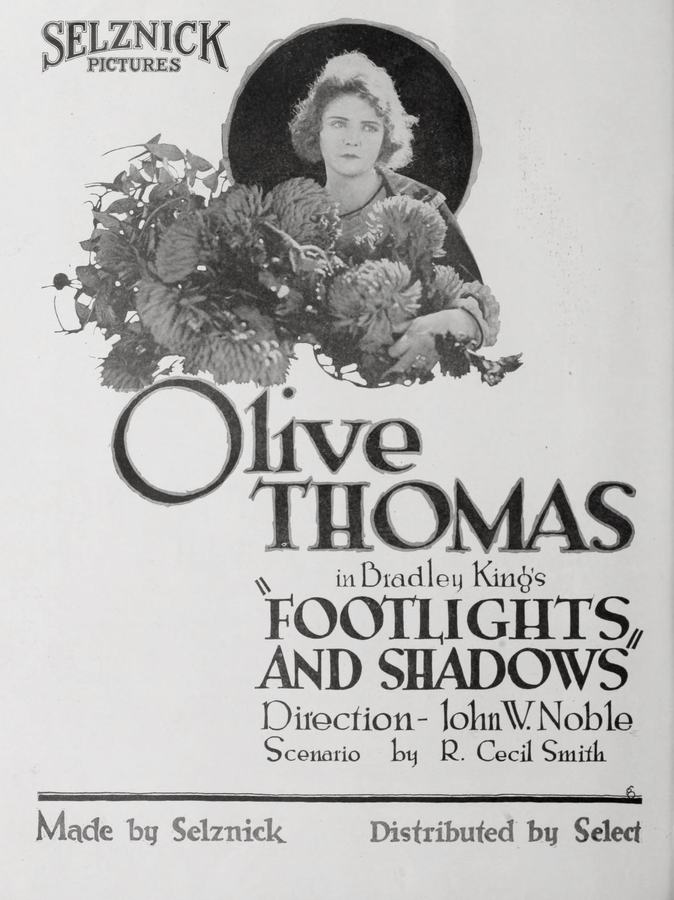
The silent era of cinema, often dismissed by the modern layman as a pantomime of exaggerated gestures, frequently harbored psychological depths that rival the most nuanced contemporary dramas. Footlights and Shadows (1920) stands as a testament to this overlooked complexity. Starring the ill-fated and ethereal Olive Thomas, the film navigates the precarious intersection of high-society expectations and the raw, unvarnished impulses of the human heart. It is a work that utilizes the 'follies' backdrop not merely as a decorative setting, but as a metaphor for the performative nature of social identity.
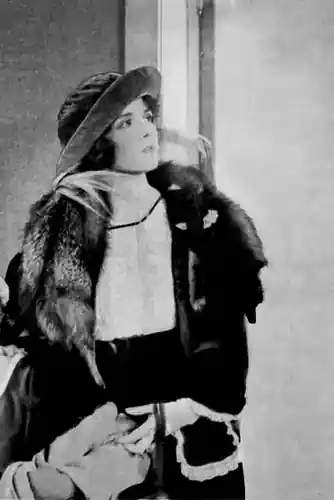
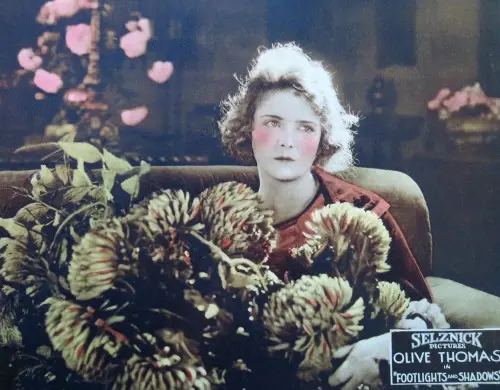
To discuss this film without first acknowledging the gravitational pull of Olive Thomas would be a critical oversight of the highest order. Thomas, who would tragically perish shortly after the film's release, possesses a screen presence that is both fragile and fiercely resilient. Her portrayal of Gloria Dawn avoids the easy pitfalls of the 'gold-digger' archetype. Unlike the protagonists in Dimples, who often navigate their worlds with a more simplistic innocence, Thomas’s Gloria is a woman of the world who deliberately chooses to soften. Her transition from a woman eyeing a marriage of convenience with Peter Shaw to a woman risking her social standing for a nameless stranger is handled with a subtlety that belies the era’s reputation for histrionics.
The camera lingers on Thomas with a reverence that borders on the hagiographic. Her expressions serve as the film's emotional barometer, shifting from the cool, calculated gaze of a stage star to the wide-eyed vulnerability of a woman in love. This performance provides a fascinating counterpoint to the roles found in A Girl Named Mary, where the search for identity is externalized; here, the search is internal, a quiet revolution occurring beneath the sequins and the footlights.
The plot device of amnesia is a well-worn trope, yet in the hands of writers Josephine Miller and Bradley King, it takes on a philosophical dimension. When Jerry O’Farrell (played with a convincing daze by Robert Lee Keeling) stumbles into Gloria’s life, he is a man without a shadow. He is stripped of the sportsman’s ego and the millionaire’s entitlement. This allows Gloria to fall in love with the essence of the man, rather than the stature he represents—a stark contrast to her engagement with Shaw, which is predicated entirely on the latter’s fiscal prowess.
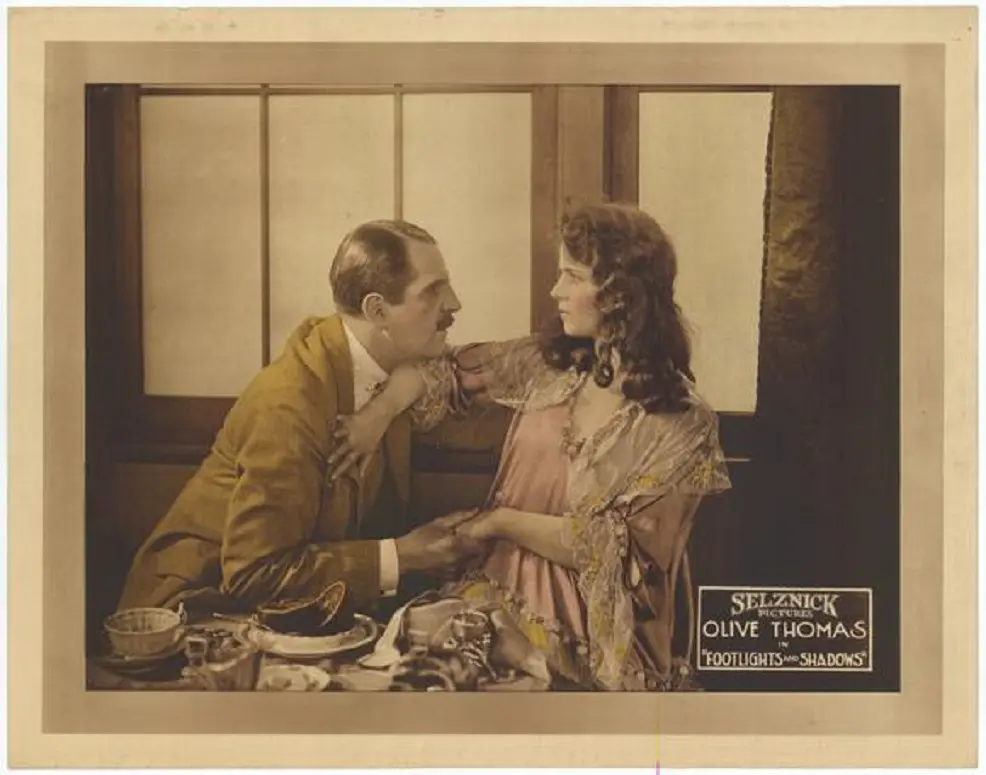
This dynamic creates a palpable tension. As viewers, we are forced to wonder: is the 'real' Jerry the man with the memories, or the man without them? The film suggests that the amnesiac state is a period of purification. Much like the characters in Lost in Transit, Jerry is a drifter in his own life, a ghost haunting the periphery of his own existence until Gloria provides him with a tether. The medical instruction that he 'must not be moved' serves as a physical manifestation of the emotional stasis both characters find themselves in.
The direction by John W. Noble makes effective use of the contrast between the dazzling, over-lit world of the stage and the intimate, often shadowed spaces of Gloria’s apartment. The 'footlights' of the title represent the public performance, while the 'shadows' are the private moments of doubt and nurturing. This visual dichotomy is far more sophisticated than the straightforward presentation seen in The College Widow. There is a specific scene where Gloria watches over the sleeping Jerry, the lighting casting long, expressionistic shadows that suggest the uncertainty of their future. It is a masterful use of cinematic chiaroscuro.
The fire sequence at the theater is the film’s technical centerpiece. While it may lack the pyrotechnic extravagance of modern blockbusters, the sense of genuine peril is effectively conveyed through frantic editing and the visceral reactions of the extras. The fire acts as a literal and metaphorical cleansing agent, burning away the deceptions of the past and forcing the characters into a moment of absolute truth. It is during this conflagration that Jerry’s memory returns—not through a gentle realization, but through the shock of trauma, a common theme in silent-era psychological dramas like Money Madness.
Beneath the romance, Footlights and Shadows offers a biting critique of the upper-class social structures of the early 20th century. Peter Shaw represents the stagnation of wealth—a man who views Gloria as an acquisition rather than a partner. His eventual confrontation with Jerry is not merely a battle for a woman’s hand, but a clash between two different types of masculinity: the possessive, static wealth of Shaw versus the revitalized, active sportsman spirit of O’Farrell.
The film subtly explores the precariousness of the working-class artist. Gloria’s initial desire for a 'fortune' is framed not as greed, but as a survival mechanism in a world that offers little security to women of the stage. This thematic depth elevates the film above contemporary works like The Pride of the Firm, which often treated class issues with a more heavy-handed moralism. Here, the morality is fluid, defined by individual choices rather than societal dictates.
When placed alongside Pals First, another film dealing with hidden identities and social maneuvering, Footlights and Shadows feels more intimate and emotionally resonant. While Captain Kidd's Kids leans into the whimsical and the comedic, Noble’s film maintains a consistent tone of earnest melodrama. Even in its most improbable moments—such as Jerry stumbling into the exact apartment of a star who would later find him in a crowded theater—the emotional logic remains sound.
The film also shares a certain DNA with Bread, particularly in its depiction of the sacrifices made for financial stability. However, where Bread focuses on the domestic grind, Footlights and Shadows uses the artifice of the theater to highlight the authenticity of the characters' internal lives. It is a fascinating paradox: the most 'real' moments happen when the characters are furthest from their public personas.
The final act is a whirlwind of tension. The intervention of Jerry during Shaw’s assault on Gloria is a cathartic moment that satisfies the audience's desire for justice. It is a reclamation of agency for both Gloria and Jerry. Jerry rescues Gloria from the physical threat of Shaw and the metaphorical threat of a loveless marriage, while Gloria has already rescued Jerry from the oblivion of his own mind. This mutual salvation is the heart of the film.
Critics of the time might have found the resolution too tidy, but from a modern perspective, the ending feels earned. The journey through the 'shadows' of amnesia and the 'footlights' of fame leads to a clear, bright dawn—a play on the protagonist's name that is surely intentional. The film avoids the darker, more cynical endings found in later noir-adjacent silents like The Pursuing Vengeance, opting instead for a romanticism that feels both grand and personal.
In the grand tapestry of silent cinema, Footlights and Shadows deserves a prominent place. It is a film that balances spectacle with soul, utilizing its star’s immense talent to ground a plot that could easily have drifted into absurdity. Olive Thomas delivers a performance of remarkable clarity, proving that she was far more than just a 'Ziegfeld Girl'—she was a formidable actress capable of conveying complex emotional states with a single glance.
For those interested in the evolution of the melodrama, or for those who simply wish to be transported to a world of 1920s glamour and intrigue, this film is essential viewing. It lacks the slapstick simplicity of A Lucky Dog's Day or the rigid procedural nature of The District Attorney. Instead, it offers a lush, romantic experience that lingers in the mind long after the final frame. It reminds us that even when the memories fade and the lights go down, the truth of one's character remains, waiting for a spark to bring it back into the light.
Ultimately, Footlights and Shadows is a meditation on the transformative power of empathy. Gloria Dawn’s decision to care for a stranger—without the promise of reward—is the pivot upon which the entire narrative turns. In a world of 'money madness' and 'pursuing vengeance,' this small act of humanity is the most radical thing of all. As we look back through the lens of a century, the film’s message remains as pertinent as ever: we are defined not by what we have, but by whom we choose to save.
IMDb 6.1
1932
Community
Log in to comment.