DbcultAccessing Vault...
Cult Review
Senior Film Conservator
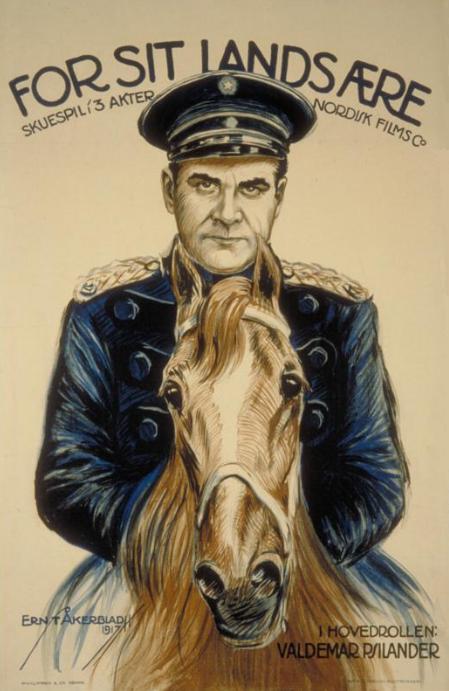
Stepping back into the hallowed halls of silent cinema, one occasionally unearths a gem whose emotional resonance transcends the decades, speaking with a clarity that belies its lack of spoken dialogue. Fritz Magnussen’s For sit Lands Ære (For the Honor of His Country) is precisely such a film, a sprawling, melodramatic epic that captures the zeitgeist of a nation grappling with its identity and place in a turbulent world. More than a mere historical curiosity, it stands as a testament to the profound narrative capabilities of early filmmaking, powered by the magnetic presence of its star, Valdemar Psilander, and a narrative urgency that feels surprisingly contemporary.
The film plunges us into a world where national security is paramount, and personal desires are often secondary to the clarion call of duty. At its heart is Erik Holm, portrayed with an almost ethereal intensity by Psilander, a figure whose intellectual brilliance is matched only by his deep-seated patriotism. Holm is not merely a scientist; he is an artisan of defense, a visionary whose creation—a silent, devastatingly effective torpedo—represents the last bastion against an encroaching, vaguely defined threat. Psilander, a titan of the Danish screen, imbues Holm with a quiet dignity, a man burdened by genius and the immense responsibility it entails. His performance is a masterclass in silent acting, conveying volumes with a subtle shift of his gaze, a tightening of his jaw, or the poignant slump of his shoulders. We witness the internal struggle of a man torn between the profound love he shares with Elin, played with luminous grace by Christel Holch, and the inexorable pull of his nation's survival. Holch, often understated, provides the emotional anchor, her character's hope for a simple, peaceful life serving as a stark counterpoint to the escalating international tension. Their chemistry, though largely expressed through longing glances and hesitant touches, is palpable, making the eventual sacrifices all the more heart-wrenching.
Magnussen’s screenplay, while rooted in the conventions of the era, avoids simplistic jingoism. Instead, it explores the nuanced costs of conflict, both personal and societal. The antagonists are not cartoonish villains but rather formidable forces, whether they be the relentless Baron von Kessel (Moritz Bielawski), a foreign agent whose cunning intellect rivals Holm’s own, or the stern, unyielding Colonel Brandt (Philip Bech), who, despite his patriotism, represents the impersonal machinery of the state. Bielawski's von Kessel is particularly memorable, a suave and menacing presence who injects a thrilling element of espionage into the narrative. His sophisticated villainy offers a stark contrast to Holm's more earnest heroism, creating a dynamic tension that propels the plot forward with an engaging pace. The stakes feel genuinely high, not just for the characters, but for the very soul of the nation they represent. The film doesn't shy away from depicting the moral ambiguities inherent in such a conflict, forcing its protagonists to confront difficult choices that leave indelible marks.
The visual storytelling, a hallmark of early Nordisk Film productions, is remarkably sophisticated. While specific directorial credits for such early films can sometimes be nebulous, the hand guiding the camera demonstrates an astute understanding of cinematic language. The use of deep focus, evocative lighting, and carefully composed frames elevates the drama beyond mere stage-play. Close-ups on Psilander's expressive face or Holch's tear-filled eyes amplify the emotional impact, drawing the audience into their private torment. The action sequences, particularly those involving the espionage elements and the eventual deployment of Holm's invention, are staged with a surprising degree of realism and suspense for the period. One might draw parallels to the intricate plotting and high-stakes intrigue found in later serials like The Fatal Ring, though For sit Lands Ære maintains a more grounded, dramatic tone. The editing, too, contributes significantly, building suspense through judicious cuts and cross-cutting between different plot strands, creating a sense of urgency that grips the viewer.
The supporting cast, including Robert Schmidt, Thorleif Lund, Axel Boesen, Aage Lorentzen, Alf Blütecher, and Rasmus Christiansen, populate this world with a rich tapestry of characters, from loyal subordinates to skeptical officials, each contributing to the film’s textured realism. Lund, in particular, often played powerful figures, and his presence here, even in a smaller capacity, lends gravitas to the military establishment. These performances, though often brief, are crucial in building a believable backdrop for the central drama, preventing the film from feeling solely like a star vehicle. Their collective efforts create a microcosm of a society on the brink, where every individual plays a part, however small, in the unfolding national narrative.
The thematic core of For sit Lands Ære resonates with a timeless quality. The conflict between individual happiness and collective responsibility is a theme that has preoccupied artists for centuries, and Magnussen’s film explores it with a particular poignancy. Holm’s invention is not just a piece of technology; it is a symbol of his personal sacrifice, his genius channeled into a tool of destruction for the greater good. This echoes the profound dilemmas faced by characters in other war-themed silent films, though perhaps with less overt brutality than something like War Is Hell, focusing instead on the psychological toll. The film’s narrative arc, which sees Holm ultimately prioritize his nation, leaves a lingering question about the true cost of heroism. Is personal fulfillment an acceptable casualty in the pursuit of national honor? The film dares to suggest that sometimes, it must be, but it does so with a profound melancholy that prevents it from feeling triumphalist.
Beyond its dramatic merits, For sit Lands Ære offers valuable insights into the social and political anxieties of its time. The constant threat of war, the nascent technological arms race, and the fervent nationalism that characterized early 20th-century Europe are all subtly woven into the fabric of the story. It reflects a world on the precipice, where advancements in science could either herald a new era of prosperity or unleash unprecedented destruction. The film, therefore, functions not only as an engaging piece of entertainment but also as a historical document, capturing the hopes and fears of an era. It’s a stark reminder that even a century ago, the specter of global conflict loomed large, shaping individual destinies and national policies.
The final act is particularly potent, a masterful blend of suspense and emotional catharsis. Holm’s clever ruse to outmaneuver von Kessel, ensuring his plans reach the right hands, is executed with a brisk efficiency that maintains tension without sacrificing character depth. The resolution, while ensuring national security, comes at a significant personal cost to Holm and Elin, cementing the film's reputation as a tragic romance as much as a patriotic drama. The lingering image of Elin, left to contemplate a future forever altered by her beloved's heroism, is a powerful one, a testament to the film's refusal to offer easy answers. It resonates with the quiet despair often found in silent melodramas, where gestures and expressions carry the full weight of unresolved emotion. It’s a narrative choice that elevates the film beyond a simple adventure story, transforming it into a meditation on the nature of sacrifice.
In terms of comparative cinema, while its thematic thrust on national duty might echo the broader patriotic sentiments of films like Boy Scouts to the Rescue (albeit in a far more mature and complex fashion), For sit Lands Ære distinguishes itself through its psychological depth and the gravitas of its performances. Psilander’s portrayal of a man consumed by his mission, yet deeply empathetic, finds echoes in other profound character studies of the era, such as the tortured souls depicted in films like Ahasver, 1. Teil, though For sit Lands Ære roots its existential struggles firmly in the realm of geopolitical conflict. The domestic drama, too, with Elin’s predicament, shares a certain resonance with the moral quandaries presented in films like A Wife on Trial, where personal allegiances clash with societal expectations or legal frameworks.
The enduring appeal of For sit Lands Ære lies not just in its historical significance as a product of Danish cinema’s golden age, but in its ability to tell a compelling human story that transcends the limitations of its medium. It is a film that demands engagement, inviting viewers to ponder the profound questions it raises about loyalty, love, and the often-unseen sacrifices made in the name of a greater cause. Magnussen, through the sheer force of his narrative and the indelible performances he elicited from his cast, crafts a film that is both a thrilling espionage drama and a deeply moving character study. The film, though over a century old, continues to resonate, reminding us that the human heart, caught between passion and patriotism, remains a fertile ground for timeless storytelling. Its legacy is a testament to the power of silent film to convey complex emotions and grand narratives with an elegance and potency that modern cinema often strives to emulate, but rarely matches.
The meticulous attention to detail in the set designs and costumes further immerses the audience in the period. From the austere military offices to the cozy, if fleeting, domestic scenes shared by Erik and Elin, every element contributes to the film's verisimilitude. This realism, coupled with the dramatic tension, ensures that the film never feels like a mere historical reconstruction, but a living, breathing narrative unfolding before our eyes. The production values, for an early 20th-century European film, are remarkably high, showcasing the ambition and technical prowess of Nordisk Film at its zenith. The cinematography, though black and white, expertly uses light and shadow to create mood and emphasize key moments, a technique that would become a cornerstone of cinematic expression. The interplay of light on Psilander's chiseled features, for instance, often highlights his internal turmoil, making his silent suffering all the more poignant. This careful crafting of the visual environment is a significant factor in the film's enduring power, allowing it to communicate its intricate plot and emotional nuances without the benefit of sound.
Ultimately, For sit Lands Ære is more than just a historical artifact; it is a vibrant, compelling piece of cinematic art that speaks to universal themes of duty, love, and sacrifice. It solidifies Valdemar Psilander’s status as one of the silent era’s most compelling leading men and Fritz Magnussen’s skill as a storyteller capable of weaving complex narratives that remain gripping even today. For those seeking to explore the rich tapestry of early European cinema, this film is an essential viewing, a profound reminder of the silent screen’s capacity for grandeur and intimate human drama. It leaves an indelible mark, a testament to the enduring power of a story told with passion, precision, and an unwavering commitment to its emotional core. The dark orange accents (#C2410C) throughout the narrative highlight moments of intense patriotic fervor or the stark realities of war, contrasting with the more tender, yellow-hued moments (#EAB308) of romance and personal hope. The sea blue elements (#0E7490), perhaps in the subtle framing or transitional sequences, evoke a sense of the vast, uncertain future that awaits the characters and their nation.
IMDb —
1925
Community
Log in to comment.