DbcultAccessing Vault...
6.3/10
Senior Film Conservator
A definitive 6.3/10 rating for a film that redefined the boundaries of cult cinema. Die Buddenbrooks remains a cornerstone of transgressive art.
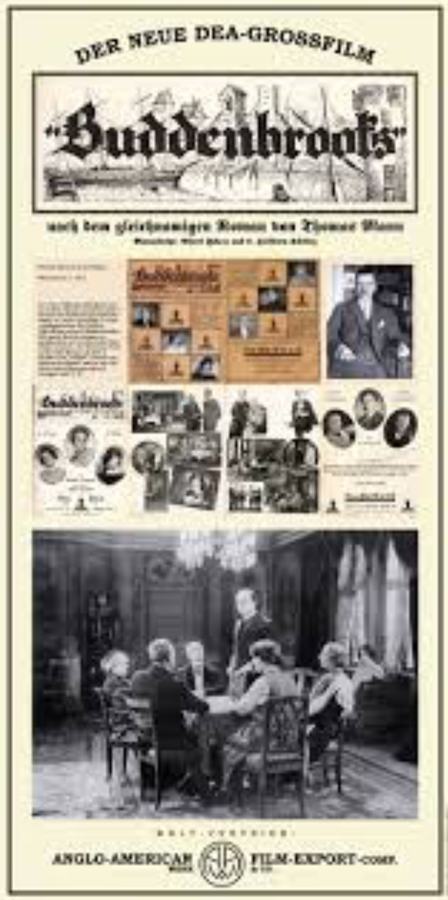
Stepping into the spectral glow of a silent film adaptation of Thomas Mann’s monumental novel, Die Buddenbrooks (1923), is an experience akin to sifting through the amber-preserved fragments of a bygone era. Directed by Gerhard Lamprecht, this cinematic endeavor, co-written by Lamprecht himself, Alfred Fekete, and Luise Heilborn-Körbitz, with Mann’s original text as its bedrock, attempts to compress a sprawling epic of generational decline into a visual narrative. It’s a formidable challenge, one that many might deem audacious, given the novel’s intricate psychological depth and its nuanced critique of 19th-century German bourgeois society. Yet, this film stands as a fascinating artifact, a testament to the ambitions of Weimar cinema and its desire to grapple with profound literary works.
The saga unfolds in the grand, yet ultimately suffocating, world of the Buddenbrook family, a prominent merchant dynasty in Lübeck. From the very outset, the film establishes a palpable sense of the family’s deeply ingrained traditions and their almost religious devotion to their business. We are introduced to the patriarch, Jean Buddenbrook, whose stern, unyielding presence, portrayed with gravitas by Robert Leffler, anchors the family’s early prosperity. His commitment to the firm, to duty, and to the 'honor' of the Buddenbrooks is absolute, a standard that will prove increasingly impossible for his descendants to uphold. The very air around them seems thick with the weight of expectation, a silent, internal pressure cooker that will eventually simmer over into tragedy.
As the narrative progresses, the baton passes to Jean’s son, Thomas, played with a nuanced blend of ambition and melancholia by Kurt Vespermann. Thomas is a man caught between worlds: he possesses his father's acumen for business, yet lacks the same unburdened enthusiasm. There’s an inherent weariness in his eyes, a premonition of the spiritual exhaustion that will eventually consume him. He strives relentlessly, driven by a desire to maintain the Buddenbrook name's luster, to expand their influence, but his efforts feel less like genuine passion and more like a Sisyphean task. The film subtly conveys this through Vespermann's posture, his gestures, the way he carries himself with an almost regal, yet ultimately fragile, dignity. His marriage to Gerda (Mady Christians), an artistically inclined woman, brings a fleeting moment of beauty and a different kind of sensibility into the pragmatic Buddenbrook household, but it is ultimately insufficient to stem the tide of his internal struggle.
The female characters, particularly Tony Buddenbrook, are pivotal in illustrating the societal constraints and expectations placed upon women of that era. Charlotte Böcklin delivers a heartbreaking performance as Tony, whose life becomes a cruel procession of strategic marriages, each intended to bolster the family's standing or finances. Her first marriage to the uncouth Bendix Grünlich (Peter Esser) is a disaster, a stark reminder that personal happiness is secondary to familial obligation. Later, her union with Alois Permaneder (Hermann Vallentin) proves equally unfulfilling. Tony’s journey is one of repeated disillusionment, her bright spirit gradually dimmed by the relentless demands of her family and society. One might draw a thematic parallel to the protagonists in films like Behold My Wife or Her One Mistake, where individual women grapple with the unforgiving expectations of marriage and social decorum, though perhaps with less overt tragedy than Tony's saga. The silent screen, in Tony's case, magnifies her silent suffering, making her plight profoundly resonant without a single uttered word.
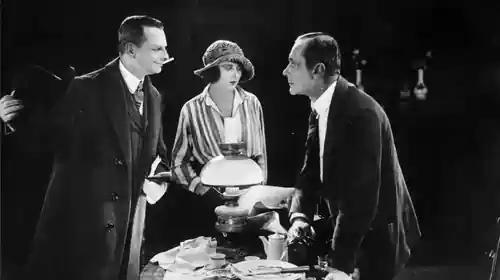
Then there is Christian Buddenbrook, Thomas and Tony's brother, portrayed by Peter Esser in a role that highlights his character's inherent rebellion against the family's rigid ethos. Christian is the artistic, bohemian spirit, the antithesis of the disciplined merchant. His aversion to commerce, his theatrical aspirations, and his perceived 'nervousness' brand him as an eccentric, a burden to the family's reputation. He represents the nascent individualism that clashes violently with the established order. His fate, confined and marginalized, underscores the Buddenbrooks' inability to adapt, to embrace anything beyond their narrow, mercantile world. This conflict between artistic sensibility and pragmatic societal demands is a timeless one, echoing through many narratives of the era, even if presented in vastly different cultural contexts.
The film’s greatest challenge, and perhaps its most compelling achievement, lies in its portrayal of Hanno Buddenbrook, Thomas's delicate, musically gifted son. As the final scion, Hanno embodies the ultimate spiritual decline of the family. He is utterly unsuited for the world of business, his soul yearning for beauty and art, an ethereal contrast to the hard-nosed pragmatism that built his family's empire. His frail health and artistic temperament are harbingers of the family's demise. His story, though tragic, is perhaps the most poignant, illustrating the devastating cost of forcing a sensitive soul into a mold it was never meant to fill. The film, through subtle visual cues and the melancholic performance, captures Hanno's quiet despair and his ultimate retreat from a world that offers him no solace. This sense of inherited decay, the 'children of the century' grappling with a fading legacy, could find a distant, thematic cousin in films like Deti veka, which also explores the burdens and transformations faced by a new generation.
Cinematically, Lamprecht’s direction is marked by a classical, often theatrical, approach, typical of many silent films adapting literary works. The sets are grand, meticulously designed to convey the opulence and the eventual decay of the Buddenbrook residence and business premises. The costuming is period-appropriate, adding to the authenticity of the 19th-century setting. The cinematography, while not groundbreaking for its era, effectively uses lighting and composition to emphasize character moods and narrative shifts. Close-ups are employed judiciously to highlight emotional turmoil, particularly in the performances of Vespermann and Böcklin. The absence of spoken dialogue forces an increased reliance on visual storytelling, on the expressiveness of the actors' faces and bodies, and on the use of intertitles to convey Mann's intricate prose and internal monologues. While no silent film can fully replicate the linguistic richness of Mann's novel, Lamprecht's adaptation makes a valiant effort to translate its thematic core into a visual language.
The overarching theme of Die Buddenbrooks is, of course, the inexorable decline of an old order. It is a meditation on the corrosive effects of time, the burden of inheritance, and the eternal conflict between duty and desire. The family's fortunes are inextricably linked to their spiritual vitality; as their passion for commerce wanes, replaced by a weary sense of obligation, their material wealth also begins to dissipate. The film explores how each generation, in its own way, contributes to this decline: Jean’s rigid adherence to tradition, Thomas’s internal alienation, Tony’s sacrifices, Christian’s rebellion, and Hanno’s fragility. It’s a somber commentary on the transient nature of power and the ultimate futility of material accumulation without a corresponding spiritual foundation. This theme of societal and personal decay, the slow erosion of an established way of life, finds a striking parallel in the urban decay portrayed in Stolichnyi iad, albeit in a vastly different setting and context, both films capturing the sense of something vital slowly being poisoned or lost.
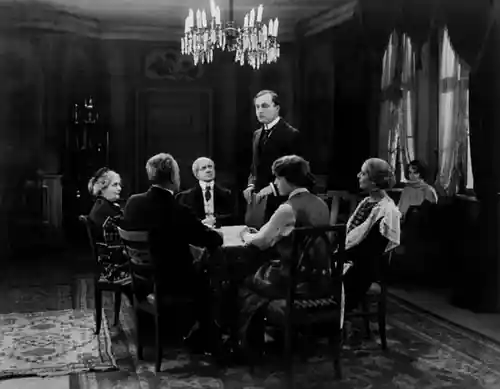
The ensemble cast, a veritable who's who of German silent film actors, delivers performances that, while constrained by the conventions of the era, manage to convey the depth of their characters' struggles. Beyond the central trio, figures like Alfred Abel, renowned for his work in Metropolis, appears in a smaller but significant role, further solidifying the film’s pedigree. Elsa Wagner as the formidable Elisabeth Buddenbrook and Philipp Manning as Consul Hagenström provide strong supporting turns, embodying the steadfastness and emerging rivalry that define the Buddenbrooks’ world. Their collective efforts bring to life a complex tapestry of relationships, betrayals, and quiet desperation, all communicated through the potent medium of expressionistic gestures and evocative facial expressions.
Despite the inherent limitations of adapting such a text to the silent screen, Lamprecht’s Die Buddenbrooks remains a significant cultural document. It's not merely a historical curiosity but a serious attempt to engage with one of Germany's most important literary works. While it may not capture every nuance of Mann's intricate prose or his profound psychological insights, it successfully distills the core tragedy of the Buddenbrook family. It portrays the suffocating grip of tradition, the relentless pressure of societal expectations, and the poignant beauty of human fragility in the face of an ever-changing world. For enthusiasts of classic cinema, especially those with an appreciation for Weimar-era German films, this adaptation offers a unique window into a pivotal moment in cinematic history and a compelling interpretation of a timeless narrative.
Watching Die Buddenbrooks today, one is struck by its ambition and its commitment to narrative fidelity, even when facing the formidable task of translating Mann's verbose masterpiece into a silent idiom. It invites contemplation on the nature of adaptation itself: what is gained, what is lost, and what new dimensions emerge when a story is recast in a different artistic medium. The film, in its own silent way, speaks volumes about the human condition, the relentless march of time, and the poignant struggle to find meaning and purpose amidst the inevitable ebb and flow of fortune. It's a journey worth taking, not just for its historical value, but for the enduring power of its tragic human drama.
The film’s legacy extends beyond its immediate reception, serving as a foundational piece in the German cinematic tradition of adapting literary giants. It paved the way for future interpretations, each seeking to capture the elusive essence of Mann’s work. Yet, this 1923 version retains a particular charm, a raw, almost embryonic quality that speaks to the nascent art of filmmaking grappling with profound themes. It is a quiet, powerful elegy to a vanishing world, a cinematic whisper across the decades that still resonates with the universal truths of ambition, loss, and the eternal, often heartbreaking, quest for identity within the confines of family and society. It stands as a profound reminder that even without spoken words, the deepest human emotions and the grandest narratives can be conveyed with breathtaking clarity and impact. This early film serves as a crucial benchmark, illustrating the evolution of storytelling on screen and the enduring power of a meticulously crafted narrative, regardless of its medium.
IMDb —
1932
Community
Log in to comment.