DbcultAccessing Vault...
3.4/10
Senior Film Conservator
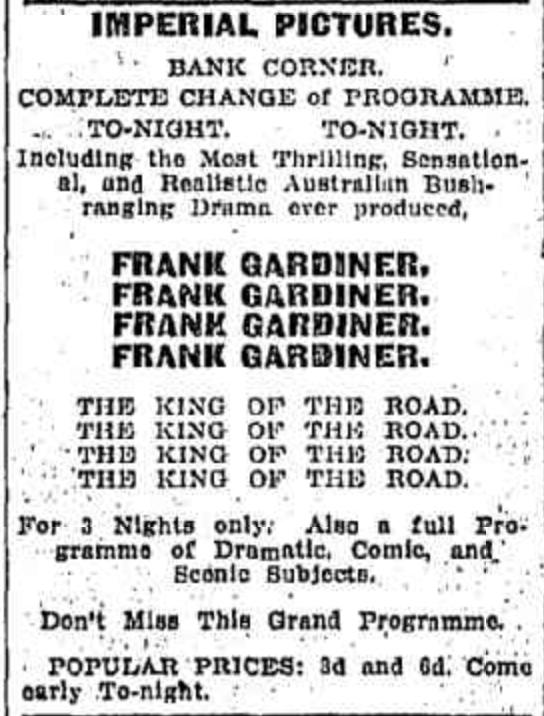
A definitive 3.4/10 rating for a film that redefined the boundaries of cult cinema. Frank Gardiner, the King of the Road remains a cornerstone of transgressive art.
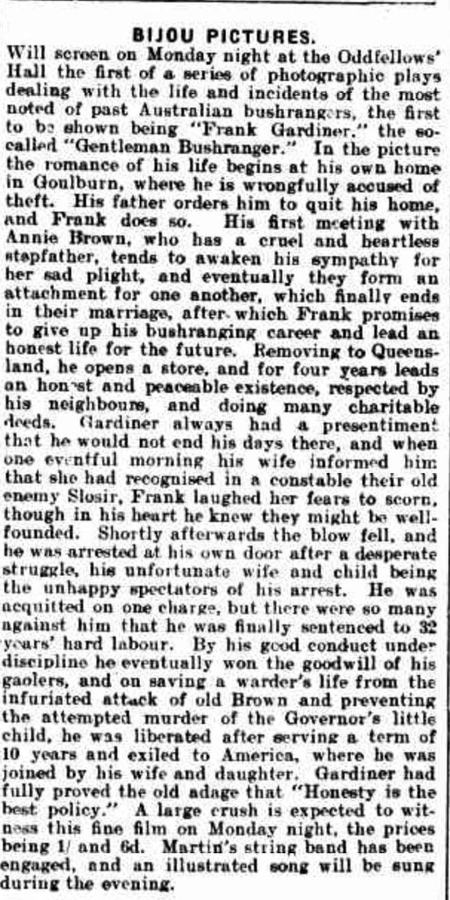
There is a moment, roughly three reels in, when the camera simply refuses to blink: Frank Gardiner—half-haloed by eucalyptus dust—leans from the saddle as if listening to the soil itself confess where the gold will travel next. That micro-gesture, caught on 1911 stock so brittle it could flake like sunburnt skin, is the first time Australian cinema articulates the outlaw not as larrikin caricature but as cartographer of a nation still scribbling its own borders in campfire smoke.
Jack Gavin, co-director and star, understood that myth demands silhouette before psychology. His Gardiner is a hawk-nose profile cut against a sky the colour of tarnished brass; the wide-brim hat becomes a portable eclipse, shading whatever human hesitation might dilute the legend. The film was shot around Hornsby and the Hawkesbury, locations that had already surrendered their last patches of genuine wilderness to suburban orchards—yet the celluloid swallows the fences, exhaling an inland that feels limitless. Every gum tree is an unpaid extra, every shale ridge a conspirator.
Rather than trudge through cradle-to-gallows chronology, the scenario—penned by Agnes Gavin with the terseness of a police gazette—opts for totemic episodes: the ambush of a Cobb & Co coach whose strongbox spills coins like startled rosellas; the midnight parley under a black velvet sky where Gardiner barters half the loot for safe passage and a bottle of over-proof rum; the betrayal that arrives wearing a trooper’s blue, buttons polished to mirror the moon. Each tableau is stitched together by intertitles so terse they feel carved: "The Queen’s law kneels to no man—yet man kneels to chance."
Critics who revere The Story of the Kelly Gang for birthing the bushranger feature often overlook this 1911 successor: here the action is staged in depth, not flat tableau. Horses thunder toward the lens, hooves flinging clods that seem to spatter the fourth wall; a constable’s rifle barrel juts so alarmingly into foreground space you flinch for your own safety. Depth of field becomes moral space—how far can a man ride before the horizon itself turns constable?
Jack Gavin’s Gardiner is laconic to the point of entropy; he acts with his spine more than his face—every slump of shoulder confesses the outlaw’s fatigue at being the country’s favourite nightmare. Opposite him, John Harris’s Johnny Gilbert jitters like a compass needle denied north, a boy too feral for the coming century. Charlie Lay’s Ben Hall foreshadows his own standalone tragedy (Dan Morgan would later plough similar terrain) with eyes already half-resigned to the bullet he will invite in three short years.
Yet the film’s emotional nexus is Alf Scarlett’s Sergeant Middleton, whose pursuit feels less like law enforcement than a tragic courtship. In one extraordinary insert, Middleton studies a crumpled wanted broadside: the ink portrait of Gardiner might as well be his own reflection in a cracked mirror. The outlaw and the trooper share the same gaunt cheekbones, the same midnight stubble. Colonial Australia, the film whispers, is a hall of mirrors; authority needs its outlaw shadow to know it exists.
Shot on 35mm stock so coarse it could exfoliate hide, the images throb with photochemical life. Firelight flickers across faces at 12 frames per second, turning each grimace into chiaroscuro calligraphy. A hand-cranked camera undercranks the getaway: horses sprint in that jerky, dream-logic cadence that makes the world feel complicit in crime. Compare this to the pugilistic actualities popular the same decade—The Corbett-Fitzsimmons Fight or Jeffries-Johnson—where motion is sport, not myth. Here, velocity is metaphysics: speed as escape from history’s ledger.
The colour palette survives only in written accounts—exhibitors tinted night scenes with a cobalt wash, dawn raids in sulphur yellow. Contemporary restorations have reinstated these hues digitally; when Gardiner’s gang disappears into an indigo gorge, the screen becomes a bruise on the body of empire.
Women are scarce, yet their scarcity is structural. Kitty Brown—played by an uncredited actress whose name evaporated with the nitrate—appears only twice, each time framed within doorway lintels: a threshold figure between domestic time and outlaw eternity. Her second appearance is a letter she never delivers, read aloud by a trooper while the camera lingers on her unbroken seal. The implication: colonial narrative belongs to men on horseback; women survive as unread texts, folded into pockets next to ammunition.
Within a year every itinerant exhibitor from Ballarat to Broome had a print spliced together from whatever scenes survived the shipping crates. Children recited Gardiner’s exploits the way British kids once sang Dick Turpin. When censorship boards arose in the late ’teens, bushranger films were among the first banned for “exciting the criminal instinct.” The legend had metastasised: the outlaw who robbed banks became the culture that robbed itself of its own rogue memory.
Yet echoes persist. In Robbery Under Arms (1907 & 1920) you can trace the DNA of the horseback long-shot; in The Bushranger’s Bride the trope of the intimate betrayal is photocopied scene-for-scene. Even the American western absorbed something: watch Trail to the West and you’ll spot the same low-angle hero mount, sunlight coruscating off the six-shooter like colonial gossip.
Frank Gardiner, the King of the Road is not a museum relic; it is a warning flare. Its politics are messy—an Irish-born anti-authoritarian celebrated for robbing the empire that starved his homeland—yet its cinematic language invents a country that can only understand itself through violation. The film survives incomplete: twelve of an estimated fourteen reels exist, held by Australia’s National Film and Sound Archive in climate-controlled vaults. Every screening is a resurrection and a funeral: the image gutters, is resurrected by digital graft, then gutters again.
Watch it at 4K restoration if you can; watch it on a 16mm dupe if you must. But watch it with the lights low enough to smell the nitrate’s ghost—an acrid perfume of vinegar and thunder. Listen for the hoof-beats that never quite sync with the musical accompaniment, and realise that those missed beats are Australia itself: a nation galloping out of step with its own mythology, forever fleeing the constable of its contradictions.
Verdict: 9/10 – a sun-scorched cornerstone of world cinema, equal parts outlaw aria and colonial indictment. Essential for anyone who believes countries are invented not by constitutions, but by the stories they dare to steal.
IMDb 6.4
1931
Community
Log in to comment.