DbcultAccessing Vault...
Cult Review
Senior Film Conservator
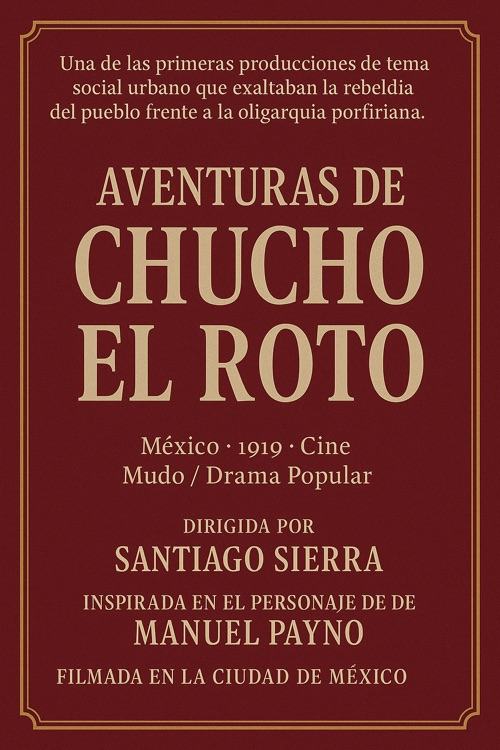
In the pantheon of Mexican folk heroes, few figures loom as large or as enigmatically as Jesús Arriaga. The silent film Aventuras de Chucho el Roto serves not merely as a historical document but as a vibrant, albeit flickering, testament to the enduring power of the social bandit mythos. Watching this film in the modern era requires a calibration of the senses; one must look past the grain and the inevitable temporal decay to see the burning conviction of its narrative. It is a work that grapples with the fundamental friction between law and justice, a theme that resonates as powerfully today as it did during the film's initial screenings.
The performance of Leopoldo del Cerro is a masterclass in silent-era physical storytelling. Without the crutch of synchronized dialogue, Del Cerro conveys a profound sense of indignation and subsequent liberation through his posture and the intensity of his gaze. His transition from the earnest, laboring artisan to the flamboyant, calculating trickster is handled with a subtlety that belies the era's penchant for melodrama. Much like the moral complexities explored in The Primal Lure, where the environment dictates a harsh ethical code, Chucho’s environment—a stratified Mexico—forces him into a life of crime as the only viable path to integrity.
The film’s visual language is deeply rooted in the contrasts of the era. We see the opulent salons of the Porfirian elite, captured with a sprawling, almost claustrophobic attention to detail, which contrasts sharply with the stark, minimalist despair of the prison cells. This dichotomy is central to the film’s efficacy. It doesn't just tell us about inequality; it frames it through the very geometry of the screen. The aristocratic interiors feel heavy, burdened by their own decadence, while Chucho’s presence brings a kinetic energy that disrupts these static spaces.
Comparing this to other contemporary works, such as Hypocrisy, we see a shared fascination with the masks people wear to navigate societal expectations. Chucho’s disguises are not merely plot devices; they are metaphors for the fluidity of identity in a world where one's worth is dictated by title rather than character. Hilda North, playing the role of the love interest, provides a necessary emotional anchor. Her performance captures the tragic realization of a woman trapped between her familial obligations and her genuine human impulses, a theme mirrored in the narrative arc of Her Unmarried Life.
What makes Aventuras de Chucho el Roto particularly compelling is its refusal to simplify the protagonist’s motives. While he is a 'Robin Hood' figure, there is a palpable sense of personal vendetta that fuels his early exploits. This isn't just about altruism; it's about the reclamation of agency. The film manages to balance these personal stakes with a broader sociopolitical commentary, much like the way La capanna dello zio Tom utilized a singular narrative to expose systemic inhumanity. The 'adventures' are episodic in nature, yet they build toward a crescendo of myth-making that elevates Arriaga from a man to a symbol.
Technically, for its time, the film exhibits an impressive grasp of pacing. The escape from San Juan de Ulúa is filmed with a tension that anticipates the modern thriller. The use of shadows and the play of light on the water create a sense of existential dread that is quite sophisticated. It reminds me of the atmospheric density found in The Three Black Trumps, where the visual mood is as essential as the dialogue. The directors (though the credits from this era are often debated) clearly understood that the audience needed to feel the weight of the walls closing in on Chucho to appreciate the catharsis of his liberation.
When we look at the cinematic landscape of the 1910s and 20s, Chucho el Roto stands out for its cultural specificity. While American films like Jack and the Beanstalk were exploring vertical hierarchies through the lens of fantasy and folklore, the Mexican industry was grounding its legends in the very real soil of revolution and class warfare. There is a grit here that is often absent from the more polished Hollywood productions of the same period. Even in films like Reggie Mixes In, which deals with class crossing, the tone is often lighter, more focused on the novelty of the experience rather than the life-and-death consequences of social transgression.
Furthermore, the moral clarity of Chucho’s mission offers a fascinating counterpoint to the more ambiguous ethics found in Thou Shalt Not Covet. Arriaga’s 'coveting' of the wealth of the rich is presented as a moral imperative, a necessary correction to a broken system. This thematic boldness is what has allowed the character to persist through numerous remakes and adaptations. He is the physical manifestation of the collective desire for a champion who can navigate the labyrinth of the law without losing his soul.
The cinematography in Aventuras de Chucho el Roto utilizes the limited technology of the day to create a sense of place that is almost tactile. The dusty streets, the cold iron of the prison bars, and the shimmering silks of the upper class are all rendered with a stark clarity. The film understands the power of the close-up, using it sparingly but effectively to punctuate moments of high emotional stakes. This reminds me of the psychological intimacy achieved in I Want to Forget, where the camera becomes a confidant to the character’s internal struggle.
In the sequences where Chucho dons his various disguises, the film adopts a more playful, almost theatrical tone. This versatility is a testament to the filmmakers' ability to blend genres, moving from tragedy to heist film to social drama with relative ease. It shares this multifaceted approach with Pettigrew's Girl, which also navigates different social strata through character transformation. However, Chucho’s transformations are always anchored by his underlying mission; he never loses sight of the cabinetmaker who was wronged.
The title itself, 'Chucho el Roto' (Chucho the Broken), is a poignant irony. While the system sought to break him, it only succeeded in shattering the illusions he held about society, allowing him to rebuild himself as a force of nature. This theme of resilience is a common thread in the cinema of the era, seen in the rugged individualism of Six Feet Four or the courageous stand in The Chalice of Courage. Yet, Arriaga’s courage is distinctly communal. He does not act for himself alone; he becomes the avatar for a silent majority.
As we analyze the film's structure, we see a precursor to the modern procedural. The way Chucho plans his 'hits'—the meticulous gathering of intelligence, the exploitation of his targets' vanities—predates the sophisticated caper films of later decades. There is a proto-technological fascination here as well, perhaps not as overt as in 0-18 or A Message from the Sky, but present in the way Chucho uses the tools of the modern world against those who believe they own them. He is a hacker of the social code, finding vulnerabilities in the firewall of the aristocracy.
The film concludes not with a neat resolution, but with the sense that the struggle is ongoing. Chucho el Roto remains a figure of the shadows, a specter that haunts the conscience of the powerful. This open-endedness is a brave choice, suggesting that as long as there is inequality, there will be a Chucho. This sentiment is echoed in Lure of Ambition, which warns of the corrupting nature of power, and in the spiritual weight of The Padre, which seeks a higher justice in a flawed world.
To watch Aventuras de Chucho el Roto today is to engage with the very foundations of Mexican narrative cinema. It is a film that understands the power of the underdog and the visual potency of rebellion. It is a stark reminder that cinema has always been a tool for social reflection, a mirror held up to the face of the world, sometimes showing us the beauty of our ideals and sometimes the ugliness of our institutions. Even after a century, Chucho’s adventures remain a vital, pulse-pounding experience for anyone who believes that the law should be the servant of justice, not its master.
In summary, this film is an essential artifact. It bridges the gap between folklore and the silver screen, creating a hero that is both larger than life and deeply human. The collaboration between Del Cerro and the production team resulted in a work that transcends its technical limitations, offering a narrative richness that many modern blockbusters fail to achieve. It is a haunting, beautiful, and profoundly important piece of cinematic history that deserves its place in the global canon of silent film.
IMDb 5.5
1934
Community
Log in to comment.