DbcultAccessing Vault...
Cult Review
Senior Film Conservator
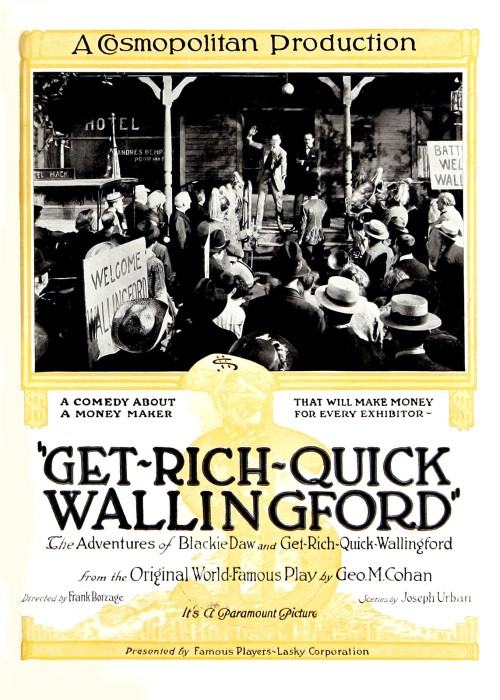
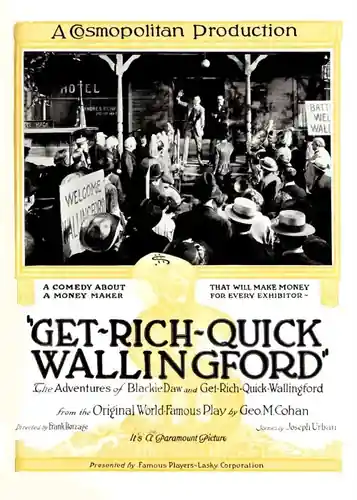
The flicker of a carbon-arc projector, the hush of an orchestra settling into ragtime—Get-Rich-Quick Wallingford emerges from 1921 like a freshly-minted coin still warm from the press. Paramount’s marketers sold it as breezy farce; in truth, it is a pocket-sized Vanity Fair etched onto nitrate, a morality play that refuses to moralize, a capitalist commedia dell’arte performed in the key of jaunty despair.
Instead of dusty exposition, the film tosses us into a passenger-train lounge car where Wallingford (William T. Hayes, all teeth and tonic) and Chester (Edgar Nelson, a fox in spats) wager on the gullibility of strangers. Their banter is a prestidigitation of eyebrows, shrugs, and the clink of highball glasses. By the time the train whistle keens, they have alighted in Stockport—a town so archetypically American it might have been sewn together from Whitman’s loose pages.
There they unfurl a tapestry of promise: a factory that will transmute local lumber into carpet tacks—those microscopic tridents pinning middle-class domesticity to the floor. The metaphor is delicious; the con men will fasten down the very carpet they intend to pull. Townsfolk empty cookie jars; widows hawk heirlooms; the mayor’s own gavel becomes collateral. Luther Reed’s intertitles sparkle with homespun poetry: “We’re not selling shares, friend—we’re selling sunrise.”
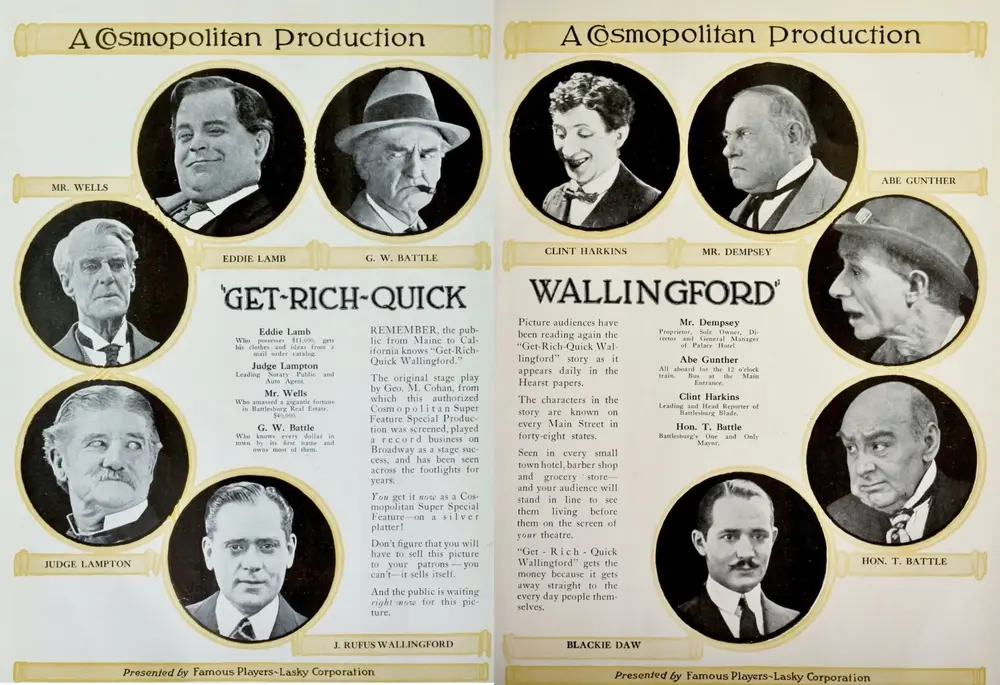
Enter suspicion in the form of Mac Barnes’s blustering councilman and Billie Dove’s secretary who keeps the books with Talmudic precision. Each ledger column threatens to expose the vacuum inside the vault. Wallingford counters not with evasion but with expansion: he doubles down on spectacle—an inaugural parade, fireworks spelling PROGRESS across sooty sky, a brass band that performs Sousa on kazoos to cut costs. The gambit works; doubt is smothered by bunting.
Just when the bubble’s skin stretches translucent, a telegram arrives: an unnamed combine offers to purchase the company at a premium that would triple every investment. The town hallucinates wealth; Wallingford hallucinates escape. Yet the buyer may be another chimera—perhaps a bigger shark, perhaps an inside job engineered by Chester who has grown weary of second fiddle. Cohan’s source play ends with handshakes; Reed’s adaptation ends on a question mark suspended like a hangman’s knot.
Cinematographer J. Roy Hunt lenses the town as though it were inside a snow globe: deep-focus main streets where distant horses shrink into fleas, and extreme close-ups of Wallingford’s eyes—two polished hematite orbs reflecting upside-down dollar signs. Note the sequence where shares are sold inside a repurposed church: hymn boards display numbers climbing like liturgical verse, while stained-glass saints seem to roll their eyes at usury below. The camera’s iris closes to a cathedral-shaped vignette, as if God Himself were narrowing His gaze.
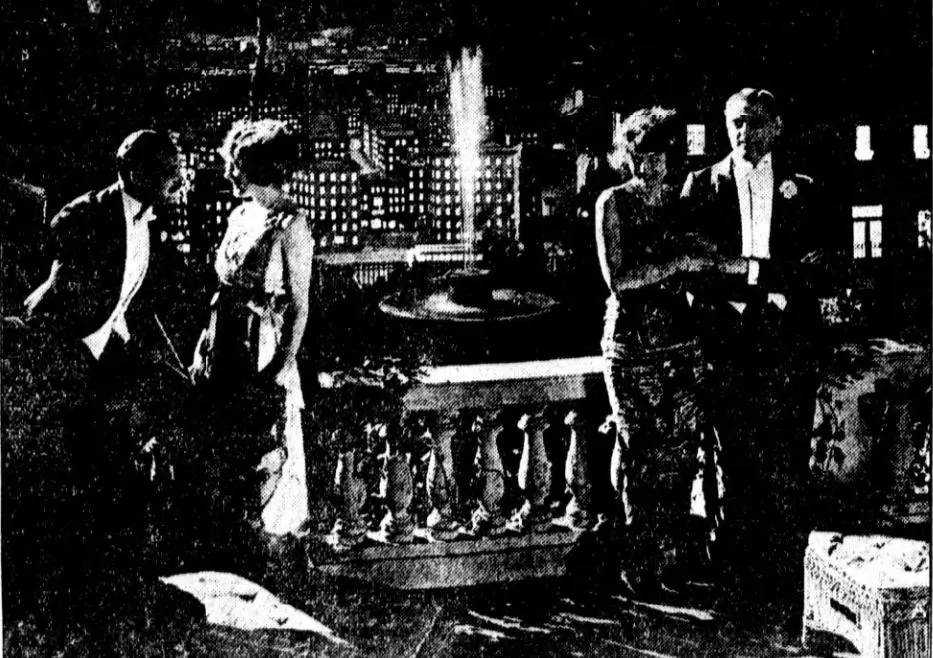
Tinting is used with surgical whimsy. Day exteriors bask in apricot; night scenes swim in nocturnal cyan; the fraudulent factory glows sulfurous yellow, predicting the sodium glare of film-noir backlots a decade later. A single hand-painted crimson frame flashes when the buyout telegram is torn open—a subliminal stab of warning.
William T. Hayes essays Wallingford as a locomotive that runs on charm coal; every piston stroke is a grin, yet in rare stillness his shoulders sag, betraying the exhaustion of perpetual invention. Watch him alone in the hotel corridor, removing his shoes: the mask slips, the smile collapses into something like remorse—three seconds, no intertitle needed.
Edgar Nelson’s Chester is the prototype for Walter Burns in His Girl Friday, all staccato gestures and pocket-watch anxiety. Their rapport is a vaudeville cakewalk synchronized to the millisecond; when Chester executes a pratfall over a discarded share certificate, Wallingford’s reflexive wink at the camera breaks the fourth wall with Brechtian glee.
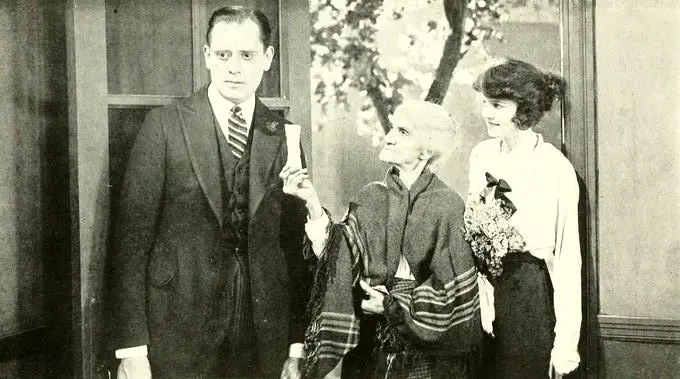
Billie Dove, billed fourth, irradiates every frame she enters. Her character arc—from skeptical clerk to complicit dreamer—mirrors America’s own journey through the coming Roaring Twenties. The moment she capitulates, signing her name beside Wallingford’s, Dove lowers her eyes; the camera catches a single tear sliding off the iris and drying mid-air, a feat achieved by over-cranking and back-lighting—an effect that reportedly took 42 takes and left the actress with conjunctivitis for a week.
The original score, attributed to Ivan Rudisill, survives only in cue sheets. Contemporary exhibitors paired it with Maple Leaf Rag for hustle montages and Lovebird Waltz for the tentative romance between Dove and Norman Kerry’s earnest stockboy. Notice how the motif for carpet tacks is a pizzicato phrase—twelve plucked violins imitating the ping of metal on hardwood—an auditory joke that predates cartoon mickey-mousing.
If Bab’s Matinee Idol satirized the fan-culture of starry-eyed ingénues, and The Coiners’ Game wallowed in the grime of counterfeiting, Get-Rich-Quick Wallingford occupies the midpoint: a sun-dappled swindle whose bitterness arrives only in the aftertaste. Its DNA echoes in Behind the Mask (corporate subterfuge) and in the sociological comedies of Broadway Love, yet none replicate its fizzy cynicism.
Released nine months before the Depression of 1920–21, the picture functioned as accidental prophecy. Urban audiences roared at the rubes; rural patrons shifted uncomfortably, recognizing their own Main Streets. Trade papers report a Michigan banker who confiscated the film, fearing copy-cat swindles. Meanwhile, the New York Call praised it as “a tonic against Bolshevism,” arguing that laughter at capital’s foibles inoculates against revolution—a dubious claim, yet evidence of the film’s ideological elasticity.
Women in this universe are no mere foils. Dove’s secretary engineers the audit that could topple the fraud; Mrs. Charles Willard’s dowager bankrolls half the shares, crowing, “I’ve buried three husbands—money’s the only one that stays decently buried.” The film quietly acknowledges women’s economic awakening post-19th-Amendment, even as it drapes them in cloche hats and bead ropes.
Within five years, sound would ossify dialogue into talkie literalism; con-men would become gangsters with gats. Thus Wallingford and Chester stand as belated avatars of an older, more oral America—hucksters who need the lilt of voice, the hush of listening marks. The silence is their accomplice; intertitles can lie more elegantly than speech.
For decades only a 9-minute condensation circulated—reels spliced into a Kodascope home reel. In 2018, a 35mm paper-print was exhumed from the Library of Congress vault, scanned at 4K, and tinted per Hunt’s continuity notes. The new restoration premiered at Pordenone; musicians Günter Buchwald and the Silent Movie Ensemble performed a score fusing ragtime with klezmer clarinet, underscoring the film’s ethnic polyglot America.
Rewatching today, one tastes FOMO, crypto pump-and-dumps, SPACs that dissolve into ether. Wallingford’s carpet-tack factory is the 1921 equivalent of an ICO for Decentralized Carpet Tacks on the Blockchain. The telegram promising buyout is the venture-capital term sheet that never materializes, or arrives larded with clawback clauses.
This is not a quaint relic; it is a hand-grenade wrapped in confetti. Its laughter detonates seconds after the credits, leaving shrapnel questions about value, trust, and the stories we pay to believe. Seek it out on Blu-ray, crank the volume so the ragtime rides the walls, and when the final iris shrinks to black, ask yourself: Would I have bought a share? If the answer is no, you’ve already fallen for the con.
IMDb —
1920
Community
Log in to comment.