DbcultAccessing Vault...
Cult Review
Senior Film Conservator
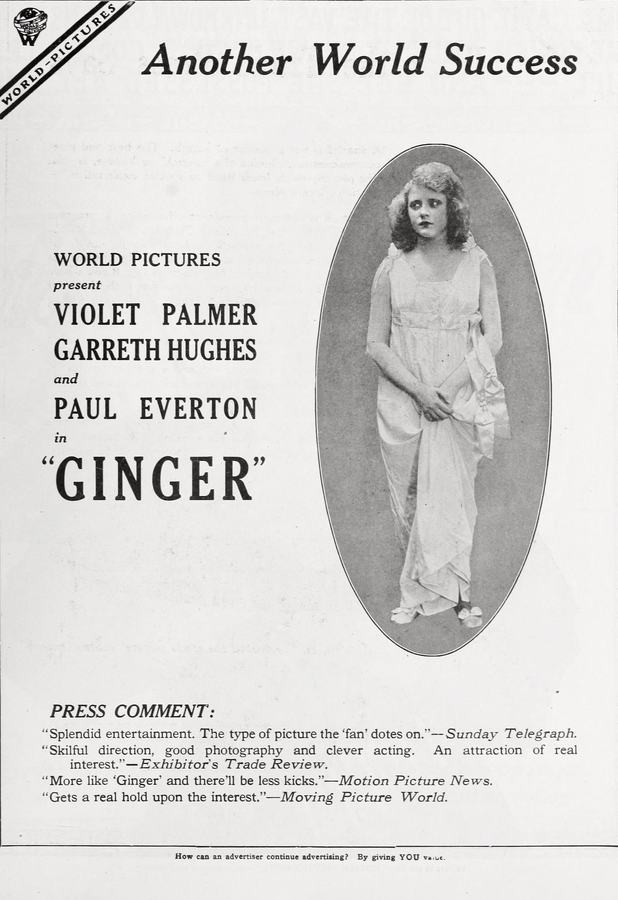
In the flickering twilight of the silent era, cinema functioned as a mirror to the anxieties of a rapidly industrializing society, and Burton George’s 1919 opus, Ginger, stands as a towering testament to this cultural preoccupation. The film is not merely a narrative; it is a visceral interrogation of the human condition, specifically the friction between deterministic heritage and the possibility of reinvention. As we peel back the layers of this celluloid relic, we find a story that resonates with a haunting contemporary relevance, anchored by a performance from Violet Palmer that transcends the pantomime tropes often associated with the period. Palmer’s Ginger is a character of profound interiority, a young woman whose every gesture conveys the weight of a dual existence.
The initial act of Ginger establishes a world defined by the harsh chiaroscuro of the urban underworld. Ginger’s father, a man whose moral compass has been completely demagnetized by a life of crime, treats his daughter as a precision tool for his larcenous endeavors. This dynamic is portrayed with a gritty realism that avoids the sentimentalism found in many of George’s contemporaries. When the inevitable arrest occurs, the film shifts from the kinetic energy of the heist to the solemnity of the courtroom. Paul Everton, portraying the Judge, delivers a performance of quiet authority, his face a landscape of jurisprudential conflict. His decision to adopt Ginger—the very girl he has just sentenced in a proxy capacity through her father—is the central conceit of the film, a gesture of radical empathy that sets the stage for the psychological drama to follow.
This adoption is a fascinating plot point that echoes the social themes found in The End of the Road, where the consequences of one's environment dictate the trajectory of the soul. However, while that film leans into the didactic, Ginger remains firmly rooted in the personal. The Judge’s household becomes a laboratory where Ginger must unlearn the survivalist instincts of her youth. The transition is not seamless; George uses subtle visual cues—a lingering look at a silver spoon, a momentary flinch at a loud noise—to illustrate the persistent ghost of Ginger’s past. It is a nuanced portrayal of what we might now call post-traumatic stress, handled with a delicacy that is rare for 1919.
As Ginger blossoms into womanhood, the narrative tension manifests in a romantic triangle that serves as a metaphor for her internal struggle. On one side, we have Bob Trowbridge, played by Gareth Hughes with a soft-edged nobility. Bob represents the promise of the future—a life of stability, intellectual pursuit, and social acceptance. His love for Ginger is pure, yet it is predicated on an idealized version of her that ignores her rough-hewn origins. In contrast, Raymond Hackett’s Tim Mooney is a vibrant, dangerous reminder of where she came from. Tim is the childhood companion who shared the bread of poverty and the thrill of the chase. His reappearance in Ginger’s life isn't just a romantic threat; it is an existential one.
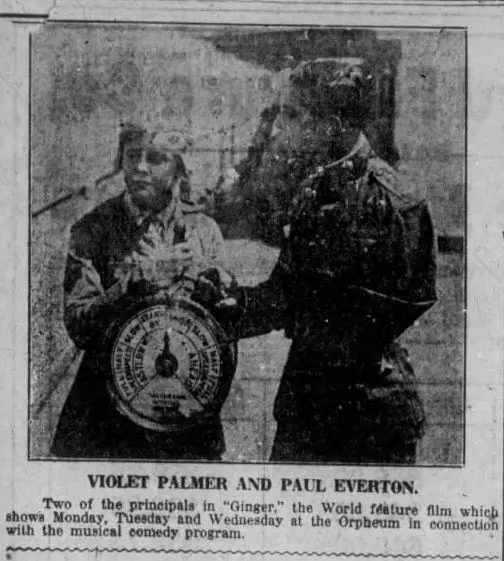
The chemistry between Palmer and Hackett is electric, crackling with a shared history that Bob can never replicate. This dichotomy reminds me of the moral complexities explored in Love and the Law, where the legal system and the human heart are often at odds. In Ginger, the law has given her a new life, but her heart remains tethered to the lawless. The scenes where Ginger is forced to choose between these two men are some of the most visually arresting in the film, utilizing tight close-ups that capture the agonizing indecision etched into Palmer’s features. It is a masterclass in silent storytelling, where the lack of dialogue only heightens the emotional resonance of the conflict.
Burton George’s direction in Ginger is characterized by a sophisticated use of space and depth. Unlike the flat, stage-like compositions of earlier silent films, George creates a sense of three-dimensional reality. The Judge’s estate is filmed with a wide-angle lens that emphasizes its vastness and, by extension, Ginger’s initial isolation within it. Conversely, the scenes in the criminal underworld are cramped and claustrophobic, reflecting the limited horizons of that life. This visual storytelling is supported by the screenplay from Raymond L. Schrock, which avoids the melodramatic excesses of the era in favor of a more grounded, character-driven approach. The pacing is deliberate, allowing the audience to inhabit Ginger’s psychological space as she navigates the treacherous waters of social mobility.
The film’s technical prowess is particularly evident in the lighting. There is a specific scene where Ginger stands between a brightly lit doorway leading to a ballroom and a dark window looking out into the night. The way the light spills across her face, dividing it into halves of shadow and brilliance, perfectly encapsulates her internal schism. It is a level of visual metaphor that one might expect from a much later period of cinema, perhaps even echoing the dark themes found in The Cavell Case. While Ginger lacks the wartime intensity of that film, it shares a similar interest in the individual caught in the gears of larger societal forces.
When placing Ginger within the wider context of 1919 cinema, its maturity becomes even more apparent. While the public was flocking to comedies like Ask Father or the broad spectacle of Yankee Doodle in Berlin, Burton George was attempting something far more ambitious. He was crafting a social drama that questioned the very foundations of American class identity. The film shares a thematic kinship with Wild Primrose, another story of a girl out of place, but Ginger feels more grounded, less reliant on the tropes of the 'waif' and more interested in the 'woman'.
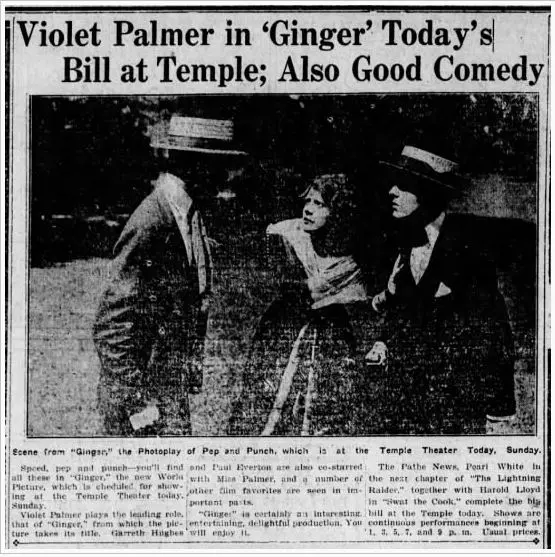
Furthermore, the film’s exploration of criminal rehabilitation predates many of the more famous 'social problem' films of the 1930s. It lacks the cynicism of The Hater of Men, offering instead a cautious optimism that redemption is possible, provided the individual is willing to confront their past. Even when compared to the high-stakes intrigue of Emerald of Death, Ginger stands out for its focus on the internal rather than the external. It is a film of quiet moments and heavy glances, where the most significant battles are fought within the confines of a single room.
One cannot discuss Ginger without returning to the luminescent performance of Violet Palmer. In an era where acting was often synonymous with grandiosity, Palmer offers a performance of startling restraint. She possesses an incredible ability to communicate complex emotions through her eyes alone. In the scenes where she is confronted by Tim Mooney, you can see the flicker of the old Ginger—the girl who knew how to pick a pocket and disappear into the fog. It is a hauntingly effective transformation. Her chemistry with Gareth Hughes is equally compelling, though in a much more restrained, Victorian manner. Their relationship feels like a fragile thing, a glass ornament that could shatter at the mention of her father’s name.
The supporting cast is equally adept. Paul Everton brings a gravitas to the role of the Judge that prevents the character from becoming a mere plot device. He is the moral anchor of the film, and his eventual acceptance of Ginger’s past is a powerful moment of catharsis. Even the smaller roles, like those found in the criminal dens, are played with a grit that suggests a lived-in reality. This attention to detail is what separates Ginger from the more assembly-line productions of the time, such as Too Fat to Fight or the more formulaic The Double Event.
As we look back at Ginger from the vantage point of over a century, its power remains undiminished. It is a film that dares to ask difficult questions about the nature of identity and the possibility of change. Is Ginger the daughter of a thief, or is she the ward of a judge? Can she be both, or must one identity eventually consume the other? These are the questions that drive the film to its poignant conclusion. The final frames, which I will not spoil here, are some of the most evocative in silent cinema, leaving the viewer with a sense of bittersweet resolution.
For fans of early cinema, Ginger is an essential watch. It occupies a unique space between the social realism of Whitewashed Walls and the romantic drama of The Remittance Man. It is a film of immense heart and technical sophistication, a reminder that even in the earliest days of the medium, filmmakers were capable of exploring the deepest recesses of the human psyche. Burton George and his cast have created something truly special here—a celluloid poem about the struggle to find one's place in a world that is constantly trying to define you by your past. It is a work that deserves to be rescued from the shadows of history and celebrated for the masterpiece that it is.
In conclusion, Ginger is a triumph of silent storytelling. It bypasses the need for spoken word through its rich visual language and the profound emotional intelligence of its lead actress. Whether you are a scholar of the silent era or simply a lover of well-crafted drama, this film offers a rewarding and thought-provoking experience. It stands alongside other great character studies of the period, such as Kildare of Storm or The Ring and the Man, as a quintessential example of how cinema can be used to explore the complexities of the human soul. Do not let the age of this film deter you; its heart beats with a modern intensity that is as rare as it is beautiful.
IMDb 3.9
1925
Community
Log in to comment.