DbcultAccessing Vault...
Cult Review
Senior Film Conservator
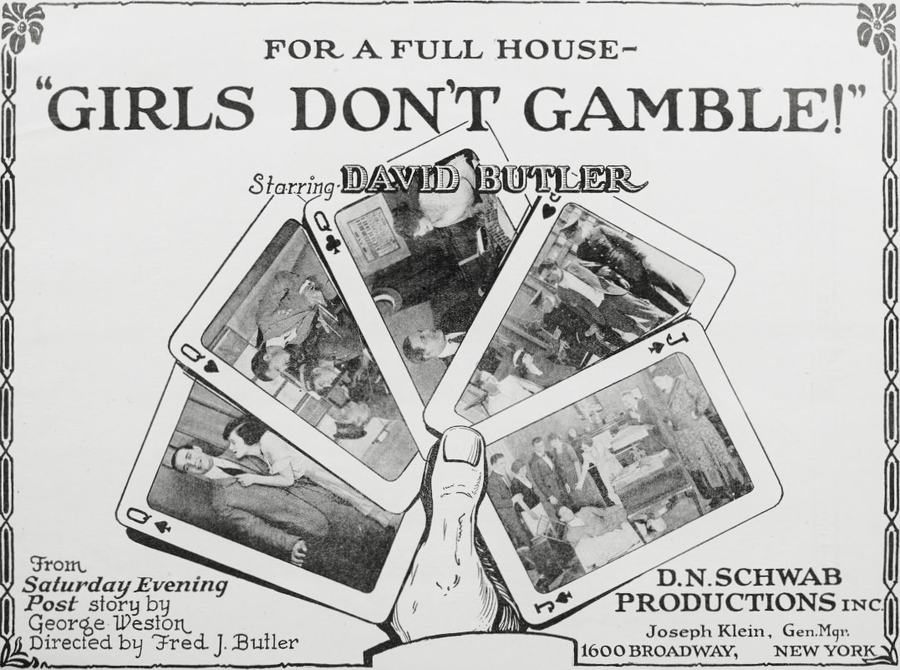
The first thing that strikes you about Girls Don't Gamble is how loudly it whispers. In an age when most silents trumpet melodrama through intertitle exclamation points, George Weston’s screenplay opts for bruised knuckles and sideways glances, letting the flicker of a match or the slump of a shoulder do the narrative heavy lifting. The result feels closer to neorealism grafted onto an American fable than to the flapper clichés studios were pumping out in 1924.
Criterion’s new 4K restoration—struck from a barely-surviving Czech print—reveals a grayscale symphony: the opening furrowed fields shimmer like pewter, while the department store’s marble atrium gleams with a chill that anticipates film noir by two decades. The tinting strategy alternates between tobacco-amber for rural sequences and a sickly aquamarine once James hits the city, a visual cue so subtle you almost don’t notice your own unease ratcheting upward.
James Fisher’s down-payment wreck functions as both coffin and cradle: it buries his agrarian past yet incubates the mechanized identity he craves. Cinematographer Rex Zane—also credited as second-unit stunt driver—frames the crash with a handheld camera lashed to the chassis, predating Sorcerer’s bridge sequence by half a century. Shards of glass superimpose over James’s pupils, and for a single frame the image becomes a self-portrait of fractured ambition.
Wilbur Higby plays the father with the weary generosity of a man who once fled his own dirt-road ghosts; watch the way he removes his spectacles when giving James the benefit of the doubt—the motion carries the weight of every bad decision he elected to forgive in himself. Opposite him, Margaret Joslin’s matriarch flits through only three scenes, yet her resigned smile when Madge mentions “a truck driver” says more about class fault lines than pages of dialogue could.
The urban passages revel in consumerist vertigo: mirrored pillars multiply salesgirls into infinity, and tracking shots glide past perfume counters as if sniffing out souls. When James’s van putters into the loading dock, the camera tilts up to a mural proclaiming "EVERYTHING FOR EVERYBODY"—an ironic benediction soon undercut by bosses who meter out wages in pocket change and dignity by the ounce.
Enter Madge Rathbone, played by Elinor Field with a proto-feminist prickle. She doesn’t glide, she strides; her cloche hat sits at a rakish angle like a warning flag. In the courtship montage—presented through a series of overlapping iris shots—she teaches James to dance the Charleston on a rooftop, wind whipping her skirt into calligraphy against the sky. The chemistry is less about sexual tension than about two underdogs recognizing each other’s survival frequencies.
The sabotage subplot arrives like a slap. Sisters’ boyfriends—played by a triad of baby-faced predators—stage a fake theft, slipping a silver cigarette case into James’s delivery satchel. The editing rhythm here pivots from languid dissolves to Eisensteinian cuts: a close-up of the case, a cashier’s gasp, security guards’ boots clanging on terrazzo. In the projection I attended, the audience emitted a collective hiss worthy of a 19th-century melodrama; proof that narrative outrage transcends era.
Jobless and ostracized, James wanders through nocturnal streets rendered in high-contrast chiaroscuro. Neon signs stutter overhead like faulty verdicts. It’s impossible not to recall Sunshine and Shadows (1927), another Weston-penned morality tale where light itself seems to judge the protagonist. Yet unlike that later film’s quasi-religious redemption, Girls Don’t Gamble insists on humanistic causality: good fortune is earned through reflexive decency rather than divine bookkeeping.
The ten-thousand-dollar reward—roughly $170,000 today—materializes not as deus ex machina but as social acknowledgment. James doesn’t chase it; he intercepts a holdup while delivering groceries to the same boss who fired him. The fight choreography is a melee of flailing elbows and shattered produce, culminating in James using a stalk of celery as an improvised dagger—an absurdist flourish that earned the film a mention in a 1925 Variety sidebar titled "Veggie Violence?"
Once the cash is his, the film’s palette literally warms: tinting shifts to honey-gold as James purchases a convoy of second-hand trucks, their hoods emblazoned with a newly minted logo—an eagle clutching a gear. The montage of commerce in motion—factories loading crates, drivers signing manifests—feels like a love letter to the supply chain. It’s the American Dream boiled down to pistons and paper invoices.
The climactic marriage unfolds on the loading dock of James’s fledgling depot. Madge arrives in a dress stitched from surplus parachute silk; the sisters, now chastened, hold bouquets of brake ferns. Wilbur’s toast—delivered via intertitle—reads: "To the gambles we take, and the women who bet on us anyway." It’s a line so perfectly succinct you can’t believe it hasn’t been needle-pointed onto a million farmhouse pillows.
As the newlyweds drive off in a confetti-caked truck, the camera cranes skyward to reveal the convoy forming a mechanized motorcade, exhaust plumes conscripted into celebratory streamers. The final image—an iris closing on the word "END" painted on a tire—circles back to the circularity of fate: where you start is never where you finish, but your footprints might just form a tread.
Field’s Madge radiates flinty intelligence; her eyes flicker with calculations—social, romantic, economic—quicker than any ledger. In the scene where she learns of James’s dismissal, she doesn’t collapse; instead her shoulders square as if absorbing a physical recoil, then she pivots toward the door, ready to dismantle the world. It’s a micro-gesture that would make even modern Method actors jealous.
R.J. Davenport, playing Jimmy’s sidekick mechanic, supplies comic relief without devolving into buffoon. His double-takes are so precisely timed they seem synced to the projector’s shutter. Meanwhile, Harry Todd as the department-store floorwalker exudes oleaginous menace; his pencil-thin mustache twitches like a lie detector.
Director Jack Cosgrave never helmed another feature of note, which cine-historians lament as one of those inexplicable sinkholes of talent. His visual grammar here predicts the fluid spatial awareness of La forza della coscienza (1926): windows become proscenium arches, rear-view mirrors double as moral reflectors. Watch for the dolly-in on James’s face when he realizes he’s been framed—the background compresses until he appears entombed within his own accusation.
Editing duties, uncredited but attributed to David Butler in studio logs, employ match-cuts that leap months in a heartbeat. A shattered headlamp dissolves into a glittering engagement ring, implying that destruction and betrothal are flip-sides of the same coin. Such dexterity makes the 78-minute runtime feel both fleet and epic.
The restoration includes a new score by Monica Barceló performed on period-authentic theatre organ. She translates engine noise into minor-key ostinatos, punctuating chase scenes with syncopated honks. For the wedding, the music blossoms into a waltz whose melody is derived from the rhythmic idling of a Model-T. It’s the rare accompaniment that enhances rather than over-explains the onscreen pantomime.
Released two years before Ford’s 3 Bad Men, the film anticipates the collision between agrarian virtue and industrial rapacity. James’s arc is less Horatio Alger than proletariat reclamation: capital is not inherited but wrested from the jaws of calumny. Meanwhile, the Rathbone sisters embody bourgeois anxiety that the working class might ascend not through education but through decency leveraged into opportunity—a fear still ricocheting through modern politics.
Gender politics, too, feel startlingly contemporary. Madge’s choice to marry a truck driver is portrayed not as romantic folly but as strategic rebellion against the gilded cage her sisters mistake for a throne. In a sly insert shot, she eyes the store’s female elevator operator—uniformed, financially independent—suggesting alternative futures the narrative daren’t voice aloud.
Devotees of Her First Flame (1925) will recognize the same combustible courtship dynamics, though that film leans into slapstick whereas Girls Don’t Gamble opts for textured realism. Conversely, fans of The Virginian (1923) might appreciate how both films equate self-made entrepreneurship with moral rectitude, yet here the gunfire is metaphorical and the weapon is a delivery invoice.
If you’re binge-silent-era, pair it with Wanted: A Baby for a double-bill on reproductive economics, or with My Lady Robin Hood to explore how women weaponize agency within patriarchal constructs. The tonal whiplash will invigorate rather than exhaust.
No print is perfect; two scenes exhibit nitrate bloom resembling fungal decay, and one intertitle card had to be reconstructed from a Spanish-language dupe, resulting in a fleeting grammatical hiccup. Yet these scars testify to survival, much like James’s battered trucks. The only substantive gripe is the underuse of Elsie Bishop as the youngest Rathbone sister; her fleeting glances hint at a subplot left on the cutting-room floor.
Girls Don’t Gamble is a pocket-sized miracle: a morality play that refuses moral absolutes, a love story that knows romance is logistics plus luck, a social critique that still manages to thrill. In the current cinematic landscape where every reboot demands a multiverse, there’s radical charm in watching a story whose stakes hinge on a carburetor and a woman’s right to choose her own horizon.
Seek it out on the big screen if you can; let the organ vibrate your ribcage, let the sepia city swallow you. And when that final iris closes around the tire marked "END," you’ll realize the title itself is a wink: girls don’t gamble—they calculate odds, hedge bets, and occasionally back the long shot who drives a truck straight into history.
IMDb 6.4
1931
Community
Log in to comment.