DbcultAccessing Vault...
Cult Review
Senior Film Conservator
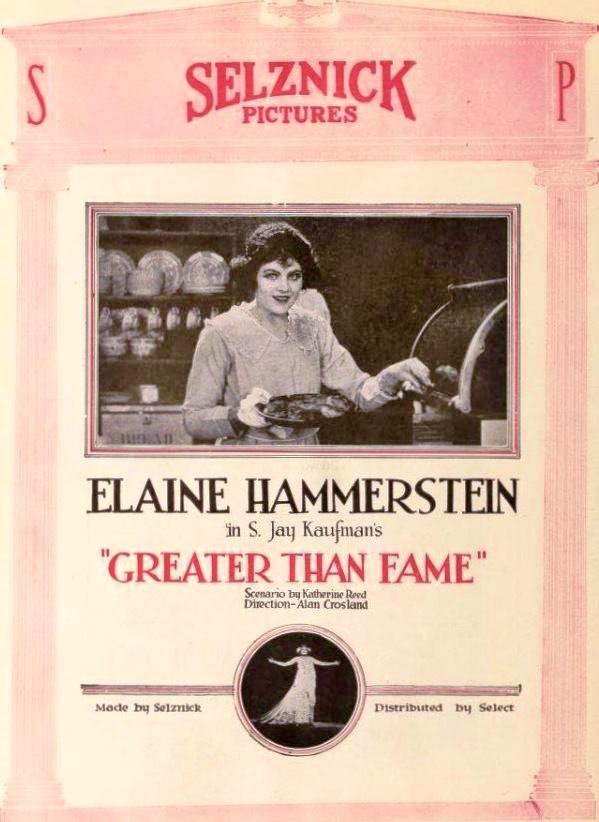
In the pantheon of early 20th-century cinema, few narratives capture the precarious trajectory of the female artist with as much raw, albeit melodramatic, sincerity as Greater Than Fame (1920). Directed with a keen eye for social stratification, this film serves as a poignant time capsule of an era where the boundary between patronage and predation was perilously thin. Starring the luminous Elaine Hammerstein, the film navigates the treacherous waters of the New York music scene, offering a scathing critique of the 'casting couch' long before the term became a staple of industry lexicon. Unlike the more whimsical explorations of fame found in later decades, this work operates with a gravity that borders on the operatic, mirroring the very art form its protagonist seeks to master.
The story commences with Margaret Brooke, a character who could easily have descended into the cliché of the 'damsel in distress' had it not been for Hammerstein’s nuanced portrayal. Margaret’s journey from the periphery to the center of cultural power is not merely a professional ascent but a moral gauntlet. When she meets Jack Martin (played with a simmering, often misdirected intensity by Walter McGrail), the film establishes its romantic core. However, the romance is quickly overshadowed by the entry of the Warings. The dynamic here is reminiscent of the social critiques found in The Law of Men, where the professional ambitions of women are constantly sabotaged by the libidinous whims of men in positions of power.
"The film’s central conflict is not the struggle for talent to be recognized, but the struggle for virtue to survive the recognition. It asks whether the price of the spotlight is the soul itself."
One of the most compelling sequences involves the 'apartment ruse' orchestrated by Philip Waring (William H. Tooker). The set design here is crucial; the apartment is portrayed not as a home, but as a gilded cage—a space where Margaret’s autonomy is subtly eroded by the weight of unearned luxury. This narrative beat echoes the themes of domestic entrapment explored in East Lynne, though updated for the urban industrial age. Waring’s advances are not merely personal transgressions; they represent a systemic failure of the elite to view art as anything other than a commodity to be possessed.
The cinematography, though constrained by the technical limitations of 1920, utilizes light and shadow to articulate Margaret’s growing isolation. As she realizes the true nature of Waring's 'generosity,' the frames tighten, creating a sense of claustrophobia that mirrors her psychological state. This tension is further amplified when she seeks help from the music impresario. In a devastating turn of events, the very individual who should be the gatekeeper of her talent becomes another predator. This double betrayal elevates Greater Than Fame above standard melodrama, pushing it into the realm of social tragedy. It shares a certain thematic DNA with Her Atonement, where the female protagonist must navigate a world designed to punish her for her own victimization.
Jack Martin’s role in the film is perhaps the most frustrating for a modern audience, yet it is essential for understanding the period's gender dynamics. His initial refusal to believe Margaret’s account of the Waring affair highlights a pervasive lack of solidarity. Jack’s jealousy is a manifestation of a fragile masculinity that views Margaret’s proximity to power as a stain on her character rather than a threat to her safety. This element of the plot feels remarkably contemporary, reflecting the 'victim-blaming' tropes that persist in modern discourse. We see echoes of this complex interpersonal conflict in For $5,000 a Year, where financial and social pressures distort personal relationships.
However, the film’s resolution offers a fascinating synthesis of art and life. Jack’s eventual realization of Margaret’s innocence leads not just to a reconciliation, but to the creation of an opera. This 'art-within-art' structure allows the film to comment on its own artifice. The opera becomes a transformative space where their shared trauma is transmuted into aesthetic beauty. When Margaret finally achieves success on the operatic stage, it is not just a victory of voice, but a victory of narrative agency. They are no longer pawns in the games of the Warings; they are the architects of their own legend.
To fully appreciate the scope of Greater Than Fame, one must look at how it contrasts with other films of the era. While Flame of the Desert utilized exoticism to distract from its emotional core, Greater Than Fame remains stubbornly rooted in the cold, hard reality of the city. It lacks the escapist allure of Maharadjahens yndlingshustru I, choosing instead to find beauty in the grit of the rehearsal hall and the hushed conversations of the backstage wings.
Furthermore, the film’s treatment of the 'fallen woman' trope is surprisingly progressive. In many contemporary films like The Girl from Beyond, a woman’s brush with scandal would lead to inevitable ruin. Here, Margaret is allowed to reclaim her status. Her 'fame' is greater because it was forged in the fires of adversity and maintained through an refusal to succumb to the industry's darker impulses. The cast, particularly Johnnie Walker and Julia Swayne Gordon, provide a solid foundation of supporting performances that flesh out this world, making the stakes feel tangible and the society feel lived-in.
Elaine Hammerstein’s performance remains the film’s heartbeat. She possesses an ethereal quality that makes her believable as a rising star, but also a groundedness that makes her suffering palpable. In an era where acting was often characterized by broad, theatrical gestures, Hammerstein employs a more restrained palette. Her eyes convey the shift from hopeful naivety to weary wisdom with remarkable clarity. This performance alone makes the film essential viewing for students of silent cinema. It stands in stark contrast to the more overtly masculine-driven narratives like The Wolf Man or the comedic lightness of Piccadilly Jim.
The screenplay by S. Jay Kaufman and Katherine S. Reed is meticulously paced, ensuring that the transition from the domestic drama of the first half to the operatic triumph of the second feels earned. While the ending—a marriage announcement as the curtain falls—might feel like a concession to the expectations of 1920s audiences, it serves a deeper thematic purpose. It signifies the restoration of order and the validation of the romantic ideal over the cynical exploitation of the patron class. It is a 'happily ever after' that has been bled for, making it more resonant than the easy resolutions of films like Bonnie May or Home Wanted.
Greater Than Fame is a staggering achievement in silent melodrama that transcends its genre conventions. It is a fierce indictment of the power structures that govern the arts and a celebration of the resilience of the human spirit. While it shares the DNA of its contemporaries like The Squaw Man or Mutter Erde in its exploration of social boundaries, it carves out a unique space for itself through its specific focus on the intersection of gender, art, and commerce. It is a film that demands to be seen, not just as a historical curiosity, but as a vital piece of cinematic storytelling that still speaks volumes today.
Reflecting on the broader landscape of 1920, one can see how this film paved the way for more complex character studies. Even when compared to the procedural intensity of The Dare-Devil Detective or the aristocratic ponderings of Baronat, Hammerstein's vehicle remains a high-water mark for emotional authenticity. It reminds us that while fame is fleeting, the integrity of the artist is indeed greater.
IMDb 5.2
1933
Community
Log in to comment.