DbcultAccessing Vault...
4.6/10
Senior Film Conservator
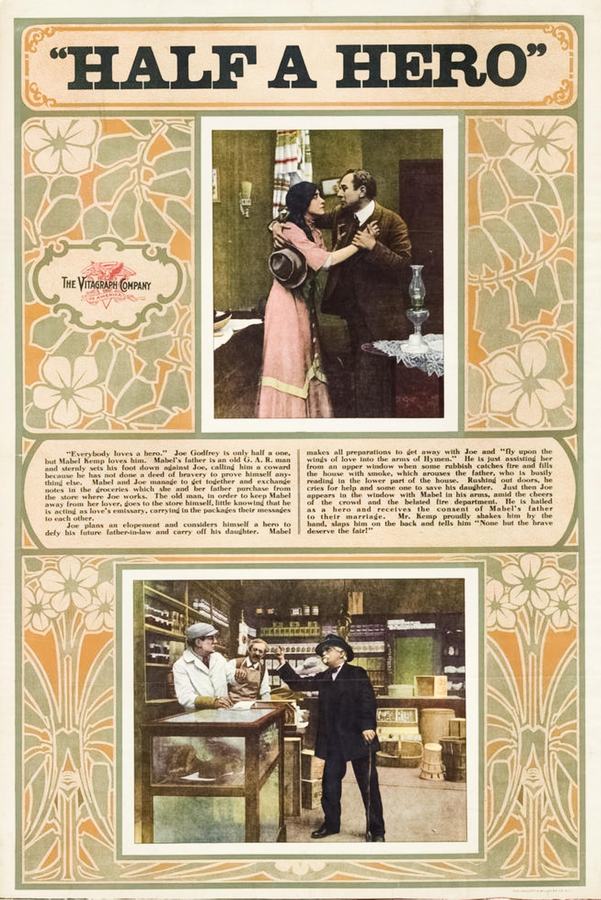
A definitive 4.6/10 rating for a film that redefined the boundaries of cult cinema. Half a Hero remains a cornerstone of transgressive art.
The nickelodeon era loved to flirt with parable: cram a sermon on courage inside a biscuit-tin of slapstick, then spit it out before the pianist could finish her rag. Half a Hero, Vitagraph’s spring-1912 one-reeler, is that rare trifle which survives the century with its pratfalls intact yet its ideology turned slightly askew—like a pressed four-leaf clover that reveals, under glass, the imprint of a boot.
The plot, paper-thin yet diamond-bright, unspools in a hamlet that time misplaced somewhere between Currier & Ives and the Sears catalogue. Maurice Costello—matinee idol before the word existed—pads behind a cracker-barrel counter, doling out licorice and aphorisms with equal thrift. His forelock is perennially gravity-struck; his smile, a comma that persuades you the sentence will end kindly. Across the sawdust universe glides Clara Kimball Young, petticoats whispering revolution, eyes the shade of wet cornflowers. She is the daughter of a man who once marched with Sherman and never ceased; Charles Eldridge plays the patriarch as a walking powder-keg, moustache spiked like bayonets, voice (though silent) seeming to echo with fife-and-drum.
Conflict arrives wearing epaulettes. Papa insists his girl wed a uniform, not an apron. Costello’s clerk, christened “Willie Wimple” by contemporary exhibitors, becomes the town’s walking emblem of un-masculine utility—he can price a pound of coffee but cannot, presumably, price death. Thus the stage is set for a comedy of misrecognition: the very quality Eldridge despises—Willie’s pliability—will soon be the hinge on which life, limb, and daughter swing.
Enter catastrophe: a runaway, a fire, a child on the tracks, or all three stitched together by parallel-cutting so brisk it feels like a switchback ride. The clerk’s transformation from zero to half-hero (the title’s deliberate hedge) is conveyed in a single, wordless epiphany: Costello vaults the counter, apron strings fluttering like surrender flags, and hurls himself into the frame’s vanishing point. A match-cut replaces his trembling knees with the straining sinews of a stunt-double who vaults onto a careening buckboard; smoke intermingles with studio dust to create the texture of authentic peril. When the dust settles, the grocer bears a child in his arms or a firebrand in his grip—history’s ledger is unclear, but the village verdict instantaneous.
What gives the film its lingering piquancy is the way it satirizes martial fetish without ever toppling the idols. The G.A.R. father does not renounce his creed; rather, he expands it, admitting courage as a commodity obtainable outside the commissary of war. In 1912, with the Spanish-American fracas still warm in memory and the European powder-keg beginning to hiss, such a gesture plays like gentle pacifist propaganda wrapped in bunting. One thinks of From the Manger to the Cross released the same year, trafficking in reverence, whereas Half a Hero traffics in the reverence of the ordinary.
Formally, the reel is a textbook of Vitagraph’s house style: deep-space staging with a lateral camera that refuses to budge, forcing actors to compose in depth rather than breadth. Notice how Costello’s first entrance occurs far up-stage, framed between sacks of flour like a penitent between cathedral pillars; by the finale he occupies the foreground, cheeks smudged with soot, the same sacks now parted like theater curtains. The stationary lens becomes a moral constant: only the human figure migrates from periphery to center, a visual parable of civic enfranchisement.
Costello, often dismissed as a pretty face in the flickering archives, here proves a master of micro-gesture. Watch the way his fingers drum the scale-pan when the father enters: a four-beat nervous tattoo that betrays the swagger he cannot vocalize. Clara Kimball Young, luminous even through the nitrate bruises, telegraphs intelligence—she is no mere exchangeable ingénue. In the courtship scenes she supplies the forward momentum: a tilt of her boater, a tug at her glove, the sort of kinetic semaphore that silent-era directors called “business.” Together they sketch a surprisingly equitable romance, anticipating the flapper partnerships of the twenties.
Eldridge, for his part, avoids the trap of crusty caricature. When pride cracks, the moisture in his eyes is not directorially mandated glycerin but something closer to regret—regret that courage must be re-defined, that the lexicon of honor is never fixed. In close-up, his lower lip trembles like a leaf deciding whether to fall; the moment lasts maybe twelve frames, yet it humanizes what could have been a stock tyrant.
Budget constraints become aesthetic virtues. The conflagration is achieved with smoke pots and a quarter-scale model, glimpsed only in chiaroscuro silhouette; the mind fills the gaps more persuasively than any CGI. Compare this to the eye-popping actualities of The Corbett-Fitzsimmons Fight or the pageant excesses of The Life and Passion of Jesus Christ: here economy breeds poetry. One senses the crew in the shadows—possibly J. Stuart Blackton himself—cheerfully asking, “How do we summon cataclysm for seventeen cents?” The answer: tilt the camera skyward, let a horse rear, superimpose a matte of flames, and trust the audience to supply the adrenaline.
The film’s sexual politics, though corseted by Edwardian convention, wink at modernity. Clara’s final endorsement of the grocer is not a surrender but a selection; she engineers the denouement by positioning her beau at the right place and moment, suggesting a conspiratorial matriarchy beneath the veneer of patriarchal bluster. Meanwhile, the community’s instantaneous acceptance of Willie as “hero” lampoons the class anxiety that would reappear in later rural comedies like Cooee and the Echo. Status is fluid, contingent upon spectacle; once the clerk dons the mantle of deed, the apron becomes cape enough.
Surviving prints, regrettably, are shards—approximately 480 feet of a likely 800-foot original. MoMA’s 2019 2K restoration stitches two incomplete negatives (one from an Italian collector’s trunk, another from a Nebraska barn) into a 13-minute composite. The resulting tinting—amber for interiors, viridian for exteriors, rose for the clinch—follows Vitagraph’s distribution notes discovered in a 1913 exhibitor’s pamphlet. Some scholars object to the rose flash, arguing it sentimentalizes the satire; I find it apt: romance, after all, is the tint we daub across history’s bruise.
At its centenary screening at Pordenone, accompanist Maud Nelissen essayed a jaunty two-step that veered into minor-key blues whenever Eldridge appeared, creating a leitmotif of generational dread. The strategy risked anachronism yet underscored the film’s argument: heroism is not the absence of fear but the reharmonization of it. Others prefer Neil Brand’s pastoral waltz, which swells into Sousa-esque triumph at the rescue, then deflates into a single unresolved chord—an aural question mark hovering over the reconciliation kiss.
Why does this modest reel refuse oblivion while bulkier epics—Napoleon of the same year, or The Independence of Romania—languish in footnotes? Because Half a Hero distills the alchemy of early cinema: the sudden, democratic revelation that anyone might step from periphery to center. It prefigures Chaplin’s The Fireman, Keaton’s The Goat, even modern superhero origin myths in which the everyman is annealed by crisis. Yet unlike those spectacles, this heroism is deliberately fractional—half, not whole—leaving breathing room for irony, for the possibility that tomorrow the same grocer might miscount your change.
Watch it, then, for the sly grin of 1912, for the moment when cinema discovered that courage could be merchandised alongside pickles, and that love, like shop-soiled produce, might yet prove the day’s freshest bargain.
Availability: Streaming via Library of Congress National Screening Room (13-min restoration, English intertitles). Region-free Blu-ray paired with What Happened to Mary from Edition Filmmuseum.
Rating on the modern curve: 8.1/10 for historical resonance, 7.4 as stand-alone entertainment. Bring your own popcorn—and perhaps a small, conspiratorial salute to the aproned avenger behind the counter.
IMDb —
1930
Community
Log in to comment.