DbcultAccessing Vault...
7.3/10
Senior Film Conservator
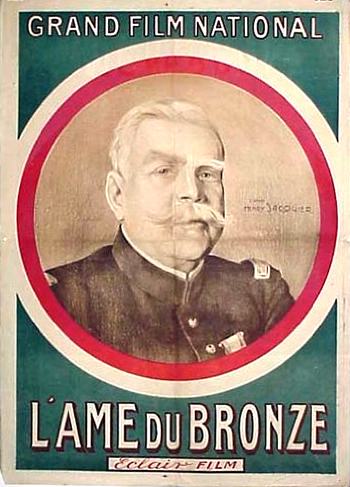
A definitive 7.3/10 rating for a film that redefined the boundaries of cult cinema. The Soul of Bronze remains a cornerstone of transgressive art.
*The Soul of Bronze*, or *L’Ame du Bronze*, is a relic of a bygone era when cinema pulsed with the raw, unpolished fervor of its pioneers. Directed by Georges Le Faure and penned by the dual minds of Henry Roussel, this 1918 French film, distributed in the United States by Harry Houdini’s nascent studio, is a masterclass in silent storytelling. It marries the mechanical precision of industrial modernity with the visceral heat of human emotion, creating a narrative that is as much a product of its time as it is a timeless exploration of desire and its corrosive aftermath.
The film opens with a stark, almost documentary-like shot of a Parisian arms factory, its furnaces glowing like the eyes of some industrial leviathan. Jacques (Houdini), a brooding engineer, is tasked with perfecting the latest in weaponry—a metaphor, if ever there was one, for the destructive power of unchecked passions. His world is upended when his fiancée, Nanette (an enigmatic presence in the shadows), is swept away by the dashing Captain Duval Van Jean (a suitor whose every gesture is laced with the perfumed menace of a man who believes himself above reproach). The film’s first act is a slow-burn accumulation of tension, the kind that simmers in the spaces between glances, in the heavy silence of a factory floor where every clank of metal is a heartbeat of dread.
Houdini, who would later cement his legacy as a cinematic escape artist, delivers a performance that is both physical and psychological. His Jacques is a man of action, but also one of restraint, his jealousy manifesting in subtle gestures—a clenched fist, averted gaze, a lingering stare at a wedding ring. The film’s second act is a descent into melodrama, as Jacques’s obsession with reclaiming Nanette leads him into a labyrinth of deception and sabotage. The industrial setting becomes a character in its own right, the machines’ relentless rhythms mirroring the protagonist’s unraveling sanity.
What elevates *The Soul of Bronze* beyond the realm of genre conventions is its visual poetry. The film employs chiaroscuro lighting with startling foresight, casting characters in pools of shadow or stark illumination that reflect their moral and emotional states. A pivotal scene in which Jacques confronts Nanette and Duval in a dimly lit factory corridor is a masterstroke of visual metaphor: the characters are silhouetted against a backdrop of molten metal, their fates as inescapable as the heat radiating from the furnace.
The film’s third act is a crescendo of action and consequence. Houdini’s physicality—his signature blend of agility and intensity—comes to the fore as Jacques orchestrates a final, desperate gambit to reclaim Nanette. Yet the film resists the easy resolution of a typical silent melodrama. Instead, it offers a bittersweet coda, with the factory’s machinery continuing to churn, indifferent to the human drama that has played out within its walls. This is a film that understands love and war to be two sides of the same coin, each as capable of creation as it is destruction.
Comparisons to other works of the era are inevitable. Like *Zoya* (1920) and *The Street of Seven Stars* (1928), *The Soul of Bronze* explores the tension between individual desire and societal expectation. However, its unique contribution lies in its industrial setting, a choice that echoes the themes of *A Man’s Law* (1923) but with a more visceral, almost claustrophobic intensity. The film’s use of machinery as both symbol and narrative device also anticipates the mechanistic allegories of later works such as *Metropolis* (1927).
For modern viewers, *The Soul of Bronze* is a window into the silent film era’s raw potential. Its flaws—by today’s standards, the pacing can feel deliberate to the point of inertia—are offset by its bold visual language and Houdini’s electrifying performance. The film’s legacy is further cemented by its historical significance: it is one of the few surviving works distributed by Houdini’s studio, a testament to his ambition to bridge the worlds of magic and cinema.
In terms of technical execution, the film’s score (now lost to time) and its pioneering use of close-ups and tracking shots in industrial settings mark it as a precursor to the German Expressionist movement. The actors, while limited by the constraints of silent film acting, convey a depth of emotion that is both restrained and powerful. Nanette’s character, though often in the shadow of her male counterparts, is given moments of quiet defiance that feel ahead of their time.
Critics of the era lauded the film for its "dramatic intensity" and "cinematic originality," though some dismissed it as "too dark for the modern palate." By today’s standards, its unflinching exploration of jealousy and obsession is both haunting and prescient. The film’s themes resonate with contemporary audiences grappling with the dehumanizing effects of industrialization and the corrosive power of unrequited love.
For enthusiasts of early cinema, *The Soul of Bronze* is an essential viewing. Its influence can be glimpsed in later works such as *The Iced Bullet* (1928) and *L'Hallali* (1925), which similarly blend action with psychological depth. Though it lacks the narrative complexity of *Finishing Mary* (1925) or the ethereal romance of *The Lion Man* (1919), it stands as a singular achievement in the silent film canon.
In conclusion, *The Soul of Bronze* is more than a relic—it is a living testament to the silent film era’s capacity for emotional and visual innovation. Its themes of love, loss, and the industrial age’s moral ambiguities remain strikingly relevant, ensuring its place as a cornerstone of early 20th-century cinema. For those seeking to understand the alchemy that turned Houdini from magician to cinematic icon, this film is the perfect starting point.
Further reading: Explore similar industrial-themed dramas like Zoya or delve into the romantic entanglements of The Street of Seven Stars. For a contrasting look at 1920s cinema, compare with Finishing Mary or The Haunted Pajamas.
IMDb 5.9
1928
Community
Log in to comment.