DbcultAccessing Vault...
Cult Review
Senior Film Conservator
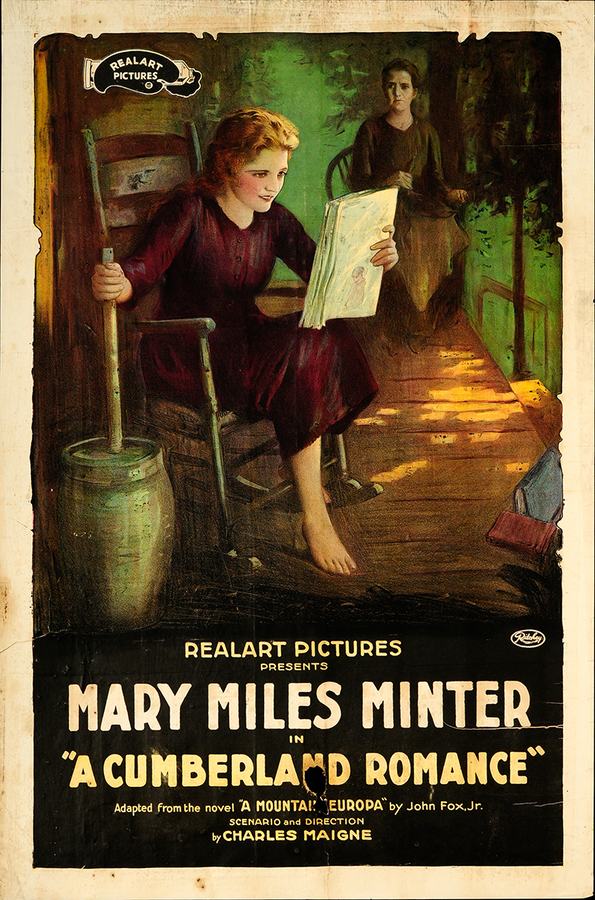
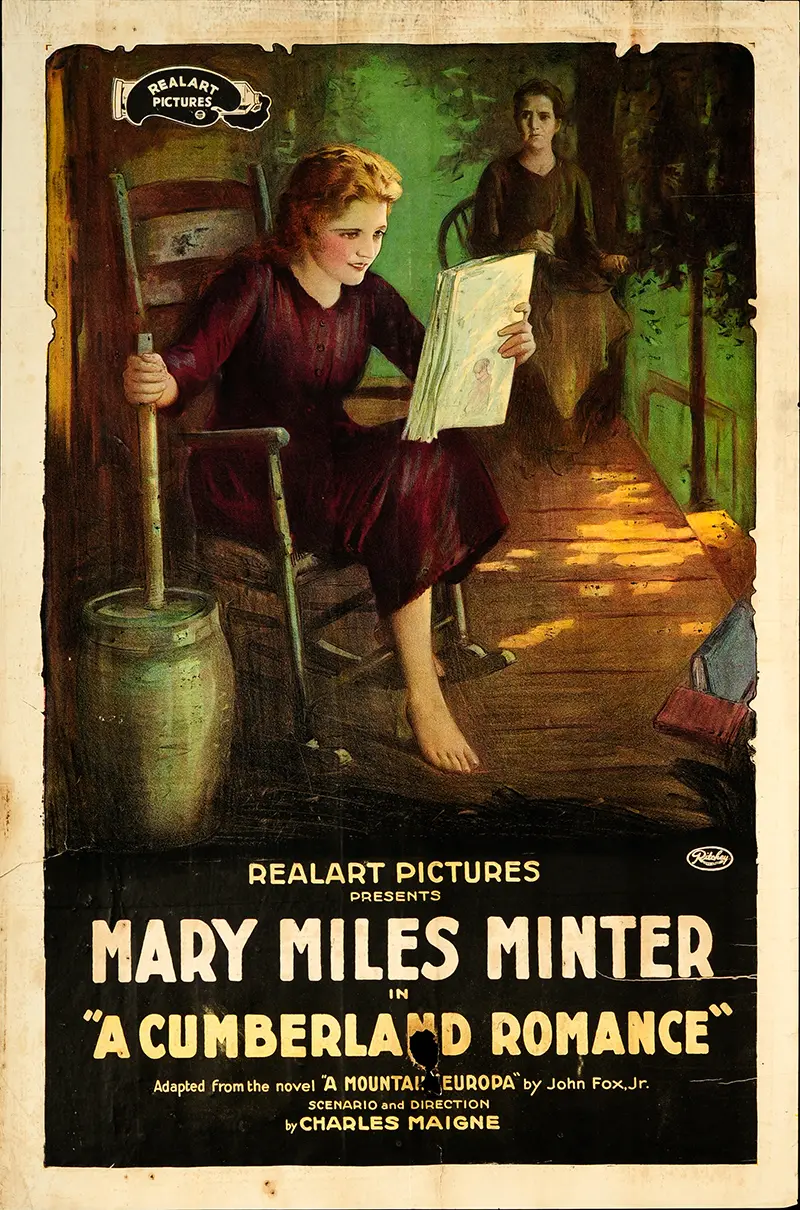
Picture a nitrate reel smuggled out of time’s crumbling valise: A Cumberland Romance radiates like ember-light on a cabin wall, its intertitles flickering between King-James cadence and back-porch drawl. Director Charles Maigne, translating John Fox Jr.’s brisk novella, refuses to let the Appalachians become mere postcard scenery; instead he lets the mountains breathe—sometimes in close-up where gnarled rhododendron claws the sky, sometimes in misty long shots that swallow figures whole. The resulting tone is a humid amalgam of cautionary folktale and fever dream, closer in spirit to the lurid moralism of The Scarlet Trail than to the cosmopolitan cynicism of Kick In.
Mary Miles Minter’s Easter is no cardboard mountain maid; her pupils dilate with the predatory curiosity of a barn-owl when she first spies Monte Blue’s Clayton. Watch how she cradles a Mason jar of lightning bugs—not as prop but as portable galaxy—before the insects escape in a phosphorescent swirl that rhymes with her own impending flight from family orbit. Martha Mattox, as the granite-jawed Pap, could have sauntered straight out of a daguerreotype; she communicates patriarchal menace through the simple act of rocking a chair too slowly, as though time itself must ask permission before moving forward.
Monte Blue’s civil engineer arrives armed with a pocket transit and a city suit that looks increasingly like a straitjacket the higher he climbs into this oxygen-thin terrain. Blue’s physical eloquence—those shoulders that never quite square to the horizon—signals a man measuring not just land but the vertigo of trespass. His courtship of Easter unfolds in iris-shot vignettes: a broken fence rail becomes a lovers’ bench, a coal-oil lamp becomes a comet. Yet every shared glance is stalked by the knowledge that mountain justice is communal, swift, and allergic to due process.
Enter Sherd Raines, incarnated by John Bowers with a smolder that predates Brando by three decades. Sherd’s internal civil war—between the decency that begs Pap for mercy and the jealousy that drives him to cast a bullet—gives the film its tragic torque. In the foundry of his shack, orange-yellow slag glows against soot while he mutters a love-hate canticle; Maigne cross-cuts to Easter on a moonlit swing, her white dress ballooning like a surrender flag that nobody heeds. The sequence is silent in the acoustic sense yet thunderous in its visual rhetoric, anticipating the expressionist crucible of Serdtse Dyavola released the same year.
The preacher’s eleventh-hour intervention, rather than offering cheap redemption, complicates the moral ledger. Played by Robert Brower with the wild-eyed conviction of a man who has seen his own grave, the circuit rider steps out of darkness as though conjured by Sherd’s guilty psyche. When the bullet mold overturns, lead hisses against damp earth in a miniature Vesuvius of self-doubt; the camera lingers on the bubbling metal as it cools into a shapeless lump—an accidental monument to aborted vengeance. It is one of those miraculous silent-era accidents where medium and metaphor fuse: the hot metal is both literal menace and molten conscience, frozen mid-transgression.
Visually, Maigne and cinematographer Frank B. Good rely on chiaroscuro that would make later noir cinematographers blush. Interior scenes are painted with kerosene lamplight that pools like liquid amber, carving cheekbones out of shadow. Exterior night shots were clearly day-for-night treated, yet the blue-silver tinting on surviving prints lends the foliage a mercury sheen, turning Cumberland forests into a ghostly amphitheater. Contrast this with the sun-bleached meadows where children chase pigs: here the orthochromatic stock renders pigskin and human skin as the same luminous gray, suggesting a world where species and sin intermingle.
Rhythmically, the film pirouettes between languor and panic. One reel luxuriates in the foot-shuffle of a square dance where bow-ties flap like signal flags; the next hurtles toward a cliffside confrontation where every pebble dislodged feels like a coffin nail. Maigne’s editorial calculus predates the Soviet montage theorists yet achieves their kinetic jolt: a shot of Sherd’s clenched fist slamming a table rhymes with Pap’s heel crushing a gourd, the visual rhyme implying genealogy of violence.
Intertitles, often the bane of modern silent-film viewers, here achieve a kind of backwoods poetry. “The hills hold their breath when a daughter dreams too loud,” reads one card, superimposed over a slow fade of Easter at her window. Another card, flashed seconds before the bullet spills, warns: “Satan counts seconds by heartbeats.” Such prose skirts purple excess precisely because it is spoken by a culture that still believes language can conjure or curse.
Comparative contextualization illuminates what A Cumberland Romance refuses to do. Unlike Allan Quatermain, it does not exoticize terrain into mere adventure playground; unlike Freckles, it declines to sentimentalize nature into moral tutor. Its closest cousin might be The Secret Orchard, another 1920 release probing the bruises left by desire, yet Cumberland eschews orchard metaphors for something more feral: love as a half-tamed mountain cat that might purr or might claw your throat out on a whim.
Performances are calibrated to a register that predates Method naturalism; actors externalize emotion through gestural semaphore. When Easter learns of Sherd’s lethal intent, Minter’s hand flutters to her throat not once but thrice—each time with diminishing force, as if life itself were leaking through her fingertips. Bowers, told via intertitle that “a man’s soul can sweat,” literally mops his neck with a bandana until the fabric drips, turning abstract guilt into visible fluid. Such stylization risks caricature, yet the cumulative effect is operatic rather than hokey.
The score, at least in the 2016 Library of Congress restoration, mingles dulcimer, banjo, and string quartet. During the bullet-casting scene, composer Martin Marks uses a low drone that gradually adds minor seconds, mirroring the temperature rise of molten lead; when the metal spills, the drone collapses into silence followed by a solitary plucked banjo—mountain heartbeat resuming after moral cardiac arrest. The audio marriage is so seamless one can almost smell pine resin and hot iron.
From a socio-historical lens, the film arrives at the hinge between Victorian moral allegory and Jazz-Age disillusionment. Released six months after Prohibition became law, its moonshine stills and clandestine jugs wink at imminent cataclysm; the preacher’s sermon against “the devil’s drink” lands as double-edged propaganda. Meanwhile, Easter’s desire to follow Clayton city-ward anticipates the rural-to-urban exodus that would reshape Kentucky demographics within a decade.
Yet the film is no sociology tract. Its abiding power lies in the intimacy of transgression: the way Sherd’s fingers tremble as he carves the bullet mold; the way Easter’s pupils contract when she hears a twig snap behind the cabin; the way Pap’s rocking chair ceases its creak at the exact moment fate pivots. These micro-epiphanies accumulate into a moral avalanche whose final image—three figures silhouetted against a ridge-line at dawn—offers no resolution beyond the uneasy truce of another day lived.
Cinephiles who revere Atlantis for its apocalyptic grandeur or Lisa Fleuron for its art-deco sheen will discover in A Cumberland Romance a quieter cataclysm: the moment when the human heart admits it cannot outrun its own echo. Available for streaming in 4K restoration on several boutique platforms, the film demands to be watched at dusk, preferably with window cracked so that night air can insinuate itself—reminding you that the Cumberland Mountains are not relics but living sinew, still flexing whenever desire dares to speak its mountain name.

IMDb 5.6
1930
Community
Log in to comment.