DbcultAccessing Vault...
7/10
Senior Film Conservator
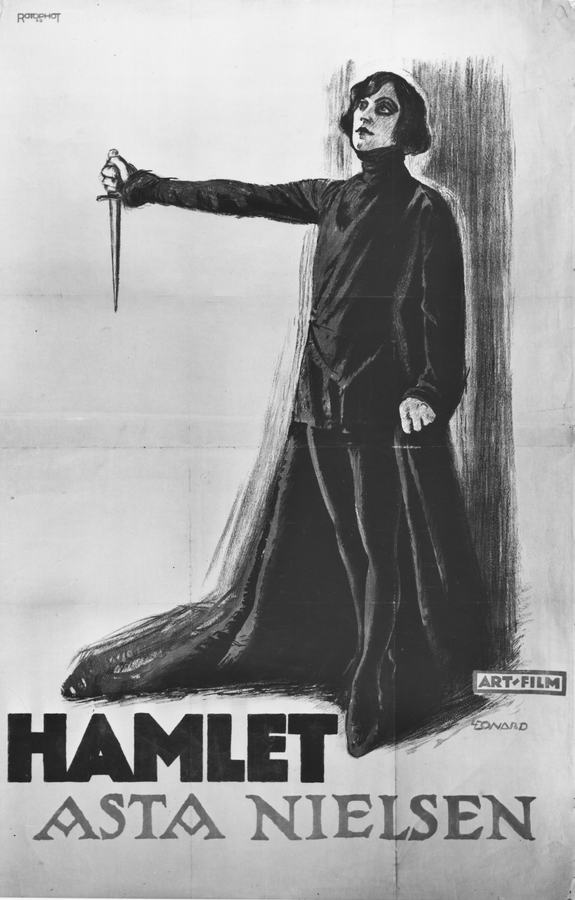
A definitive 7/10 rating for a film that redefined the boundaries of cult cinema. Hamlet remains a cornerstone of transgressive art.
Asta Nielsen’s Hamlet is not a footnote to Shakespeare; it is a palimpsest scraped clean and re-inked with the ink still wet, smelling of smoke, sweat, and subversive desire. Filmed in 1921 when Expressionism stalked German studios like a narcoleptic wolf, this Danish production sidesteps Caligari’s angular dreams for something colder: a castle of slate-grey walls where every footstep lands like a verdict. Nielsen, already a sphinx-like superstar, bankrolled the project herself, wresting the text from the bard’s centuries-old grasp and twisting it until the bones cracked. The result is a silent fever dream that mutters questions about gender, power, and performance that contemporary cinema is only now catching up to.
The boldest stroke is also the simplest: Hamlet is born a girl. The court hails a male heir; the queen, fearing dynastic collapse, swaddles her daughter in lies and britches. From this deception unfurls a tragedy less about succession than about suffocation—every breath the protagonist draws is filtered through brocade and pretense. Nielsen’s physical vocabulary is exquisite: shoulders pinned back in an eternal shrug of apology, gait a seesaw between courtly swagger and the subtle sway her corset cannot suppress. In close-up, the pupils dilate like spilt ink, betraying the panic of a woman who has learned to sign her name in a hand not her own.
Silent cinema, often caricatured as melodramatic semaphore, here achieves an erotic hush. When Hamlet, still in masculine garb, presses a hesitant kiss upon Horatio’s cheek, the frame lingers until the emulsion seems to tremble. No intertitle intrudes; the moment hangs, suspended between confession and capitulation, a glancing blow that bruises both characters. Nielsen understands that restraint can be more lacerating than bombast, and the film hoards its revelations like a miser counting coins by candlelight.
Gertrude—usually a footnote in the prince’s torment—steps forward here as co-architect of regicide. Clad in furs that glisten like wet seal, she plots with Claudius not from passion but from fiscal prudence: the first king was faltering, the second promises liquidity. This pragmatic cruelty frees the narrative from Oedipal fog and reframes maternal love as a ledger balancing blood against solvency. In one chilling iris-shot, Gertrude watches Hamlet through a keyhole, her eye a glossy coin that seems to purchase the child’s fate.
The absence of the ghost is therefore no omission but a surgical excision. Hamlet’s haunting is internalized; the voice that seeps from the tomb might be conscience, might be indigestion, might be the echo of every lie the princess has ever swallowed. By refusing to externalize the supernatural, the film insists that history’s rot emanates not from graveyards but from genealogies, from the very act of naming an heir. When Hamlet finally immolates Claudius, the blaze is less revenge than sterilization—an attempt to cauterize a bloodline diseased by deception.
Horatio, played with lambent tenderness by Anton de Verdier, becomes the axis upon which the protagonist’s world tilts. Their camaraderie—equal parts scholarly banter and furtive caress—renders every subsequent betrayal sharper. Ophelia, meanwhile, is no fragile violet but a determined rival who senses the rift between the boys and clambers into it with teeth bared. Lilly Jacobson portrays her as a hummingbird in human form, all restless motion and iridescent spite. The infamous nunnery scene converts into a triangular duel: Ophelia brandishes piety like a dagger, Hamlet counters with caustic aphorisms, and Horatio stands trapped, love for both shimmering like heat-haze above asphalt.

Water imagery recurs—Ophelia’s hair swirling in a basin, Hamlet’s reflection fracturing in a shield—to foreshadow her eventual drowning, here staged not as pastoral lament but as claustrophobic plunge inside the castle’s cistern. The camera peers over the stone lip, registering the splash as a muted gulp, an acoustic blackout that feels more violent than any stab wound.
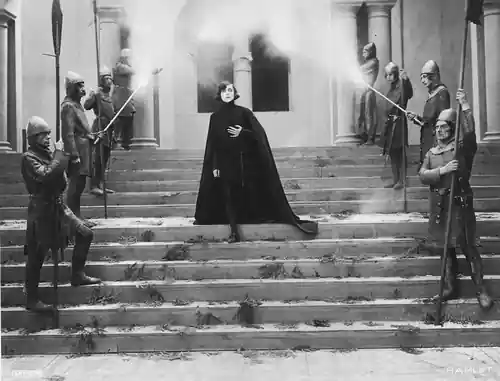
Guido Seeber’s photography eschews the grotesque angles of contemporaneous Expressionism for a chiaroscuro that carves space like a barrister’s argument. Corridors elongate into vanishing points where torchlight pools like spilt evidence. Shadows are not merely absence but testimony: they whisper that every monarchy rests upon occlusions, upon bodies bricked behind walls. When Fortinbras’s army finally marches through these halls, the camera retreats upward to a vertiginous balcony, transforming live soldiers into toy figurines—an ironic visualization of the strategic myopia that believes one can seize power without also inheriting its nightmares.
The film’s tinting strategy deserves a monograph of its own. Night scenes bathe in aquamarine, suggesting submersion; moments of erotic tension flare saffron, as though the celluloid itself blushes. Most daring is the crimson wash that floods the screen during Claudius’s immolation: the dye appears hand-painted, streaky, imperfect—an act of vandalism against the pristine monochrome, mirroring Hamlet’s own violent rupture of courtly decorum.
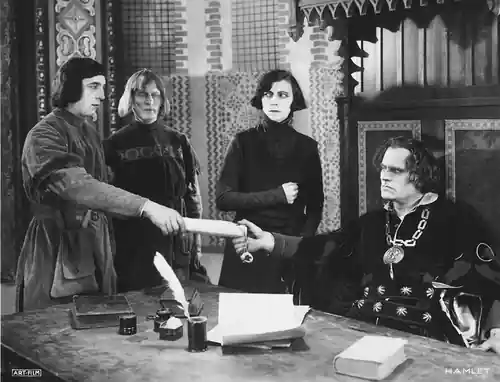
Where Shakespeare distills the finale into poisoned foil and venomous cup, Nielsen’s film stages a choreographed bloodletting that feels half ballet, half abattoir. The duel unfolds on a checkered floor like a living chessboard; each thrust and parry accompanied by orchestral fragments (in the restored print) that splice courtly minuets with atonal stingers. Gertrude presides with the satisfied smile of a hostess whose soirée proceeds on schedule even as the soufflé collapses. When she lifts the goblet—its ruby contents glinting like a traffic light—time dilates. The drink, meant for Hamlet, slides down her own gullet in an accidental toast that collapses the distance between assassin and casualty.
Hamlet’s death is not the cathartic release of the original text but a slow dawning. Pierced, she staggers toward Horatio, gloved hand fumbling for the clasp of his doublet as if to untie the very knot of gender. The final tableau—two women in male attire, one dying, one weeping—renders identity a palpable wound rather than a wardrobe choice.
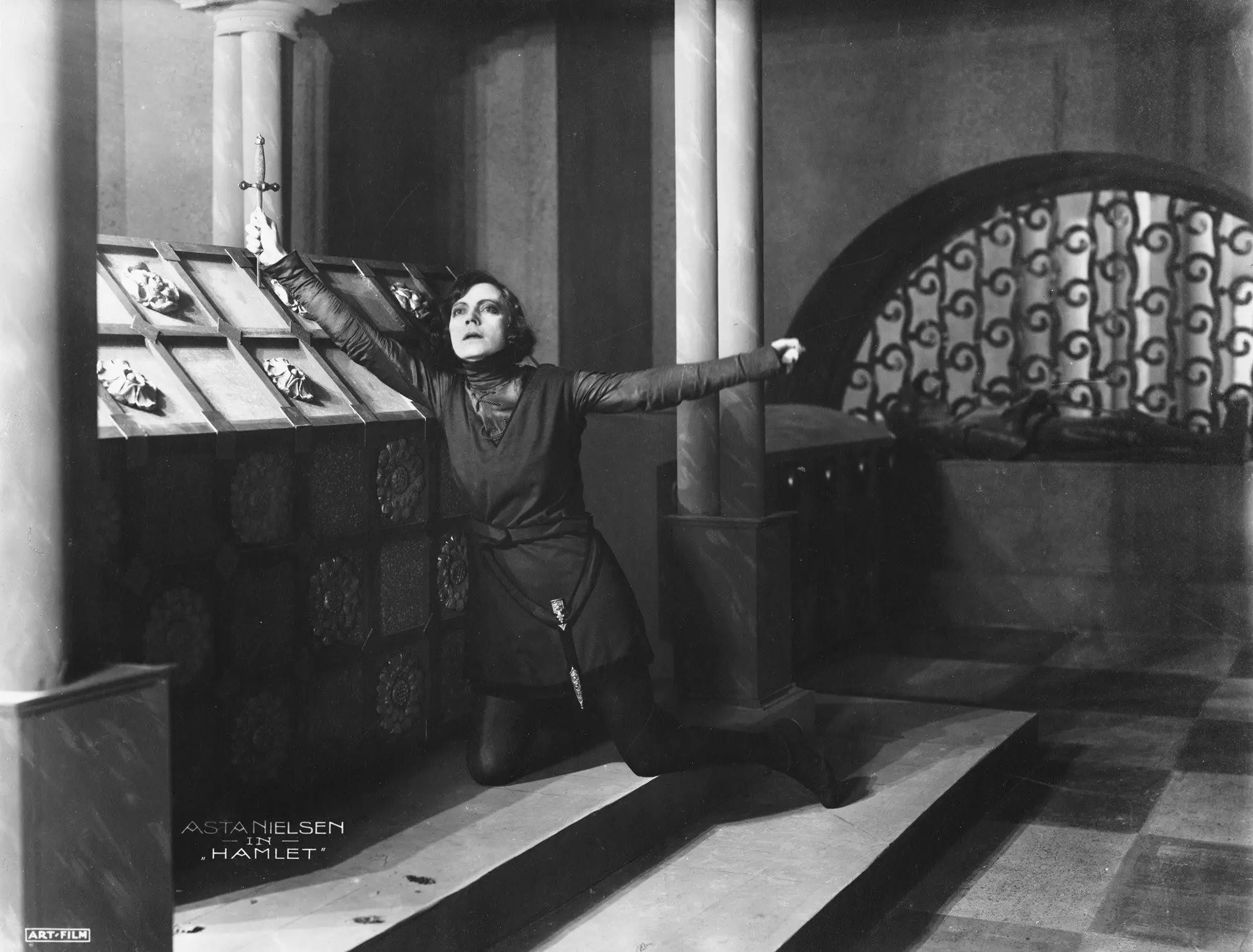
Modern viewers weaned on method naturalism may need a beat to calibrate to silent-era gestural lexicon. Yet Nielsen’s art is less declamatory than archaeological: she excavates strata of repression with the smallest of tools—a twitch of lip, a blink held half a second too long. Watch her in the prayer scene: instead of Shakespeare’s agonized soliloquy, she simply kneels, back to camera, shoulders quaking as though the chapel itself were a throat trying to swallow its own tongue. The absence of words amplifies the corporeal; the body becomes a telegram of subtext.
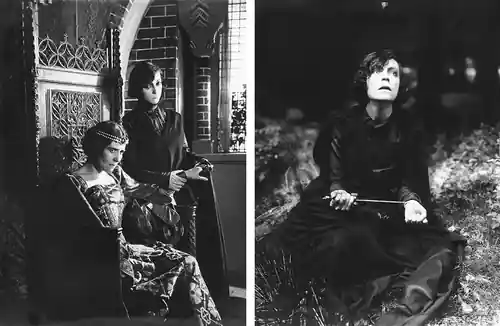
Scholars often cite her background in dance, but what registers is the muscular intelligence of her stillness. When she freezes mid-stride, the suspension feels like a skipped heartbeat, a reminder that tragedy is not the explosion but the fuse silently burning toward it.
Contemporary critics, drunk on post-war modernism, praised the film’s visual daring yet balked at the gender subversion. One Berlin reviewer quipped that Nielsen had turned the melancholy Dane into a “mascaraed mannequin,” a dismissal that reeks of Freudian panic. The picture performed robustly in cosmopolitan hubs—Copenhagen, Vienna, even a limited Manhattan run—yet distributors in smaller markets demanded recut prints that excised the Horatio romance, a cinematic lobotomy that left the narrative a gibbering echo of itself.
Rediscovered fragments in a Norwegian archive (1998) and a 4K restoration by the Danish Film Institute (2018) resurrected the complete version, allowing twenty-first-century audiences to confront its queerness without the meddling scissors of provincial censors. Streaming platforms still relegate it to the ghetto of “curiosities,” but cinephile forums buzz with essays dissecting its transgender thematics, its proto-feminist rage, its pre-Code erotic candor.
Compare this Hamlet to The Primrose Path, where the female lead also navigates a labyrinth of moral compromise, though that film ultimately reins her desire back into patriarchal order. Nielsen’s princess never repents; her death is a statement, not a salvation. Likewise, The Alien flirts with gender disguise yet uses it as narrative gimmick rather than existential inquiry.
Even within the corpus of Shakespearean silents—Undine’s waterlogged romanticism, Der Geheimsekretär’s bureaucratic intrigue—Nielsen’s film stands apart, a black swan amid white. Its influence ripples through Bergman’s medieval chamber pieces, through the stark politeness of Dreyer’s Day of Wrath, through the gender fluidity that threads The Silent Woman and beyond.
To watch this Hamlet is to witness cinema itself in adolescent metamorphosis—awkward, audacious, bristling with possibilities it cannot yet name. It does not merely reinterpret Shakespeare; it interrogates the very scaffolding of narrative, asking why tragedy so often wears a codpiece, why power clings to the pronoun “he,” why mothers must choose between crown and child. Nielsen’s performance trembles with the raw nerve of someone rewriting their own script while the ink is still wet.
The film survives not as museum relic but as open wound, its stitches visible, its pulse erratic. In an era obsessed with reboots, here is a reboot that rebooted itself before the culture could catch up. It ends, as all great films must, in silence—no swelling orchestra, no moral epilogue—just the echo of Fortinbras’s boots receding down an empty hallway, and the camera fixed on a vacant throne that will, inevitably, invite the next impostor to sit.
Seek it out. Let its irises contract your vision until the world beyond the screen feels suddenly, perilously optional. Let its tints bleed onto your retinas so that every subsequent monochrome looks anaemic. Let its princess-who-would-be-prince lodge in your cortex like a question you never knew you needed to ask, rattling around until the next time someone insists that classics are immutable, that gender is destiny, that ghosts always appear in sheets rather than in the mirror.

IMDb —
1925
Community
Log in to comment.