DbcultAccessing Vault...
Cult Review
Senior Film Conservator
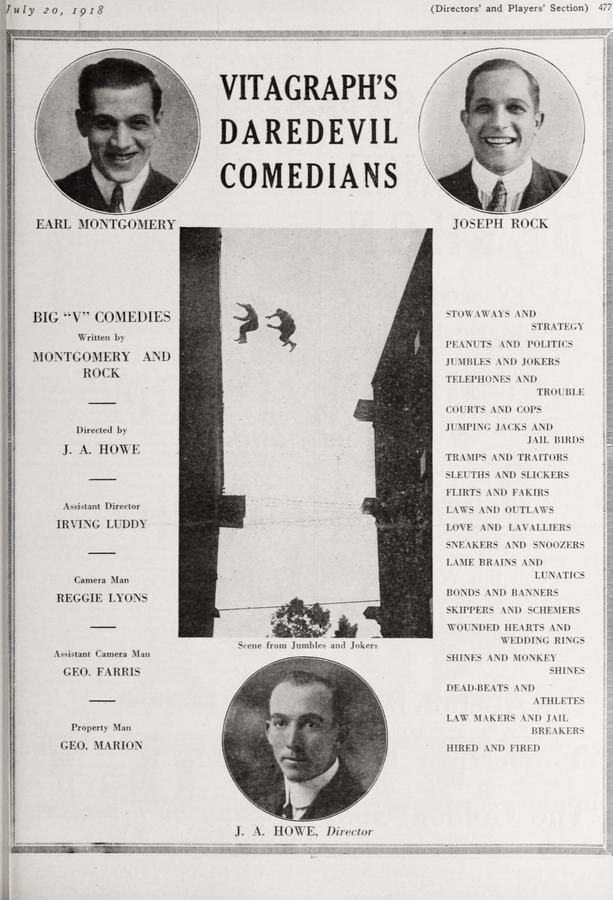
The year 1916 stands as a monumental pillar in the history of the moving image, a period where the primitive flickers of the nickelodeon era began to coalesce into a sophisticated visual language. Amidst the shadow of D.W. Griffith’s sprawling Intolerance, a more localized, frantic energy was brewing in the short-form comedies produced by the Vim Comedy Company. Love and Lavallieres, starring the indomitable duo of Joe Rock and Earl Montgomery, represents a fascinating intersection of vaudevillian physical prowess and the burgeoning technical capabilities of the silent camera. To watch this film today is to witness the raw, unpolished gears of comedy grinding with an enthusiasm that modern digital precision often lacks.
The narrative architecture of the film is deceptively simple, yet it functions as a highly efficient engine for chaos. The lavalliere—a pendant necklace that was the height of Edwardian fashion—acts as the ultimate MacGuffin. In a society where material markers of success were increasingly vital, the quest for this piece of jewelry becomes a frantic metaphor for social mobility and romantic conquest. Unlike the moralistic weight found in Pilgrim's Progress, which sought to elevate the soul, Love and Lavallieres is content to revel in the gravity-defying antics of the body. Joe Rock, whose background in stunts would later make him a production powerhouse, displays a level of elastic physical commitment that rivals the best of the era.
What distinguishes this short from the myriad of other slapstick offerings of the time, such as The Essanay-Chaplin Revue of 1916, is the specific symbiotic relationship between Rock and Montgomery. While Chaplin was refining the 'Tramp' into a figure of pathos and balletic grace, Rock and Montgomery remained committed to a more peripatetic, blue-collar brand of humor. Their timing is not merely about the punchline; it is about the rhythm of the chase. There is an inherent musicality to their movements, a staccato pacing that reflects the industrial heartbeat of the early 20th century.
Montgomery, often serving as the writer as well, understands the mechanics of the gag with surgical precision. In Love and Lavallieres, every doorway is a trap, every staircase a potential slide, and every romantic gesture a precursor to a physical catastrophe. This film doesn't possess the thematic gravity of Sam Davis, the Hero of Tennessee, but it shares a similar dedication to the singular, focused objective. Whether it is a hero facing a firing squad or a comedian losing his trousers, the silent era demanded a total commitment to the moment that transcends the need for dialogue.
Visually, the film is a treasure trove for the cinematic historian. The outdoor photography captures the dusty, sun-drenched streets of a world still transitioning from horse-drawn carriages to internal combustion. The lack of sophisticated lighting rigs meant that directors had to master the use of natural light, and in Love and Lavallieres, the high-contrast shadows add a layer of grit to the comedy. It lacks the polished, stage-bound artifice of The Bachelor's Romance, opting instead for a documentary-like immediacy that grounds the absurd physical stunts in a recognizable reality.
Consider the staging of the chase sequences. While The Mystery Ship used the camera to build suspense through atmosphere, Love and Lavallieres uses the camera as a static observer of dynamic motion. The frame is a proscenium arch, and the humor is derived from how the actors enter and exit that space with unexpected velocity. This is 'cinema of attractions' in its purest form—a spectacle designed to elicit an immediate, visceral response from an audience that was still learning how to watch movies.
Beneath the surface level of falls and fisticuffs, there is a subtle commentary on class and the performative nature of courtship. The struggle for the lavalliere is essentially a struggle for status. In this regard, the film shares a tangential DNA with The Lady of Lyons; or, Love and Pride, though it swaps poetic melodrama for frantic histrionics. The characters in Love and Lavallieres are perpetually reaching for a lifestyle that remains just out of grasp, their failures punctuated by the very objects they desire.
This obsession with wealth and the 'get-rich-quick' mentality of the era is also explored in Money Madness, but here it is played for laughs rather than as a cautionary tale. The frantic pursuit of the necklace is a precursor to the more sophisticated heist films that would follow, yet it retains a certain innocence. The violence is consequence-free, the stakes are simultaneously high and non-existent, and the resolution is always a return to the status quo of comedic frustration.
The Vim Comedy Company, though often overshadowed by Keystone or Hal Roach, was a vital laboratory for comedic technique. The editing in Love and Lavallieres is surprisingly brisk. There is a clear understanding of the 'match-on-action' cut, allowing the physical gags to flow across different locations without breaking the illusion of continuous motion. This technical competence is what allowed films like The Kid Is Clever to push the boundaries of what was possible in a single-reel format.
Furthermore, the use of intertitles in this film is minimal, a testament to the clarity of the visual storytelling. Unlike the exposition-heavy The Crimson Wing, Love and Lavallieres trusts the audience to interpret the narrative through the actors' exaggerated facial expressions and grandiose gestures. It is a universal language, one that requires no translation and remains potent over a century later. The film functions as a precursor to the 'pure cinema' advocated by later theorists, where the image is the primary driver of meaning.
To understand Love and Lavallieres, one must also look at what it was *not*. It was not a propaganda piece like How Uncle Sam Prepares, nor was it a pseudo-scientific exploration like The Book of Nature. It was an escape—a brief, ten-minute respite from the looming anxieties of World War I and the rapid industrialization of the American landscape. While Blue Blazes Rawden offered a gritty look at the Western frontier, and The Heart of Nora Flynn delved into domestic melodrama, the Vim shorts provided a space where the only law was the law of the gag.
Even when compared to the exoticism of The Hindu Nemesis, there is something remarkably grounded about the absurdity of Love and Lavallieres. It finds its humor in the mundane—the struggle to impress a girl, the frustration of a lost object, the indignity of a public fall. This relatability is why Joe Rock and Earl Montgomery were able to sustain a career in an industry that was notoriously fickle. They were the everymen of chaos, the avatars of the common man’s daily struggle against an increasingly complex world.
The survival of films like Love and Lavallieres is a minor miracle. Much of the Vim catalog was lost to nitrate fires or simple neglect. What remains is a precious window into a specific style of American performance that has its roots in the circus and the music hall. The film’s influence can be seen in the later, more famous works of Buster Keaton, who would take the kinetic energy of the Vim shorts and elevate it to the level of high art. But here, in its raw form, we see the blueprint for everything that was to come.
The cinematography, while functional, possesses a certain 'street photography' aesthetic that is invaluable for historians. We see the textures of the clothing, the architecture of the era, and the unscripted reactions of bystanders who often wandered into the frame during location shooting. It is a time capsule of 1916, wrapped in the guise of a comedy short. The lavalliere might be the object of desire within the film, but for us, the film itself is the jewel—a sparkling, slightly scuffed diamond from the crown of the silent era.
In the final analysis, Love and Lavallieres is a triumph of spirit over technical limitation. It doesn't need the massive budgets of a Griffith epic or the poetic soul of a Chaplin feature to succeed. It succeeds because it understands the fundamental truth of cinema: that there is something inherently joyful about watching a human being navigate the world with a total, reckless lack of dignity. It is a celebration of the fall, a tribute to the chase, and a reminder that even in the most sophisticated age, we are all just one banana peel away from a total loss of composure.
For those seeking to understand the evolution of the American comedy, this Joe Rock and Earl Montgomery collaboration is an essential, if often overlooked, chapter. It is a frantic, funny, and fiercely energetic piece of celluloid history that deserves to be viewed with the same reverence as the more famous classics of its time.
IMDb —
1922
Community
Log in to comment.