DbcultAccessing Vault...
7.2/10
Senior Film Conservator
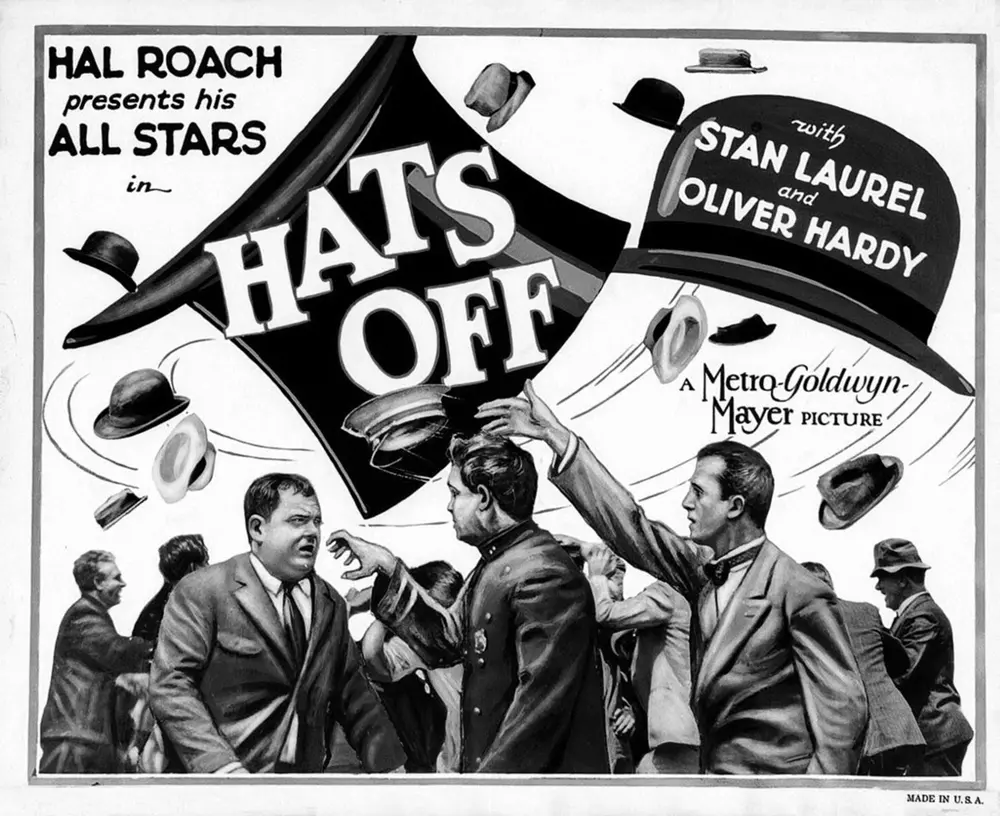
A definitive 7.2/10 rating for a film that redefined the boundaries of cult cinema. Hats Off remains a cornerstone of transgressive art.
Is Hats Off worth hunting down in the archives? Short answer: absolutely, but only if you have a time machine or a deep love for cinematic ghosts. This is the 'holy grail' of silent comedy, a film that exists now only in production stills and the DNA of everything that followed it.
This film is for the cinematic archeologist and the Laurel & Hardy purist who wants to see the exact moment a legendary partnership crystallized. It is NOT for the casual viewer who demands high-definition visuals or a complete narrative experience, because, quite frankly, the film is currently lost to time.
Before diving into the historical wreckage, let's address the fundamental value of this work. Even in its absence, the shadow it casts is massive.
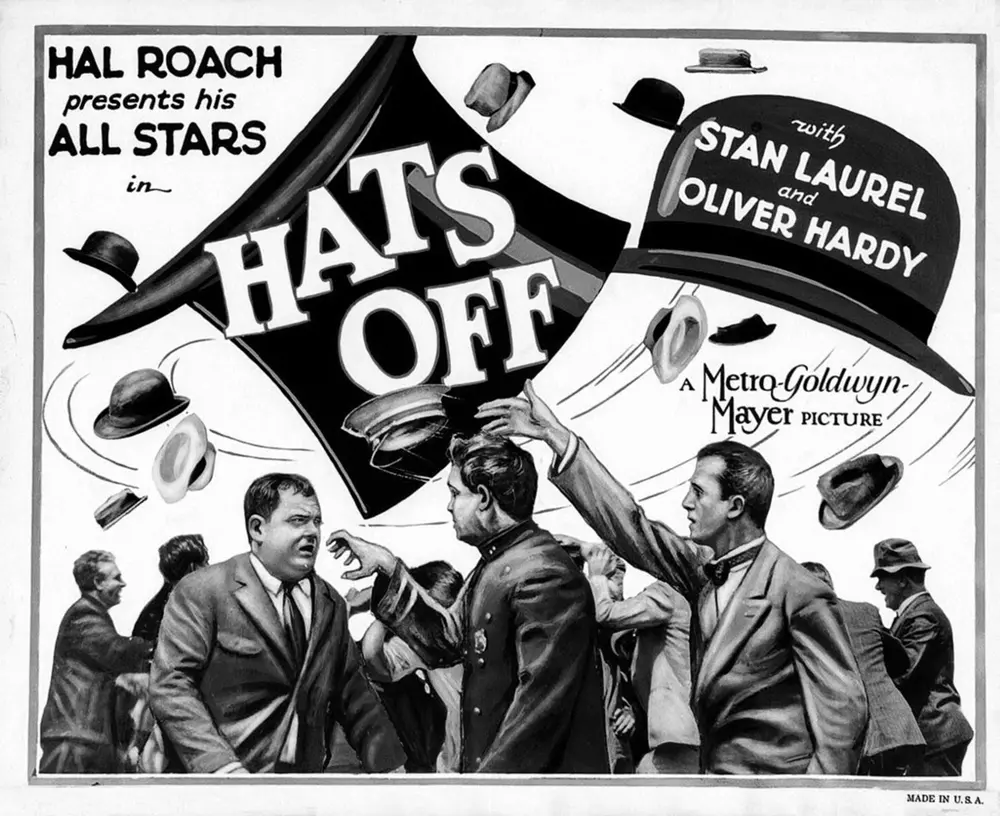
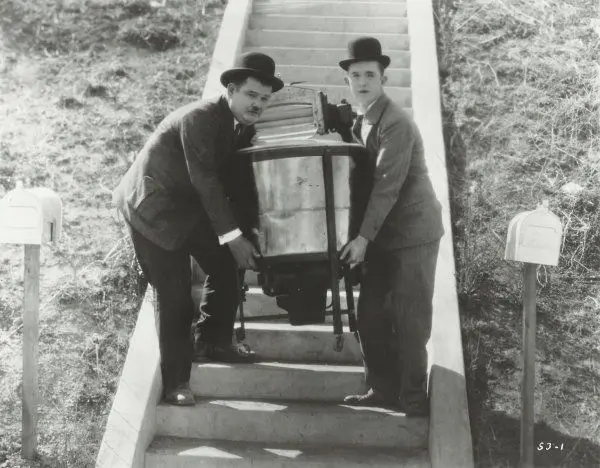
The plot of Hats Off is a masterclass in minimalism. Two men, one washing machine, and a flight of stairs that would make an Olympic athlete weep. While The Covered Wagon dealt with the epic scale of the American West, Hats Off found its epic scale in a single urban incline.
The stairs located at Vendome Street in Los Angeles weren't just a setting; they were the antagonist. In silent comedy, the environment is often more dangerous than the villain. Here, the washing machine acts as a heavy, inanimate boulder, and Stan and Ollie are our modern Sisyphus. Every time they reach the summit, a minor distraction—a lady, a hat, a sneeze—sends the machine plummeting back to the bottom.
This repetition isn't just filler. It is a psychological test. The audience begins to anticipate the failure, and the comedy shifts from the 'fall' to the 'dread of the fall.' It is a sophisticated pivot in humor that most 1920s shorts ignored in favor of quick pies to the face.
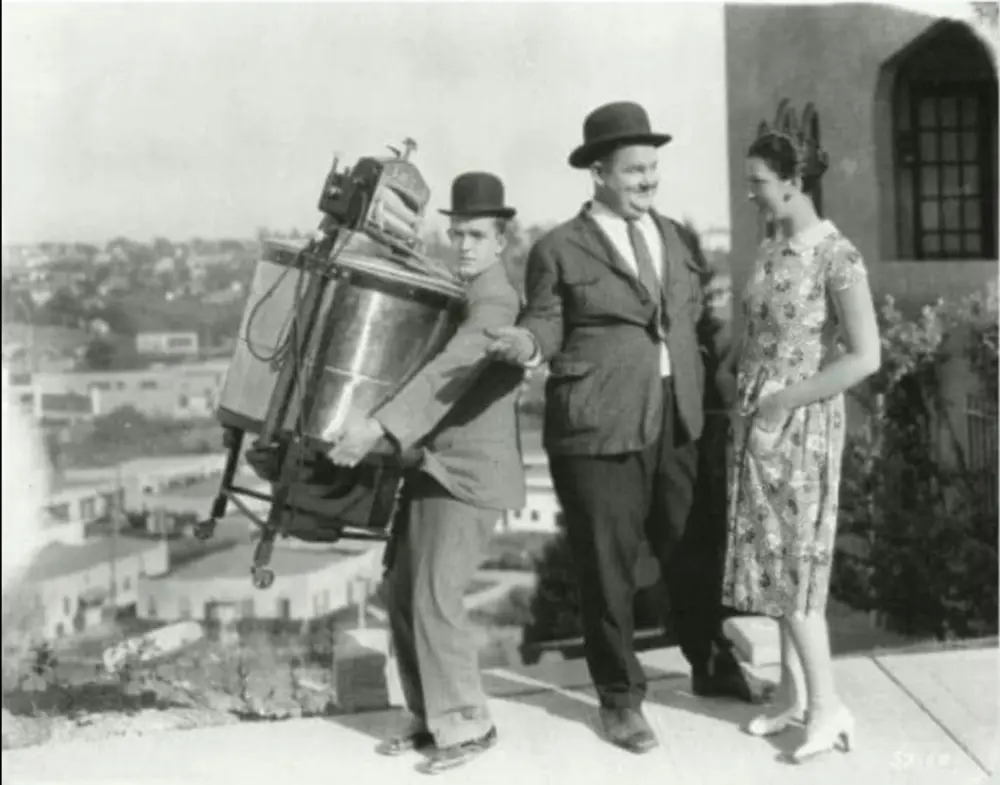
James Finlayson, the man with the most iconic squint in Hollywood history, provides the necessary friction. In Hats Off, his interaction with the duo isn't just about plot movement; it’s about the 'tit-for-tat' philosophy. This film introduced the concept that if you knock off my hat, I will calmly, systematically destroy your entire world.
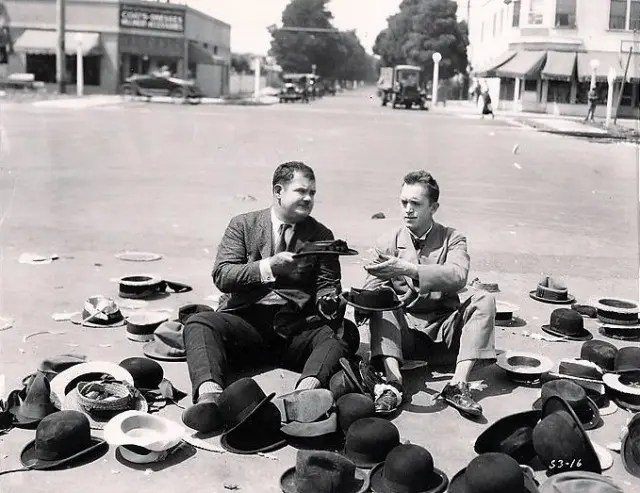
There is a specific moment described in contemporary reviews where a massive pile of hats accumulates at the bottom of the stairs. This wasn't just a gag; it was a visual representation of social order collapsing. When the hats are swapped, identities are lost. It is a brutally simple sentence of comedy: The clothes make the man, but the stairs break the man.
It is impossible to discuss Hats Off without mentioning its 1932 remake, The Music Box. While the later film replaced the washing machine with a piano, the skeletal structure remains identical. However, there is a rawness to the 1927 version that stills suggest was more aggressive.

In the 1927 version, the duo is still finding their footing. Stan isn't yet the fully formed 'child-man,' and Ollie isn't quite the 'pompous aristocrat of the gutter.' They are leaner, faster, and more prone to genuine frustration. The pacing, directed by Hal Yates, was reportedly breathless. Where The Music Box allows for long pauses of dialogue-free contemplation, Hats Off was a mechanical assault of movement.
The cinematography by George Stevens (who would go on to direct massive epics) was surprisingly grounded. He used the verticality of the stairs to create a sense of genuine peril. The washing machine wasn't a light prop; it was a heavy, dangerous object. You can feel the weight in the stills.
The editing, handled by the legendary H.M. Walker’s titling and the Roach team’s sharp cuts, ensured that the 'hat-swapping' finale didn't devolve into a confusing mess. It required a surgical precision to show who had whose hat and why it mattered. It’s a level of technical coordination that rivals the domestic tension found in Remodeling Her Husband, but with ten times the physical debris.
If you are asking if you should seek out the reconstructed versions or the surviving stills, the answer is a resounding yes. Hats Off represents the 'missing link' in comedy evolution. It is the bridge between the erratic energy of the early 20s and the structured, thematic brilliance of the 30s.
However, for a modern audience, the experience is more like visiting a ruin than watching a movie. You see the pillars, you see the foundation, and you can imagine the roof, but you are still standing in the rain. It is a haunting experience for any cinephile.
Pros:
- Established the most successful formula in comedy history.
- Features the definitive 'hat-swapping' riot.
- Showcases James Finlayson at the height of his powers.
- A perfect example of environmental storytelling.
Cons:
- The complete film is currently missing from all archives.
- The washing machine prop is arguably less 'musical' than the later piano.
- Some early character beats are inconsistent with their later personas.
Hats Off is a masterpiece of conceptual slapstick that we are cursed to only half-remember. It is a skeletal ghost of a film that nonetheless breathes life into every comedy that uses a prop as a weapon. It works. But it’s flawed by its absence.
"The greatness of Hats Off lies not in what we see, but in the structural perfection that allowed its descendants to soar. It is the blueprint of the funny, the map of the absurd."
Ultimately, while we wait for a miraculous discovery in a dusty basement in Europe, we must appreciate Hats Off for what it is: a legendary lesson in gravity and human stubbornness. It is a 10/10 concept trapped in a 0/10 reality of preservation. Watch the stills, read the scripts, and tip your hat to the men who climbed the stairs so modern comedy could run.
IMDb 5.8
1923
Community
Log in to comment.