DbcultAccessing Vault...
Cult Review
Senior Film Conservator
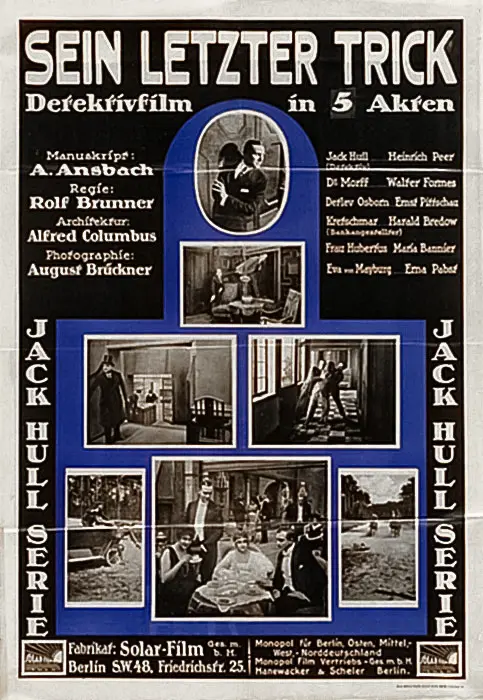
To witness Sein letzter Trick is to step into a ghost-lit chamber of the European psyche. Released in 1916, a year defined by the staccato rhythm of industrial warfare, the film offers a curiously claustrophobic diversion. It is not merely a crime drama; it is a meditation on the obsolescence of the gentleman rogue. While films like The Dawn of Freedom were grappling with the macro-sociological shifts of the era, this production turns its gaze inward, focusing on the microscopic tremors of a man realizing his repertoire of tricks has finally run dry.
The screenplay, penned with a sharp, almost cynical precision by A. Ansbach, functions as a clockwork mechanism. There is a palpable sense of the 'Kammerspiel' aesthetic beginning to germinate here, even before the movement was officially christened. The spatial dynamics are fraught with meaning; every doorway is a threshold of betrayal, every velvet curtain a shroud for a secret. Unlike the sprawling, almost operatic vistas found in The Queen of Sheba, which relied on the sheer scale of its artifice, Sein letzter Trick finds its power in the tightening of the noose. It is a cinema of proximity, where the flicker of an eyelid carries more weight than the collapse of a temple.
Ernst Pittschau delivers a performance of remarkable restraint. In an era where histrionics were often the default mode of communication, Pittschau understands the gravity of the still image. He portrays a man whose professional life is a series of masks, yet he allows the audience to see the cracks where the paint has begun to peel. There is a ruggedness to him that evokes the maritime stoicism of The Sea Wolf, but it is tempered by a continental sophistication. He isn't fighting the elements; he is fighting the inevitable erosion of his own relevance.
Opposite him, Luise Tirsch provides a performance that is both ethereal and grounded. She navigates the film’s moral gray zones with a grace that suggests a deeper backstory than the intertitles care to reveal. When compared to the domestic sentimentalism of The Old Nest, Tirsch’s role is refreshingly devoid of saccharine tropes. She is a collaborator in the deception, a partner in the dance of shadows, and her chemistry with Pittschau is the film’s emotional anchor. The supporting cast, featuring stalwarts like Heinrich Peer and Erna Pabst, populates this world with a gallery of grotesques and aristocrats, each contributing to a tapestry of early 20th-century German society that feels both lived-in and hauntingly artificial.
The cinematography in Sein letzter Trick is a testament to the ingenuity of pre-Expressionist German film. The lighting doesn't just illuminate the actors; it interrogates them. We see the influence of the 'Autorenfilm' movement—the desire to elevate cinema to the status of literature. The way the camera lingers on a discarded glove or a half-empty glass of absinthe creates a sense of foreboding that rivals the tension in Under Suspicion. There is a rhythmic quality to the editing, a pulse that quickens as the titular 'trick' approaches its climax.
Consider the scene in the parlor—a masterclass in blocking. The actors are positioned like chess pieces, their movements dictated by an invisible hand of fate. It lacks the kinetic chaos of This Way Out, opting instead for a slow, agonizing burn. This is a film that understands the value of silence within a silent medium. It allows the viewer’s imagination to fill the void, making the eventual reveal all the more impactful. It shares a certain DNA with De røvede Kanontegninger in its fascination with stolen secrets and the technology of surveillance, though it remains more focused on the psychological toll of the theft than the mechanics of the crime itself.
One cannot analyze a German film from 1916 without acknowledging the specter of the Great War. While Sein letzter Trick is ostensibly a genre piece, it vibrates with the anxiety of a world on the brink of collapse. The obsession with 'tricks' and 'deception' mirrors the propaganda-saturated atmosphere of the time. The characters are all trying to 'dodge a million'—not just in terms of the financial stakes seen in Dodging a Million, but in terms of dodging reality itself. They are trapped in a cycle of performance that feels increasingly futile.
The film’s portrayal of wealth and status is particularly biting. Unlike the aspirational narratives of When Broadway Was a Trail, which looked back at history with a romanticized lens, Sein letzter Trick looks at the contemporary elite with a cold, analytical eye. The luxury on screen feels brittle, as if it might shatter at any moment. This fragility is the film’s greatest strength; it captures the 'fin de siècle' malaise that would eventually give birth to the jagged, distorted world of Dr. Caligari.
When placed alongside Mr. Opp, the character study in Sein letzter Trick feels significantly more cynical. Where Mr. Opp deals with the delusions of a well-meaning man, Pittschau’s protagonist is a man who knows exactly how the world works and chooses to exploit it until he can no longer live with the cost. There is a thematic kinship with $5,000 Reward, specifically in how both films use a bounty or a high-stakes prize to reveal the true nature of their characters. However, the German production is far less interested in the resolution of the mystery than it is in the dissolution of the soul.
Even the smaller, more obscure titles of the era, such as The Skipper's Narrow Escape or the Italian curiosity Centocelle, highlight the unique tonal balance of Sein letzter Trick. It possesses a narrative density that makes The Stimulating Mrs. Barton look positively lightweight. It is a film that demands multiple viewings to fully parse the layers of A. Ansbach’s construction. The dialogue—represented through those beautifully ornate intertitles—is sparse but devastating, each word chosen for its maximum impact within the visual frame.
As we reach the final act, the film’s title takes on a metaphysical weight. The 'last trick' is not just a plot point; it is the director’s final statement on the nature of cinema itself. It is the ultimate sleight of hand. The way the film concludes, avoiding the easy redemption arcs found in Barnaby Rudge, cements its status as a work of profound artistic integrity. It leaves the viewer in a state of contemplative unease, questioning the veracity of everything they have just witnessed.
In the grand pantheon of silent cinema, Sein letzter Trick stands as a pivotal bridge between the straightforward storytelling of the early 1910s and the psychological depth of the 1920s. It is a work of immense lexical diversity in its visual language, utilizing shadow, movement, and stillness to tell a story that words alone could never encompass. For the modern cinephile, it is a reminder that the 'tricks' of the trade were mastered long before the advent of digital artifice. The magic was always in the shadows, and in this film, the shadows have never been more eloquent.
Verdict: A haunting, intellectually rigorous piece of silent German cinema that remains as deceptive and alluring as the day it was filmed.
IMDb 6.6
1936
Community
Log in to comment.