DbcultAccessing Vault...
Cult Review
Senior Film Conservator
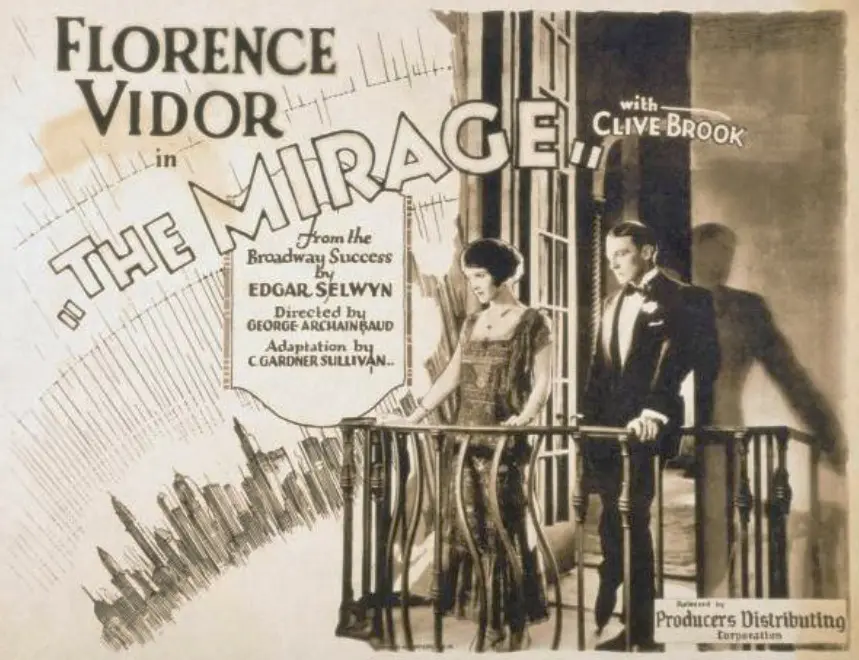
The 1924 cinematic landscape was often preoccupied with the friction between agrarian purity and the perceived decadence of the urban sprawl. In The Mirage, directed by George Fitzmaurice and penned by the formidable C. Gardner Sullivan, this dichotomy is not merely a background setting but the very engine of the drama. Florence Vidor, an actress of exceptional poise and subcutaneous emotional depth, portrays Irene Martin with a nuance that defies the era’s penchant for histrionics. Her journey is a profound interrogation of the 'American Dream' as it pertains to the female artist—a dream that frequently dissolves into the titular mirage when confronted with the hard currency of the New York elite.
The film opens with a pastoral tranquility that feels intentionally fragile. Irene’s departure from her hometown is framed not as a joyous escape but as a somber necessity. Unlike the protagonists in The Little Church Around the Corner, where the community serves as a moral anchor, Irene’s origins are a weight she must shed to achieve her operatic aspirations. However, the New York she discovers is a labyrinth of neon and artifice. The Knickerbocker Roof, rendered with opulent set design, serves as a microcosm of the city’s transactional heart. Here, Irene is not a singer; she is a component of a larger visual spectacle, a realization that Vidor communicates through a series of hauntingly subtle facial expressions.
When Henry Galt, played with a sophisticated yet predatory edge by Clive Brook, enters the frame, the film shifts into a higher gear of social commentary. Galt represents the nascent corporate power of the 1920s—a man who understands the price of everything and the value of nothing. His initial gesture of sending fifty dollars to Irene after a party is the narrative’s fulcrum. It is a moment of profound insult that mirrors the deceptions found in Trompe-la-Mort, where appearances are weaponized to subjugate the unwary. Irene’s refusal to be bought, followed by her pragmatic decision to enter a professional arrangement, showcases a modern sensibility rarely seen in the silent era’s 'damsel' tropes.
The chemistry between Florence Vidor and Clive Brook is predicated on what is left unsaid. Vidor’s Irene maintains an aloofness that is both a defensive mechanism and a statement of class. She refuses to play the role of the sycophant, and it is this very resistance that captivates Galt. Brook, who would later become an icon of British stoicism, provides Galt with a slow-burning transformation. He begins as a man who views women as decorative assets for business negotiations, much like the characters in His House in Order, but evolves into a figure capable of genuine empathy.
"The Mirage is less about the romance itself and more about the dismantling of the ego. Galt must unlearn his wealth to see Irene, and Irene must unlearn her pride to see Galt."
The middle act of the film is a masterclass in tension. As Irene entertains Galt’s prospective clients, the camera captures the claustrophobia of her position. She is surrounded by luxury, yet she is fundamentally isolated. This thematic thread of social isolation amidst plenty is a recurring motif in Sullivan’s work, echoing the emotional barriers explored in The Door Between. The visual storytelling utilizes shadows and tight framing to emphasize that while Irene’s environment has expanded, her agency has paradoxically contracted.
The arrival of Al Manning (Alan Roscoe) introduces the film’s most scathing critique: the cruelty of the 'virtuous.' Manning, the jilted sweetheart, arrives in New York not with a desire to understand Irene’s struggle, but with a predetermined narrative of her fall from grace. His reaction to finding Irene in Galt’s company is a visceral display of toxic possessiveness. Roscoe plays Manning with a self-righteous fervor that makes him far more villainous than the cynical Galt.
Manning’s decision to 'proposition' Irene as a test of her virtue is a sickening moment of narrative irony. When she rejects him, he doesn't see her strength; he sees only the confirmation of his own biases. His subsequent letter to Irene’s mother is an act of social assassination. This sequence highlights a theme prevalent in films like Youthful Cheaters, where the older generation or the 'moral' peers are the quickest to condemn without evidence. The 'mirage' of the title refers not just to Irene’s dreams of fame, but to the false image of purity that Manning demands of her.
Visually, The Mirage is a triumph of silent era cinematography. The use of lighting to differentiate between the soft, diffused glow of Irene’s memories and the sharp, high-contrast glare of the New York nightlife is masterful. The Knickerbocker Roof sequences are choreographed with a rhythmic precision that suggests the mechanical nature of the entertainment industry. It reminds one of the grand scale seen in the National Red Cross Pageant, yet focused through a much more intimate, character-driven lens.
The editing by the uncredited cutters of the era maintains a brisk pace, ensuring that the melodrama never descends into bathos. Each scene is constructed to build upon the psychological profile of the three leads. The transition from the high-society parties to the stark confrontation in Irene’s apartment is handled with a jarring realism that strips away the artifice Galt has built around her. It is in these moments that Fitzmaurice’s direction shines, opting for close-ups that allow Vidor’s eyes to carry the weight of the narrative.
The climax of the film avoids the easy out of a traditional 'happily ever after.' Galt’s proposal is initially met with skepticism—and rightly so. Irene perceives his offer as an act of gallantry, a way to 'save' a reputation he helped compromise. This skepticism is what elevates The Mirage above contemporary potboilers. Irene demands to be loved for who she is, not pitied for what she has endured.
When she finally realizes that Galt’s love is genuine—that he sees her not as a professional asset or a charity case, but as an equal—the emotional payoff is earned. It is a sophisticated ending that acknowledges the scars left by the city. Unlike the lighter fare of Taxi Please or the innocent whimsy of Playmates, The Mirage leaves the viewer with a sense of the cost of survival. It suggests that while the mirage of fame may fade, the reality of human connection can be salvaged from the ruins of ambition.
In the broader context of 1920s cinema, The Mirage stands as a poignant reminder of Florence Vidor’s immense talent. Her ability to navigate the complexities of a woman caught between two worlds—the judgmental past and the transactional future—is nothing short of luminous. While the film shares some DNA with the social dramas of its time, such as The Princess of Patches, it possesses a cynical edge that feels remarkably modern.
The screenplay by C. Gardner Sullivan remains one of the sharpest of his career, avoiding the moralizing tendencies that often hampered silent scripts. By allowing Irene to be a flawed, pragmatic, and ultimately resilient woman, the film transcends its era. It is a story about the masks we wear to survive and the courage required to take them off. For those seeking a silent film that offers more than just pantomime, The Mirage is a shimmering oasis of psychological depth. It is a vital piece of cinematic history that deserves to be viewed alongside the works of the great European directors of the same period, offering a uniquely American perspective on the price of the soul in the city of dreams.
© 1924 Cinema Review Archive. All Rights Reserved.
IMDb —
1919
Community
Log in to comment.