DbcultAccessing Vault...
Cult Review
Senior Film Conservator
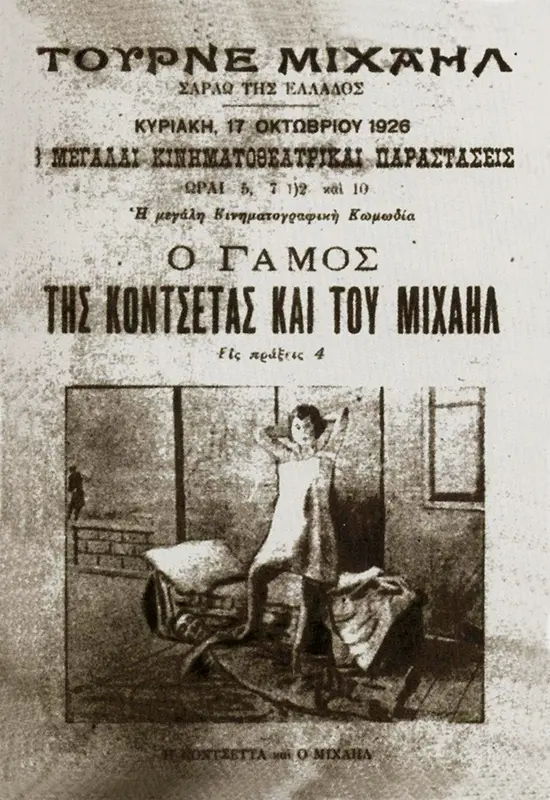
Is this film worth watching today? Short answer: Yes, but only if you view it as a frantic time capsule of comedic evolution. This film is for the cinematic historian and the lover of raw, unpolished physical absurdity; it is not for those who require high-fidelity production or the sophisticated narrative arcs of the modern era.
1) This film works because Michail Michail possesses a rubber-faced physical commitment that transcends the technical limitations of 1920s Greek cinema. 2) This film fails because its pacing is often so manic that it borders on the incomprehensible for a contemporary audience. 3) You should watch it if you want to see the exact moment where the DNA of American burlesque was grafted onto Mediterranean social satire.
The Wedding of Concetta and Mihail is not a film that asks for your respect; it demands your attention through sheer, unadulterated noise—even in its silence. While films like The Pretenders attempted a more grounded approach to social dynamics, Michail Michail’s work here is an exercise in the absurd. The plot is a mere skeleton, a clothesline upon which the director hangs a series of increasingly violent and ridiculous gags. To understand this film is to understand the 'Komentia' tradition, a style of performance that favored the exaggerated over the realistic.
In the 1920s, Greek cinema was in a state of flux, caught between the heavy melodrama of The Soul of Buddha and the desire to emulate the commercial success of American shorts like Tire Trouble. Michail Michail was the primary vehicle for this transition. His performance in this wedding short is a fascinating study in body language. Every movement is a choice. Every stumble is a statement against the rigidity of the Greek middle class. He doesn't just trip; he collapses with a poetic finality that reminds one of the best work in What Fools Men.
The term 'burlesque' in the context of this film refers to the American tradition of caricature and parody, rather than the later association with striptease. This is a film of 'bits.' We see the groom struggling with the basic mechanics of a tuxedo, a sequence that feels like a direct ancestor to the slapstick seen in The Applicant. The camera is largely static, a silent observer to the whirlwind of activity, but the framing is intentional. By keeping the camera still, the chaos of the ensemble cast—including the vibrant Popi Megoula and Emmanouil Gavathiotis—is allowed to fill the frame to the point of bursting.
One cannot ignore the technical grit of the production. The lighting is harsh, and the transitions are often jarring. However, this lack of polish actually enhances the film’s frantic tone. It feels dangerous. It feels like the film itself might fly off the projector at any moment. This is a stark contrast to the more polished, albeit slower, pacing of Just Suppose. In Concetta and Mihail, there is no time for supposition; there is only the immediate, visceral impact of a pie to the face or a kick to the shins.
If you are looking for a historical document that proves comedy is a universal language, then yes, this film is essential. It provides a rare look at how early European filmmakers interpreted the slapstick revolution happening in Hollywood. While it lacks the budget of High Power, it compensates with a local flavor that makes the humor feel personal. It is a loud, messy, and occasionally brilliant piece of early avant-garde comedy that refuses to play by the rules of polite society.
While Michail is the star, the supporting cast provides the necessary friction. Concetta Moshou, as the bride, serves as the 'straight man' to the escalating madness. Her reactions ground the film, preventing it from floating off into pure abstraction. The interplay between the wedding party feels reminiscent of the social dynamics in Eve's Lover, though played for much broader laughs. There is a sense that everyone on screen is in on the joke, a communal effort to mock the sanctity of the institution they are supposedly celebrating.
The film also touches on themes of class and expectation. The wedding is a formal affair, yet the characters are anything but formal. This tension is where the best comedy lives. It’s the same tension found in Madonnas and Men, but stripped of the melodrama and replaced with a cynical, biting wit. When Mihail fails to perform the basic duties of a groom, he isn't just being clumsy; he is failing to conform to the role society has written for him. It is a subtly subversive message wrapped in a very loud package.
When we look at other films of the era, such as The Tornado, we see a similar fascination with energy. But where The Tornado uses physical force for drama, The Wedding of Concetta and Mihail uses it for liberation. The film is an escape valve for the anxieties of the 1920s. It takes the stuffy, traditional Greek wedding and puts it through a meat grinder. The result is something that feels more modern than many of its contemporaries. It has the DNA of a Monty Python sketch or a Looney Tunes cartoon.
Even when compared to the more structured comedies like Blue Blazes, Michail’s work stands out for its lack of restraint. There is no moral lesson here. There is no growth for the characters. There is only the wedding, the chaos, and the eventual collapse of order. It is a refreshing antidote to the moralizing seen in A Petal on the Current. It is cinema at its most primal.
Pros:
- A fascinating look at 1920s Greek culture.
- Exceptional physical comedy from Michail Michail.
- Short runtime makes it a punchy, easy watch for film buffs.
- Historically significant as an early example of cross-cultural genre blending.
Cons:
- The film quality is significantly degraded in most surviving copies.
- Some gags are repetitive, reflecting the 'burlesque' formula of the time.
- The lack of a strong narrative might bore casual viewers.
The Wedding of Concetta and Mihail is a beautiful disaster. It is a film that wears its flaws on its sleeve and dares you to look away. While it may not have the emotional depth of The Secret Kingdom or the high-stakes action of En buena ley, it possesses a unique, frantic soul that is impossible to replicate. It works. But it’s flawed. And in that flaw lies its true value. It is a reminder that at the dawn of cinema, the goal wasn't always to tell a perfect story—sometimes, it was just to see how many people you could fit into a frame before everything fell apart. For that alone, it is a piece of history worth revisiting.
IMDb —
1936
Community
Log in to comment.