DbcultAccessing Vault...
Cult Review
Senior Film Conservator
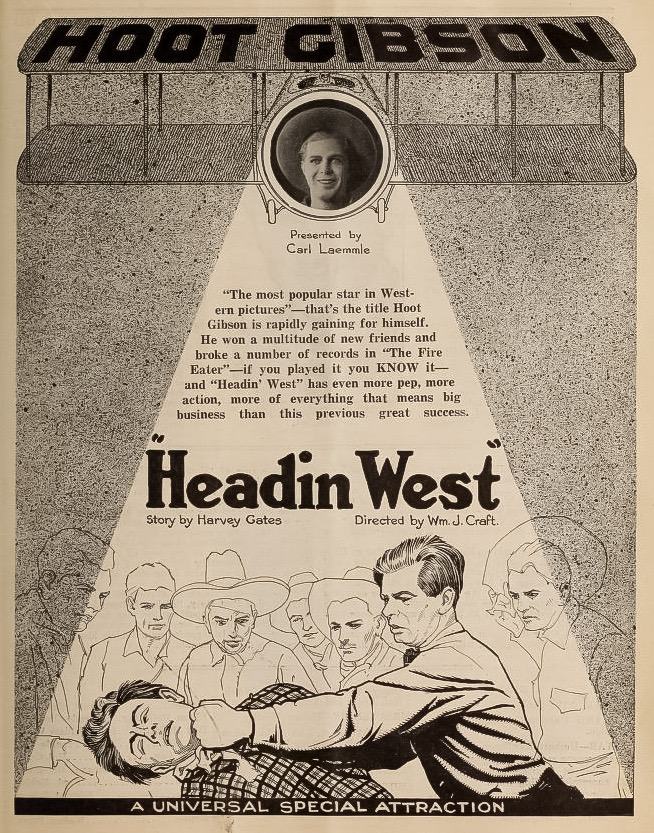
There's a certain charm to the silent Western, a raw, untamed energy that often speaks louder than any dialogue could. And then there's Headin' West, a 1922 cinematic offering that, while rooted in the familiar tropes of the genre, manages to inject a refreshing dose of ingenuity and unexpected twists. It's a film that demands attention not just for its star, the ever-charismatic Hoot Gibson, but for a narrative audacious enough to begin with a parachute descent into a hotbed of frontier intrigue. This isn't your grandfather's typical dusty trail ride; this is a story that understands the power of a grand entrance and the enduring appeal of a hero forged in unexpected circumstances.
The journey begins with Bill Perkins, portrayed with understated intensity by Gibson. A war veteran, adrift and seemingly directionless, he finds himself literally dropping into a new life. His aerial disembarkation, a truly novel concept for the era, immediately sets a tone of whimsical adventure that belies the serious drama to unfold. Landing squarely amidst a heated cattlemen's dispute, Perkins is an outsider in every sense, yet his arrival is destined to unravel a tightly woven conspiracy. The visual spectacle of a lone figure parachuting into the vast, rugged landscape is an evocative image, a potent metaphor for a man quite literally falling into his destiny. It’s a moment that, even a century later, retains a certain kinetic thrill, proving that early filmmakers weren't afraid to push the boundaries of visual storytelling.
Perkins' initial foray into this new world is far from heroic. He secures a humble position as a dishwasher, a stark contrast to his past as a soldier and his future as a ranch owner. This period of quiet observation, however, is crucial. It allows him to absorb the intricacies of the local power dynamics, to witness firsthand the avarice and machinations threatening the ranch's future. He quickly uncovers a nefarious plot orchestrated by the crooked foreman, a character whose villainy is painted with broad, yet effective, strokes. This foreman's ambition is simple: to seize control of the ranch from its absent heir. The stakes are clear, and Perkins, despite his initial detachment, finds himself drawn into the unfolding drama, a silent observer whose presence will soon disrupt the carefully laid plans of the conspirators.
Central to the foreman's scheme, and indeed to the film's emotional core, is Polly, a character imbued with strong ideals and a moral compass that refuses to waver. Portrayed by the luminous Louise Lorraine, Polly represents the integrity and hope that the foreman seeks to crush. Her unwavering principles make her a target, and it is in a twisted act of spite and manipulation that the foreman persuades Perkins to impersonate the missing heir. This is where Headin' West truly begins to explore themes of identity and deception. Perkins, a man without a clear path, is suddenly thrust into a role that is both a lie and, ironically, a stepping stone towards his true self. The film deftly navigates the moral ambiguities of his situation, presenting him not as a malicious deceiver, but as a man caught in a web of circumstances, learning to play a part that gradually reveals a deeper truth.
The genius of Harvey Gates' screenplay lies in its meticulous construction of this deception. The audience is privy to Perkins' internal struggle and his gradual assimilation into the role of the heir. This isn't merely a plot device; it's a character arc. As he dons the mantle of the missing heir, Perkins begins to embody the very qualities required to protect the ranch. His close proximity to the foreman's illicit activities, now as an 'insider,' provides him with the perfect vantage point. It's a classic case of the hunter becoming the hunted, with Perkins turning the foreman's own trickery against him. The tension builds as Perkins gathers evidence, and Hoot Gibson's subtle expressions convey the growing weight of his masquerade, coupled with a burgeoning sense of purpose.
The climax of this masquerade arrives with an electrifying confrontation. At an opportune moment, Perkins orchestrates the exposure of the ranch gang as brazen cattle rustlers. This sequence, undoubtedly filled with the kind of robust action and daring stunts that Hoot Gibson was renowned for, would have been a highlight for audiences of the era. The visual storytelling of silent cinema excels in such moments, relying on dynamic framing, swift editing, and the physical prowess of its stars to convey urgency and danger. Gibson, a true cowboy at heart, brings an authenticity to these scenes that elevates them beyond mere spectacle. His actions are decisive, his presence commanding, cementing his role as the reluctant hero who rises to the occasion.
However, the drama doesn't conclude with the unmasking of the rustlers. The foreman, in a desperate attempt to salvage his crumbling scheme, denounces Perkins as an impostor. This moment of public humiliation is designed to discredit him entirely, to strip away his newfound authority. Yet, it serves only to pave the way for the film's ultimate, and most satisfying, revelation. In a twist that retroactively justifies the entire narrative, Perkins proves that he is, in fact, the rightful heir to the property. This revelation is not just a convenient plot device; it provides a profound sense of poetic justice. The drifter, the imposter, the war veteran, is revealed to be the true inheritor, a man whose journey has led him home, albeit through the most circuitous and perilous of routes.
The thematic resonance of Headin' West extends beyond simple good versus evil. It delves into the nature of identity, suggesting that true belonging can be found even in the midst of fabricated roles. Perkins' journey from aimless wanderer to legitimate heir is a testament to the idea that circumstance can reveal inherent nobility. His initial deception, born of manipulation, ultimately serves a higher truth. The film also champions the ideal of justice, demonstrating that even the most cunning conspiracies can be undone by integrity and a keen intellect. Polly's steadfast belief in what is right provides a moral anchor, and her eventual recognition of Perkins' true character, both as a man and an heir, provides the emotional culmination of the narrative.
Hoot Gibson's performance as Bill Perkins is a masterclass in silent film acting. Known for his authentic cowboy persona, Gibson brings a nuanced depth to Perkins that transcends the typical stoic hero. His expressions, though subtle, convey a range of emotions: confusion, reluctance, growing determination, and ultimately, a quiet triumph. He doesn't rely on grand gestures, but rather on a genuine presence that grounds the more fantastical elements of the plot. Louise Lorraine, as Polly, provides an equally strong counterpoint, her portrayal of a woman of conviction shining through the challenges she faces. The supporting cast, including Charles Le Moyne, Mark Fenton, Leo White, Frank Whitson, George A. Williams, Gertrude Short, and Jim Corey, each contribute to the film's rich tapestry, creating a believable world of both virtue and villainy.
Harvey Gates' writing is the backbone of this film, crafting a plot that is both intricate and engaging. The pacing is expertly handled, allowing for moments of quiet observation to build tension before erupting into thrilling action sequences. The twists are earned, flowing organically from the characters' motivations and the established circumstances. While the premise of a hidden heir is a common trope in Westerns, Gates imbues it with a fresh perspective by introducing the element of deliberate impersonation, a dynamic that elevates the narrative beyond simple discovery to a more complex exploration of self-actualization. One might even draw a thematic parallel to films like The Voice on the Wire, where hidden information and concealed identities drive the plot, albeit in a different genre. Both films leverage the mystery surrounding a character's true nature to propel their respective narratives forward, creating suspense and anticipation for the eventual reveal.
In terms of cinematic technique, Headin' West showcases the strengths of early 1920s filmmaking. The use of location shooting lends an undeniable authenticity to the Western setting, immersing the audience in the rugged beauty of the frontier. The cinematography, while perhaps lacking the sophisticated camera movements of later eras, is effective in its framing of both intimate character moments and expansive action. Intertitles are deployed judiciously, providing necessary exposition without bogging down the visual flow. The stunts, particularly those involving horses and the culminating cattle rustling sequence, are executed with a verve that speaks to the practical artistry of the period. The film's ability to tell a compelling story primarily through visual cues and the expressive power of its actors is a testament to the enduring power of silent cinema.
Comparing Headin' West to other films of its time reveals its strengths. While many Westerns focused on straightforward narratives of good versus evil or man versus nature, this film introduces a layer of psychological intrigue. It's not just about who shot first, but who *is* whom. This element of sophisticated deception might remind one of the intricate plots found in dramas like Her Husband's Wife, where mistaken identities and hidden truths drive much of the relational conflict. Similarly, the struggle for control over property and the battle against corrupt forces could be seen as a precursor to narratives found in films like Builders of Castles, where the foundation and defense of one's domain form the central conflict. The film manages to blend the action-packed excitement of the Western with the cerebral engagement of a mystery, creating a hybrid that is both thrilling and thought-provoking.
The enduring appeal of a story like Headin' West lies in its universal themes. The quest for identity, the battle against injustice, and the triumph of truth are narratives that resonate across generations. Bill Perkins' transformation from a drifter to a leader, from an impostor to a rightful heir, is a powerful arc. His journey is one of self-discovery, prompted by external forces but ultimately driven by an innate sense of morality and courage. The film's resolution, with Perkins not only reclaiming his inheritance but also winning the affection of Polly, provides a satisfying conclusion that reinforces the idea that virtue, even when disguised, will ultimately prevail. It's a testament to the power of classic storytelling, proving that a well-crafted plot, compelling characters, and a touch of daring originality can create a cinematic experience that endures.
In retrospect, Headin' West stands as a vibrant example of silent-era Westerns at their best. It's more than just a vehicle for Hoot Gibson's star power; it's a meticulously constructed narrative that leverages its genre conventions while simultaneously pushing their boundaries. The film's unique opening, its exploration of deception and revelation, and its ultimate embrace of justice and true identity make it a compelling watch, a relic from a bygone era that still speaks volumes about the timeless allure of the American West and the inherent drama of the human spirit. It's a journey worth taking, a cinematic gem that reminds us of the creativity and narrative sophistication present in the early days of filmmaking, solidifying its place as a noteworthy entry in the annals of silent cinema.
IMDb 6.9
1931
Community
Log in to comment.