DbcultAccessing Vault...
Cult Review
Senior Film Conservator
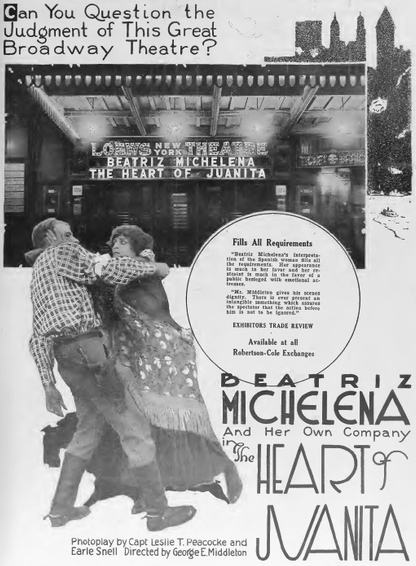
Stepping back into the nascent days of cinema, when flickering images and orchestral scores wove narratives of grand passion and stark morality, we encounter Heart of Juanita. This 1919 silent film, a collaboration between writers Earle Snell and Leslie T. Peacocke, and brought to life by a compelling cast including Beatriz Michelena, Irene Outtrim, and William Pike, is more than just a historical artifact; it's a vibrant tapestry of human emotion, set against the wild, untamed backdrop of early California. It’s a melodrama, yes, but one imbued with a raw energy and a surprising depth that transcends its era, offering a fascinating glimpse into the storytelling conventions and societal anxieties of its time.
The narrative unfurls with the intensity of a frontier ballad, centering on Juanita, a character of volatile spirit and captivating beauty, portrayed with undeniable charisma by Beatriz Michelena. Juanita is not merely a dance hall queen; she is a force of nature, her Castilian heritage manifesting in a fiery temperament that brooks no slight, especially concerning matters of the heart. Her world, a boisterous early California settlement, is one where passions run high and justice often takes a circuitous route. When she discovers Jim Brandt, the proprietor of the dance hall and her current lover, entangled in an embrace with a new, younger dancer, her jealousy ignites into a furious conflagration. The resultant act—a swift, desperate knife thrust—is both shocking and tragically understandable, a visceral outpouring of wounded pride and possessive love. This opening sequence immediately establishes the film's commitment to high drama, setting a tone that is sustained throughout its runtime. Michelena’s ability to convey such intense emotion without uttering a single word is a testament to the power of silent film acting, her expressive eyes and gestures painting a vivid portrait of a woman pushed to the brink.
Fleeing the immediate, dire consequences of her crime, Juanita seeks refuge in the solitary cabin of Calvert, a hermit trapper. This forced retreat from the tumultuous world of the dance hall into the quiet, isolated wilderness provides a stark contrast, allowing for a different kind of drama to unfold. Here, amidst the rugged tranquility, an unexpected and profound connection begins to form between the fiery fugitive and her unwitting rescuer. The initial dynamic of protector and protected slowly morphs into something deeper, a bond forged in shared solitude and burgeoning understanding. Juanita, stripped of her public persona, reveals a vulnerability that is profoundly human, and Calvert, played by William Pike, emerges from his reclusive shell, drawn to her complex spirit. It’s a nuanced development, demonstrating the film’s capacity to explore the complexities of human connection beyond simple romantic tropes. However, Calvert's affections are not initially for Juanita; his heart, we learn, belongs to Irene, the parson's daughter, a figure of purity and grace, portrayed by Irene Outtrim.
The ensuing love triangle is far from conventional. Juanita, acutely aware of Calvert’s feelings for Irene and perhaps sensing a rival, observes Irene's growing intimacy with Sheriff Tanner. In a move born of desperation and a burgeoning, protective love for Calvert, she reveals this impending engagement to him. This revelation shatters Calvert's idealized vision of Irene, leading to a confrontation that is both poignant and inevitable. Irene, stung by Calvert’s reproaches, acts out of wounded pride and a desire for retribution. Her subsequent actions—informing Brandt of Juanita's hiding place and, more damningly, falsely accusing Calvert of assault to Sheriff Tanner—set in motion a chain of events that spirals irrevocably towards a dramatic climax. This moment of betrayal is a pivotal turning point, illustrating how easily perceived innocence can mask a capacity for malice, a theme explored in other silent-era dramas like Her Mistake, where misjudgment and deceit lead to devastating outcomes. The layers of deception and retaliation add significant depth to the plot, elevating it beyond a simple tale of crime and pursuit.
Sheriff Tanner, portrayed by Clarence Arper, is introduced as a figure of unwavering law and order, a stark contrast to the passionate, often lawless individuals he pursues. His diligent pursuit of justice, fueled by Irene's false accusation and the initial crime, leads him and his posse to Calvert's secluded cabin. The timing of their arrival couldn't be more fraught with tension: Calvert has just incapacitated Brandt, who, driven by his own possessive rage, had tracked Juanita down. The cabin becomes a powder keg, with Juanita, demonstrating unexpected courage and loyalty, holding the posse at bay with a rifle, buying precious moments for Calvert. The ensuing knife duel between Tanner and Calvert is a masterclass in silent film suspense, a raw, visceral struggle that speaks volumes without dialogue. The choreography of the fight, the intensity of the actors' expressions, all contribute to a scene of gripping drama that keeps the audience on the edge of their seats, much like the high-stakes confrontations seen in contemporary action-dramas.
The true genius of Heart of Juanita, however, lies in its astonishing climactic reveal. In the midst of their desperate struggle, Tanner discovers a locket on Calvert, a seemingly innocuous detail that unravels a profound, life-altering truth: Calvert is his long-lost son. This revelation is a narrative bombshell, a twist of fate so potent it reshapes everything that has come before. It transforms the relentless lawman into a conflicted father, and the reclusive trapper into a son unexpectedly reunited. This kind of dramatic irony, where the pursuer and the pursued are inextricably linked by blood, is a powerful device, reminiscent of the hidden identities and surprising familial connections that often drove the plots of serials and melodramas of the era, such as The Mystery of 13. The emotional weight of this discovery is immense, forcing both characters, and indeed the audience, to re-evaluate their understanding of justice, duty, and familial bonds.
Despite the personal epiphany, the wheels of justice, however imperfect, continue to turn. Juanita, for her initial crime, must face the consequences, and is taken to Mexico. This resolution, while seemingly harsh, underscores the era's moralistic leanings, where transgressions, especially those involving violence, demanded recompense. Yet, the film refuses to leave its protagonist in despair. In a poignant and deeply romantic gesture, Calvert, now unequivocally in love with Juanita and having reconciled with his father (one presumes, given the emotional weight of the revelation), forsakes his former life. He chooses to join Juanita in exile, embracing a new destiny forged in shared affection and mutual support. This ending is a powerful testament to the transformative power of love, suggesting that genuine connection can transcend societal judgment and even the most severe legal consequences. It's a defiant, hopeful conclusion that elevates the film from mere melodrama to a profound exploration of human resilience and the enduring quest for happiness, even in the face of adversity.
The performances across the board are commendable, especially considering the technical limitations and performance styles prevalent in the silent era. Beatriz Michelena, in particular, commands the screen. Her portrayal of Juanita is a tour de force, embodying a spectrum of emotions from fiery jealousy to tender affection, from desperate fear to steadfast loyalty. She communicates volumes through her physicality and facial expressions, proving herself a formidable presence in early cinema. William Pike, as Calvert, provides a strong counterpoint, his initial stoicism gradually giving way to vulnerability and fierce devotion. Irene Outtrim’s Irene is a compelling study in contrasts, her initial portrayal of demure innocence making her subsequent actions all the more impactful. The direction, while adhering to the visual storytelling conventions of the time, effectively builds tension and orchestrates the dramatic confrontations, ensuring that the narrative momentum never falters. The use of the Californian frontier as a setting is also crucial, lending a sense of rugged individualism and a backdrop where societal rules are often tested, much like in The Governor's Boss, which also explored the raw dynamics of power and justice in a frontier-like environment.
What makes Heart of Juanita particularly compelling is its intricate exploration of themes that remain universally resonant. Jealousy, as the catalyst for the entire plot, is depicted in its most destructive form, yet the film also delves into the redemptive power of love. Juanita’s journey from impulsive violence to profound devotion, and Calvert’s transformation from reclusive indifference to unwavering commitment, speak to the human capacity for growth and change. The unexpected revelation of familial ties adds another layer, forcing a re-examination of identity and the arbitrary nature of justice when personal bonds intervene. This thematic richness is what elevates Heart of Juanita beyond a simple potboiler, making it a thoughtful commentary on human nature. It touches upon questions of morality, destiny, and the choices we make when confronted with the consequences of our actions, mirroring the complex moral landscapes often found in films like The Sins of the Mothers, which similarly grappled with the long-term repercussions of past deeds and societal expectations.
From a technical perspective, the film showcases the evolving craft of silent cinema. While the editing might appear straightforward by modern standards, it serves the narrative with clarity and impact. The cinematography, though limited by the technology of the era, captures the stark beauty of the Californian landscape, using it as an effective backdrop for the unfolding human drama. The use of close-ups, though perhaps not as frequent or sophisticated as later silent films, effectively draws attention to the emotional states of the characters, particularly in moments of high tension or profound revelation. One can only imagine the impact of the live musical accompaniment that would have originally graced its screenings, adding an additional layer of emotional resonance to the visual narrative. This blend of visual storytelling, powerful performances, and thematic depth solidifies its place as a significant work of early American cinema, a testament to the creativity and ingenuity of filmmakers working at the dawn of the medium.
In conclusion, Heart of Juanita is a captivating journey into the heart of silent-era melodrama. It’s a film that defies simplistic categorization, offering not just thrilling plot twists but also a nuanced exploration of character and theme. Beatriz Michelena’s magnetic performance anchors the entire production, making Juanita a memorable figure in cinematic history. The film’s ability to weave together elements of crime, romance, family drama, and frontier adventure into a coherent and emotionally satisfying whole is truly remarkable. For anyone interested in the foundational works of American cinema, or simply in a compelling story told with passion and skill, this film remains a compelling watch. It reminds us that even without spoken dialogue, the human story, in all its messy, glorious complexity, can resonate across generations. It stands as a vivid example of how early cinema, with its unique artistic language, captured the imagination and explored the enduring questions of the human condition, offering a rich tapestry of life and emotion that continues to enthrall and provoke thought. Its legacy is not just in its dramatic narrative but in its enduring power to connect with audiences on a deeply emotional level, a true gem from a bygone era.
IMDb —
1927
Community
Log in to comment.