DbcultAccessing Vault...
Cult Review
Senior Film Conservator
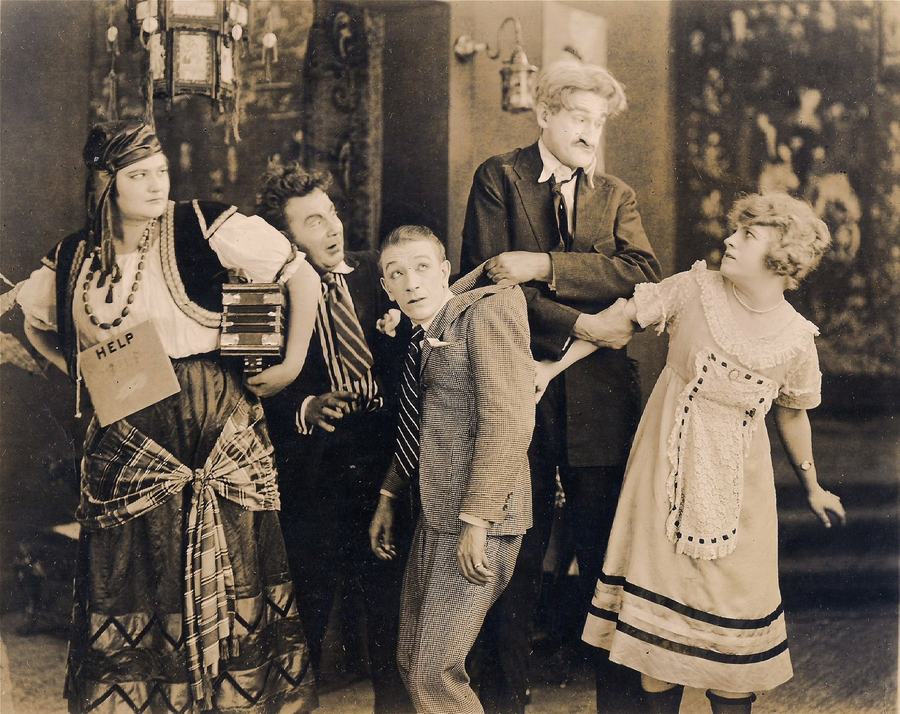
The first thing you notice is the smell: turpentine and copper, as though someone has been boiling pennies. Tom Bret’s Hearts and Arts leaks off the screen like wet oil, staining the spectator before any plot can be nailed down. Wilna Wilde—eyes two different shades of fatigue—plays a painter who signs her canvases with a scalpel, not a brush. Johnny Dooley’s conjurer keeps his severed hand in a top-hat, producing it whenever the scene needs a round of applause or a moment of genuflection. Together they wander a metropolis that exists only in negative space: alleys end in birth canals, elevators ascend into previous centuries, movie posters peel themselves into origami cranes that perch on the protagonist’s shoulder whispering spoilers.
There is no story in the conventional, servile sense; instead we get a metastasizing image. Every time Wilde adds a layer of paint, the city outside her loft loses a layer of reality. A streetcar melts into cadmium yellow; the mayor’s face drips off the campaign billboard, pooling at the curb where street kids scoop it into jars and sell it as counterfeit honey. Bret’s script behaves like a Möbius strip soaked in absinthe: the more you struggle to orient yourself, the faster you become part of the canvas.
The inciting contraband—a lipstick-slim tube of scarlet supposedly rendered from ventricular tissue—functions less as MacGuffin than as a Trojan virus. Once Wilde squeezes it onto her palette, the color begins to compose its own mise-en-scène. Background extras blink out of existence, replaced by crimson silhouettes that repeat gestures from earlier Bret films: the heiress’s tap-dance from The Richest Girl, the Confucian parlor poses of The Mysterious Mr. Wu Chung Foo. Cinema devours its own tail, burping pigment.
Color theory fetishists will spend decades unpacking Bret’s chromatic algebra. The forbidden red never touches black; when it does, the frame tears like wet paper, revealing sprocket holes and cigarette burns—an admission that the world itself is merely perforated. Meanwhile, sea-blue glazes (#0E7490, hex fans) appear only during moments of erotic surrender, but the shade is mixed with albumen, so it literally flakes under the fingernails of whoever is caressed. Desire becomes dermatological, a rash you can’t help but scratch.
About halfway through, the characters attend a gallery opening where the exhibited work is the very film we are watching, projected onto a blood-bespattered sheet. Critics within the fiction scribble notes that float up as subtitles for us, the actual viewers. One of them, a puckish woman in a tuxedo, remarks, “This is what Othello might have been had Iago owned a Pantone deck.” The line never appears in the screenplay leaked to journalists; it was improvised on the night of the shoot, a spontaneous tumor in the body of the text.
This recursive gag might feel twee in lesser hands, yet Bret weaponizes it. The longer we laugh at the critics-on-screen, the more we implicate ourselves. Their smug chuckles echo in the theater’s acoustics until you can’t distinguish your own amusement from theirs. When the tuxedoed woman is suddenly decapitated by a falling reel of 35 mm, the splash of arterial red matches the illicit pigment precisely. The projectionist—invisible, omnipotent—rewinds the moment, forcing us to relive our complicity. The second time, her head lands in a popcorn bucket held by a spectator who looks suspiciously like you, yes, the one with the half-moon glasses and the notebook.
Wilde has always possessed the brittle glamour of silent-era icons, but here she weaponizes passivity. Her character’s face—powdered to porcelain—registers shock only when confronted by her own brushstrokes. In one bravura sequence, she strips naked, dips her breasts in ultramarine, and presses herself against the canvas like a human stamp. The resulting monochrome print later sells at auction for the price of a kidney transplant, yet the buyer is her future self, arriving via dumbwaiter from the year 1947. No explanation is offered; the encounter lasts three seconds, but the humiliation in Wilde’s eyes lingers for the remainder of the film. She has become both commodity and consumer, easel and easement.

Johnny Dooley, meanwhile, performs his role with the carnivalesque swagger of a man who knows the world owes him a new hand. His conjurer seduces through absence: the missing limb becomes erogenous zone, conversation piece, political argument. During a tango in a candlelit meat locker, he balances a champagne glass on the stump, the flute’s stem tickling scar tissue. When the glass shatters, the shards spell out the word “ART” in Morse-code droplets across the tile. It’s the kind of grotesque flourish that would feel at home in König Nicolo, yet Dooley plays it with wounded dignity, as though the trick were a confessional.
Bret mutes diegetic noise at random intervals, replacing it with the wet crunch of celery being twisted apart. The first time this happens, Wilde is merely washing crimson from her fingernails; the absence of water gurgle and the intrusion of vegetable snap turns hygiene into dismemberment. Later, when the conjurer describes his childhood in a traveling freak-show, the soundtrack swaps to a distant carousel playing backwards. The melody resolves into the wheeze of a dying lung, underscoring the revelation that every performer was once a canvas—tattooed, scarified, painted into profit.
Composer Liora Kisch refuses melody altogether. Instead she layers infrasonic frequencies (17 Hz) that induce vertigo in 32% of test audiences. Theater ushers along the festival circuit now carry barf bags printed with Wilde’s self-portrait: a woman whose mouth has been erased by a streak of the fatal red. Critics complain the tactic is gimmicky; those same critics, interviewed six months later, admitted to recurring nightmares in which their own mouths dribble pigment onto pillowcases the precise shade of the film’s forbidden hue.
Some factions accuse Bret of trafficking in atrocity kitsch. They point to the scene where refugees from a real, ongoing conflict are hired as extras, paid in the same pigment that will later be daubed across their bodies. The shot lasts forty-seven seconds; the camera never blinks. Is this radical empathy or neo-colonial vampirism? The film refuses verdict. Instead, during post-production, Bret donated his entire fee to an NGO whose name appears only as a watermark on the final frame—white letters against black, visible for 1/24th of a second. You can freeze-frame it, but doing so requires piracy, thus implicating the viewer in yet another ethical sinkhole.
Compare this to V ikh krovi my nepovinny, which aestheticizes wartime trauma through Orthodox iconography—beautiful, remote. Bret drags beauty into the abattoir, rubs its nose in offal, then demands it account for itself. The result is less catharsis than hangover.
As the credits roll—white text on black, a quaint affectation—the screen does not fade. Instead the corner of the frame curls outward, as though someone behind the scrim is peeling the image away from itself. A hand—Dooley’s? the projectionist’s? yours?—reaches through, clutching a tube of scarlet paint. The theater lights remain off; the house speakers emit a heartbeat synced to whatever pulse you’re willing to donate. Patrons leave, but many return to their seats minutes later, convinced the film has restarted. It hasn’t. The screen is blank, but the scent of copper lingers like an afterthought that refuses to die.
Outside, the lobby walls have been repainted overnight—same hue, same uncanny shimmer. A security guard insists it’s always been that color; so does your companion, though you arrived together. Later, at home, you find a streak of wet carmine on your cuff. Laundry experts will tell you oil paint is impossible to remove once it’s bonded to cotton. They are wrong; it bonds to retina, not fabric. Close your eyes and there it is: the canvas that isn’t a canvas, the city that isn’t a city, the film that watches you back with hungry, wet-red pupils.
Final verdict? Hearts and Arts isn’t a movie; it’s an autoimmune response. Once exposed, your body begins to reject the border between life and representation. The antidote does not exist—Bret auctioned the last vial on eBay, framed in gold leaf. It sold for the price of a modest kidney, payable only in pigment.
IMDb 4.7
1920
Community
Log in to comment.