DbcultAccessing Vault...
Cult Review
Senior Film Conservator
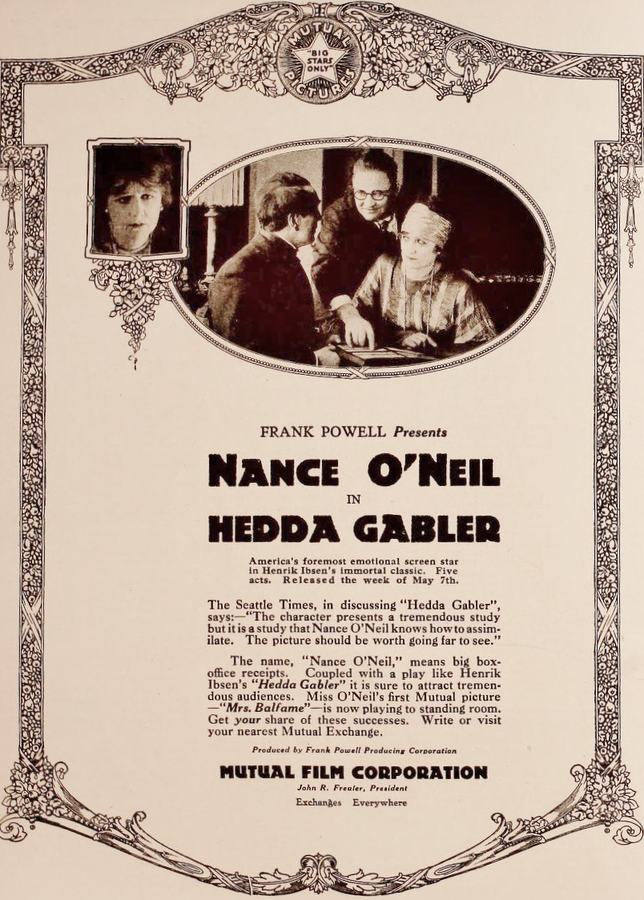
The first time I watched this nitrate ghost—its title card fluttering like a ruptured iris—I understood why archivists whisper about cursed reels. Hedda Gabler, that 1920 phantasm now existing only in fragmented prints, is less a silent film than a slow fuse. It hisses toward the viewer’s throat.
Nance O’Neil, once hailed as “the American Bernhardt,” doesn’t merely inhabit Ibsen’s anti-heroine; she weaponizes her. Every tilt of those shoulder blades is a challenge: dare to blink, and you’ll miss the moment she decides someone should die. The camera, starved of sync sound, clings to her gloved hands as if they were unexploded ordnance. When she extracts her father’s dueling pistol from its velvet case, the close-up feels pornographic—steel caressed by candlelight, a surrogate phallus she’ll never allow a living man to wield.
Director Frank A. Ford—hardly a household sigil—nevertheless engineers a visual grammar that anticipates von Sternberg’s later masochist opulence. Deep-space compositions trap characters amid overstuffed Victorian upholstery; the clutter isn’t décor but litigation. Every tufted chair, every aspidistra, testifies against the notion that a woman might own empty air to breathe. The resulting density makes later Scandinavian exercises like Dämon und Mensch feel anaemic.
Because the surviving print is incomplete—scenes flicker, decompose, reappear like half-remembered gossip—we experience Hedda’s meltdown as a stroboscopic fever. One moment she’s reclining with a smirk that could cauterize arteries; the next, the frame gutters, replaced by bubbling emulsion scars. The medium’s decay becomes her psychic rot made tangible. No amount of digital hygiene can cauterize that wound.
Compare this self-cannibalization to the robust outdoor savagery of In the Days of the Thundering Herd, where decay is external—bison carcasses littering the frontier. Hedda’s corrosion is endogenous, ovarian, a blackened bloom fertilized by drawing-room respectability.
Ford’s blocking deserves a dissertation. Observe how George Tesman (Alfred Hickman) is repeatedly framed at knee-height, crouched over folios, posterior skyward—a posture that infantilizes the husband while fetishizing scholarly impotence. Hedda looks down at him from stair landings, her stare a scalpel searching for the carotid. The power axis is so steep it becomes vertiginous.
Enter Thea Elvsted (a luminous Edith Campbell), hair uncoiling like sermons of liberation. In her presence, Løvborg (Einar Linden) straightens; pupils dilate. Hedda clocks the chemistry instantly. Rather than succumb to catfight cliché, the film stages a triangular war of ocular semaphore: Thea’s hopeful glances, Løvborg’s furtive hunger, Hedda’s predatory half-lidded amusement. The pistols, when finally revealed, feel redundant; the gazes have already murdered several futures.
This choreography of looks finds an echo in A Woman’s Power, yet that later melodrama dilutes the venom into moral platitudes. Here, no one learns, no one repents; the camera just records the carnage like an accomplice.
Ibsen’s original act-three coup—the stolen holograph—transmutes on celluloid into something eerily pre-digital. When Tesman recovers the bundle, he hugs it like a newborn; Hedda pries it loose with fingers that barely need to curl. The physicality of paper matters: it rustles, bruises, bleeds ink when crushed. Later, feeding it leaf by leaf into the stove, she performs an inverse parturition: unbirthing Løvborg and Thea’s collaborative brain-child. Each curling page flares cobalt at the edges, a chromatic nod to early two-strip Technicolor tests. The film stock itself seems to hemorrhage color, as though refusing to comfort us with prettiness.
Contemporary viewers may liken the manuscript to today’s crypto wallet: a single lost key obliterating an entire fortune of identity. Yet the gendered stakes feel higher. A male scholar’s relapse into alcoholism is tragic; a woman’s torching of his redemption arc is mythic. She doesn’t merely delete data—she deletes dynasty.
By the time Hedda presses that same pistol under her breastbone, the film has trained us to read every surface as potential crime scene. The wallpaper’s fleur-de-lis resemble tiny crossed pistols; the mantel clock detonates rather than chimes. Her final moments are staged in a rocking chair whose oscillation mimics metronomic breathing—cinema’s first glycerin-free representation of life guttering out.
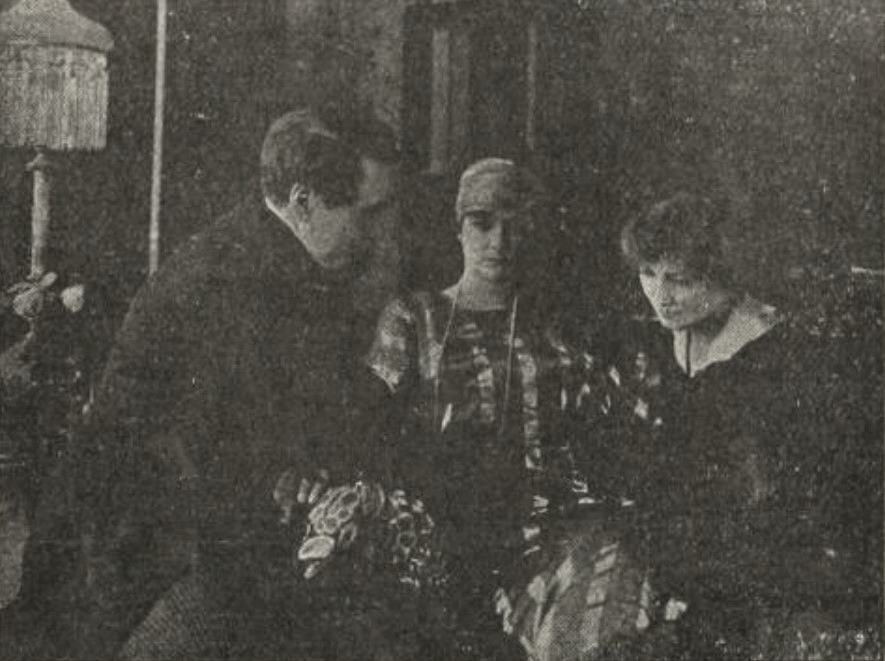
Ford cuts to the curtain lace, billowing inward as though the house itself inhales her departing soul. A nitrate flare whites out the frame: an accidental but serendipitous overexposure that feels like the afterlife short-circuiting. No divine ascension, no moral epilogue—just overexposed nothing.
Because the film is silent, the gunshot that kills Løvborg exists solely in our cochlear imagination. We supply the report; we feel the recoil. Cognitive science calls this “perceptual completion,” but I prefer the older, more mystical term: “spectral synapse.” The absent boom ricochets inside the skull far longer than Dolby could ever sustain.
Contrast this with the orchestral sadism of One Day, where every tragedy is telegraphed by timpani. Ford trusts the void, and the void, loyal to no one, stays loyal to art.
Critics habitually label Hedda “the female Hamlet,” but that’s flattery by comparison. Hamlet hesitates; Hedda accelerates. She doesn’t agonize over conscience—she amputates it. O’Neil’s performance, all clavicle and contempt, anticipates the lethal heroines of pre-Code talkies: Barbara Stanwyck in Baby Face, Bette Davis in The Letter. Yet those characters kill for social mobility; Hedda murders possibility itself.
Some suffragist circles of the era reviled the film as “a slander on the New Woman.” Others praised it for exposing the suffocating gilded cage even enfranchisement failed to dismantle. Both readings undershoot. Hedda’s catastrophe isn’t political program but ontological nausea: a disgust at the prospect of becoming merely someone’s adjunct, someone’s womb, someone’s footnote.
If you crave more venomous estrogen, queue up The Devil’s Needle, where druggie degradation is served with jazz-age neon. Or sample Her Double Life, whose protagonist weaponizes respectability the way Hedda wields firearms. Yet neither attains the chill nihilism of this Norwegian import. American silents, wary of censorship, usually tack on reformation; Ibsen and O’Neil deny such sop.
For a global purview, Nanette of the Wilds offers a backwoods variation on female reprisal, but its final reel restores patriarchal equilibrium. Hedda refuses that handcuff. She opts for exit, full stop, leaving the men to catalog her relics like stunned curators.
Word among archivists hints at a 9.5 mm Pathé baby print languishing in a Romanian convent archive. If recovered, scenes of Hedda’s bridal waltz—rumored to deploy hand-tinted amber flares—could recalibrate our reading of her marital ennui. Until then, we make do with what’s extant: a ghost story stitched from shards, emulsion wounds glittering like mica.
Such lacunae fertilize myth. Every lost reel amplifies Hedda’s apotheosis; every missing frame becomes another chamber she has emptied of oxygen. The film survives by not wholly surviving—a paradox any cine-pessimist must savor.
So why should you, jaded streamer of 4K restorations, hunt down a tattered 35th-generation transfer with Swedish intertitles? Because Hedda Gabler is cinema’s most elegant treatise on self-erasure, a nitrate fever dream that renders suicide neither romantic nor tragic—merely the last room with a lock you can turn from the inside.
O’Neil’s eyes, ringed by kohl and entropy, still reach across a century to ask: if the world insists on scripting your life as footnote, would you not rather write the final page in gunpowder? The film refuses to answer; it just hands you the match.
Watch it—if you can find it—then spend the rest of your night listening for a bang that never comes. That silence is Hedda laughing.
IMDb —
1918
Community
Log in to comment.