DbcultAccessing Vault...
Cult Review
Senior Film Conservator
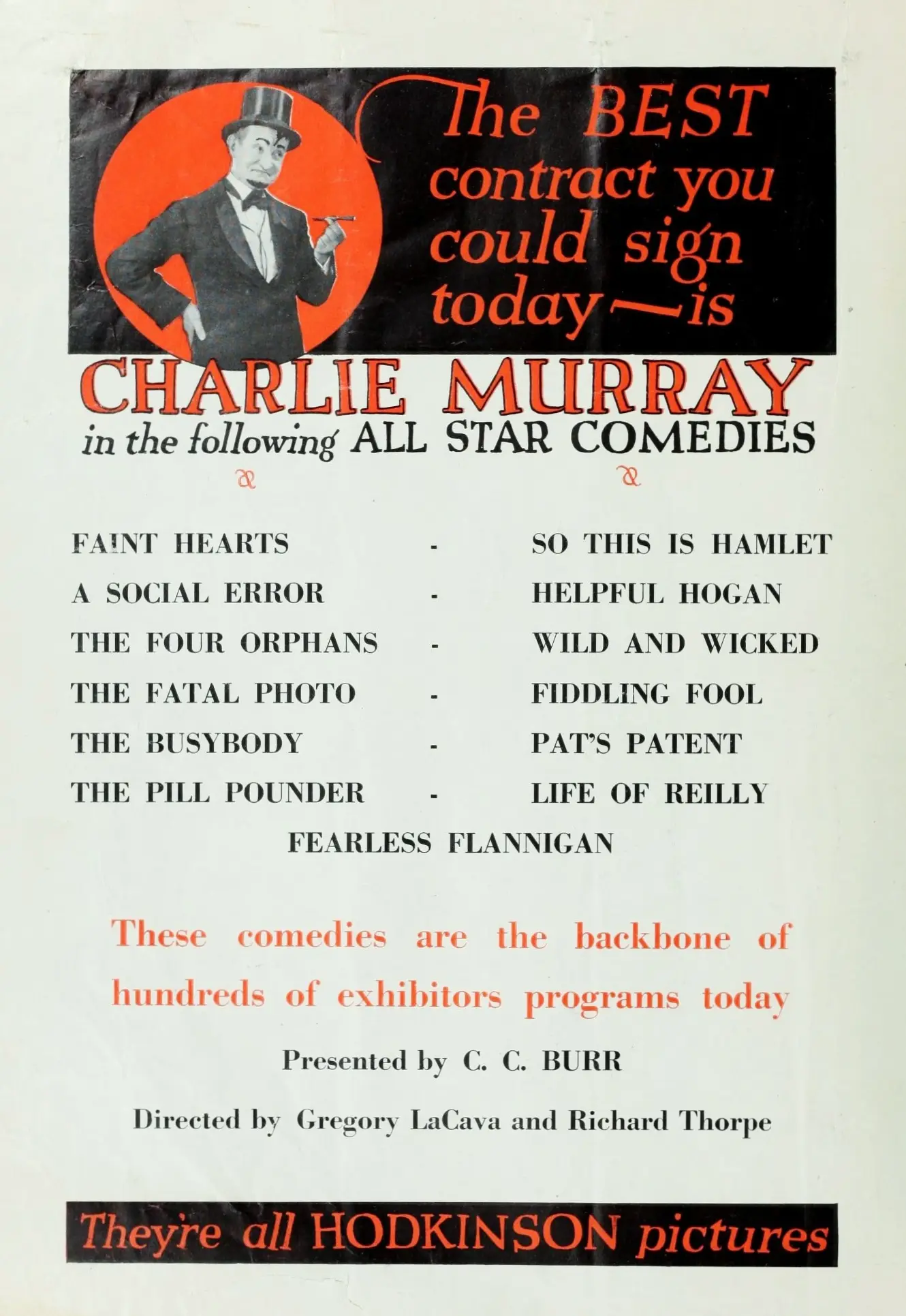
Stepping back into the flickering shadows of early 20th-century cinema, one encounters a peculiar breed of comedic architecture, often built on the simplest of premises yet yielding surprisingly complex emotional resonance. ‘Helpful Hogan’, a name that promises benevolent intervention, delivers instead a masterclass in the ironic reversal, a delightful subversion of expectation that characterizes much of the era's best physical comedy. Charles Murray, a stalwart of silent film, anchors this narrative with a performance that is both endearing and utterly exasperating, embodying a character whose very essence is a contradiction: a man whose heart is gold, but whose hands are harbingers of chaos. His Hogan is not malicious; indeed, he is the epitome of good-naturedness, a soul genuinely inclined towards altruism. Yet, it is precisely this unyielding desire to assist that becomes the engine of every escalating disaster, transforming minor embarrassments into public spectacles and simple misfortunes into grand, unforgettable farces. The film, in its brevity and clarity of purpose, manages to distill a universal truth about the best-laid plans of mice and men, often leaving both in a state of disarray.
The comedic mechanics at play here are quintessential silent-era slapstick, yet executed with a precision that elevates them beyond mere pratfalls. Murray’s physicality is central to this. He doesn't just fall; he tumbles with a certain grace, a bewildered dignity that makes his predicaments all the more humorous. When he attempts to right a capsized canoe, he inadvertently capsizes a dozen more. When he tries to retrieve a dropped item, he triggers a domino effect of destruction. It’s a beautifully choreographed dance of unintended consequences, each movement contributing to a larger, more elaborate comedic tapestry. The genius lies in the film's relentless escalation. What begins as a minor mishap quickly spirals into a community-wide catastrophe, all thanks to Hogan's well-intentioned but utterly clumsy interventions. The film never allows the audience to forget the source of the mayhem, constantly cutting back to Hogan's earnest, furrowed brow, his genuine confusion as to why his efforts consistently yield such calamitous results. This creates a compelling juxtaposition between his internal world of helpfulness and the external reality of havoc.
The supporting cast, including the talented Kathryn McGuire and Raymond McKee, serve as excellent foils to Murray's bumbling benevolence. Their reactions—ranging from bewildered tolerance to outright exasperation—are as crucial to the comedy as Hogan’s actions themselves. McGuire, in particular, often portrays the recipient of Hogan’s 'help,' her expressions conveying a spectrum of human emotion, from initial gratitude to profound mortification. This interplay between the well-meaning perpetrator and the increasingly distressed victims forms the emotional core of the film, allowing the audience to empathize with both sides of the comedic equation. It's not just about what Hogan *does*, but how others *react* to his doing, and how their dignity is slowly eroded by his relentless, if unintentional, onslaught of assistance. One might draw a parallel to the escalating social awkwardness found in films like ‘The New Teacher’, where a newcomer's earnest attempts to fit in inadvertently lead to a series of escalating gaffes, though Hogan’s impact is far more widespread and physically destructive.
The film's visual storytelling is another highlight. Without the crutch of dialogue, every gesture, every facial expression, and every meticulously staged gag must convey meaning. The directors (though uncredited in the prompt, the visual language speaks volumes of their craft) employ wide shots to establish the scale of Hogan’s chaos and close-ups to capture the nuanced reactions of the characters. The pacing is brisk, a rapid-fire succession of gags that keeps the audience engaged and laughing. There's a certain timeless quality to this kind of observational humor, where the comedy arises from universal human experiences: the desire to help, the fear of embarrassment, and the sheer absurdity of life’s unexpected twists. The editing, while perhaps primitive by today’s standards, is effective in building momentum, cutting between Hogan’s earnest efforts and the ensuing pandemonium with a rhythm that underscores the comedic timing. This is a film that understands the power of visual irony, where the gap between intention and outcome is the source of all humor.
‘Helpful Hogan’ also offers a fascinating glimpse into the social mores and everyday life of its era. The settings—be it a bustling street, a tranquil park, or a communal gathering—are rendered with a level of detail that transports the viewer. The film doesn't just tell a story; it paints a picture of a bygone world, where community interactions were perhaps more direct, and public mishaps could quickly become local legends. The humor, while broad, is rooted in relatable scenarios, making it accessible even to modern audiences unfamiliar with silent film conventions. It's a reminder that human nature, with all its inherent follies and aspirations, remains remarkably consistent across generations. The film's portrayal of societal reactions to Hogan's antics, from initial shock to eventual collective exasperation, reflects a community grappling with a well-meaning but ultimately disruptive force. This societal backdrop adds another layer to the comedic narrative, making Hogan's blunders not just personal failures, but public disturbances.
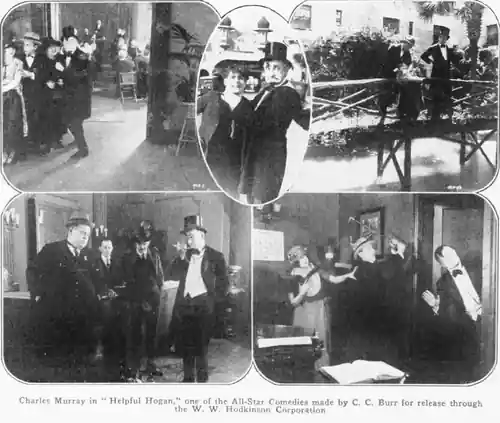
Comparing Hogan's character to other figures of silent comedy, one might see echoes of the earnest but often out-of-his-depth protagonists found in many contemporary shorts. However, Hogan's particular brand of disaster-prone helpfulness sets him apart. He is not merely clumsy; he possesses an almost supernatural ability to turn the simplest task into an epic failure. This isn't the graceful, often poetic slapstick of Chaplin, nor the daredevil stunts of Keaton. Instead, it's a more grounded, yet equally absurd, form of comedy rooted in the exasperation of everyday life. One could argue that Hogan's character shares a thematic resonance with films like ‘John Petticoats’, where a character's attempt to navigate unfamiliar social territory leads to a series of missteps and comedic misunderstandings. However, Hogan's impact is more physically destructive, his interventions leaving tangible wreckage rather than just bruised egos.
The brilliance of Murray's portrayal lies in his unwavering optimism. No matter how many wagons he overturns, how many people he inadvertently douses with water, or how many structures he unintentionally dismantles, Hogan remains resolutely cheerful, utterly oblivious to the trail of destruction and humiliation he leaves in his wake. This blissful ignorance is key to the humor. If Hogan were aware of the scope of his blunders, the film would lean into tragedy. Instead, his perpetual good humor transforms potential pathos into pure, unadulterated comedy. It's a testament to Murray's skill that he can maintain this delicate balance, making Hogan both a sympathetic figure and an agent of relentless chaos. His facial expressions, particularly, convey a childlike innocence, a perpetual state of 'what just happened?' that is endlessly amusing. This lack of self-awareness is Hogan's defining trait, and it is meticulously maintained throughout the film, providing a consistent comedic anchor.
The film's exploration of the theme of 'good intentions' is surprisingly nuanced for a comedy of its time. It playfully suggests that perhaps not all acts of charity are truly helpful, especially when executed by someone with Hogan's particular set of skills (or lack thereof). It’s a subtle commentary on the difference between wanting to help and actually being capable of helping, a distinction that Hogan perpetually fails to grasp. This underlying theme gives the film a depth that transcends its slapstick surface, inviting viewers to ponder the true nature of assistance and its often-unforeseen consequences. It's a narrative that implicitly questions the adage that 'it's the thought that counts,' demonstrating that sometimes, the thought, when coupled with monumental ineptitude, can be more detrimental than outright malice. This philosophical undercurrent, while never preachy, enriches the comedic experience, making the laughter slightly more thoughtful.
Moreover, the sheer inventiveness of the gags is commendable. Each scenario Hogan finds himself in is a fresh opportunity for disaster, and the film rarely repeats itself, finding new and creative ways for his helpfulness to go awry. From assisting a stranded motorist to intervening in a minor altercation, every situation becomes a canvas for Hogan's unique brand of accidental destruction. This commitment to fresh comedic scenarios prevents the film from feeling repetitive, a common pitfall in serial comedies of the era. The production values, though modest, are entirely appropriate for the narrative, allowing the focus to remain squarely on the characters and the unfolding comedic events. The set pieces are functional, serving as playgrounds for Hogan's inadvertent mayhem, rather than distracting backdrops. The film's commitment to continuous invention within its simple premise is a testament to its enduring comedic power.
The film's place within the broader context of silent comedy is perhaps not as prominent as the works of the 'big three,' but it represents a vital thread in the fabric of the genre. It's a testament to the myriad ways comedic talent found expression in an era defined by visual storytelling. Films like ‘Blue Blood and Bevo’, while different in plot, share a similar spirit of lighthearted, episodic comedic adventures, where the enjoyment comes from watching characters navigate increasingly absurd situations. ‘Helpful Hogan’, with its singular focus on a character whose defining trait is his ironically disastrous helpfulness, carves out its own niche. It’s a film that reminds us that humor doesn't always need grand narratives or complex character arcs; sometimes, the simplest premise, executed with skill and genuine comedic sensibility, is more than enough to entertain and provoke thought. The film showcases a particular brand of humor that relies on the audience's anticipation of impending doom, knowing full well that Hogan's next act of kindness will inevitably lead to further chaos, and relishing every moment of that predictable, yet endlessly entertaining, downfall.
Ultimately, ‘Helpful Hogan’ stands as a charming, if somewhat overlooked, example of silent-era comedic brilliance. Charles Murray's performance is a tour de force of physical comedy and character acting, making Hogan a memorable figure in the pantheon of well-meaning cinematic blunders. The film’s ability to generate consistent laughter from a simple, repeated premise speaks volumes about its craftsmanship and the timeless appeal of its humor. It’s a delightful journey into a world where good intentions pave the road to comedic hell, and every act of kindness is a potential disaster waiting to happen. For anyone seeking to understand the foundations of cinematic comedy, or simply in need of a good, hearty laugh, ‘Helpful Hogan’ offers a compelling and thoroughly entertaining experience. Its legacy, though perhaps not shouted from the rooftops of film history, is subtly woven into the fabric of comedic storytelling, a quiet testament to the enduring power of a well-executed gag and a character whose heart is perpetually in the right place, even if his actions are anything but. The film, in its unpretentious charm, continues to resonate, demonstrating that the universal language of laughter requires no dialogue, only genuine human folly and the brilliant execution thereof.
IMDb 6.4
1930
Community
Log in to comment.