DbcultAccessing Vault...
5/10
Senior Film Conservator
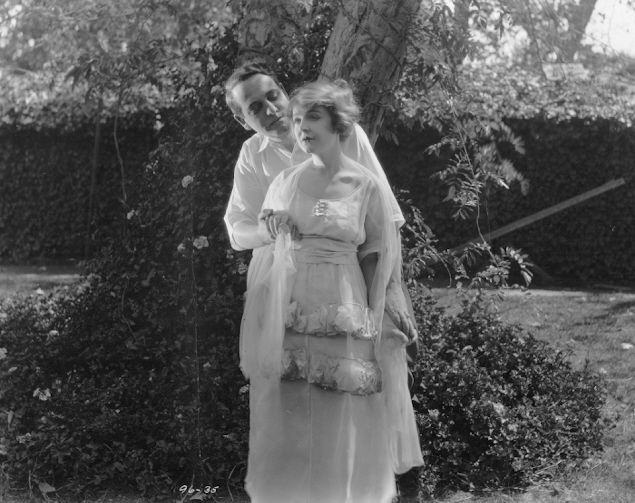
A definitive 5/10 rating for a film that redefined the boundaries of cult cinema. Her Husband's Friend remains a cornerstone of transgressive art.
Spoilers cling to every reel—enter only if you dare.
Picture, if you can, a marriage dissolving not with a whimper but with the crisp snap of legal parchment. Judith Westover—played by Enid Bennett with the feline composure of a woman who has already mourned her love while the body beside her still breathes—stands in a drawing room paneled in the color of old money. She requests her freedom from Billy, a boy-king of capital rendered by Rowland V. Lee as a cigarette-wielding Icarus whose wings are soldered with gold leaf. Billy’s infidelity is not a scarlet letter but a neon sign, flashing its gaudy promise to every chorus girl who drifts like cigarette smoke through the speakeasy haze. The camera, hungry, lingers on Judith’s eyes: two polished onyx stones reflecting a future she has already decided to abandon.
Then the telephone rings—a shrill mechanical bird heralding catastrophe. Billy’s fortune, once as reliable as sunrise, has imploded in a margin-call avalanche. The news lands like a guillotine, severing the last filament of his swagger. He exits, coat flapping like a broken sail, and steps into the street where fate arrives wearing the chrome grille of a delivery truck. The collision is not shown; we glimpse only Judith’s face through beveled glass, watching the world invert in the time it takes for a teacup to slip from saucer to parquet. The abruptness is Brechtian before Brecht was fashionable: life discounted to a telegram of loss.
Cut to the Ogilvy estate—an empire of lawns maintained by invisible armies of gardeners who clip every blade to the height of propriety. Here the film’s palette shifts from urban chromium to pastoral silver, as though someone has poured moonlight directly into the emulsion. Dr. Henrietta Carter, essayed by Aileen Manning with the brisk tenderness of a woman who has seen every variety of heartbreak and keeps them catalogued like pressed flowers, prescribes solitude and sea air. Yet solitude is a porous commodity in silent cinema; it leaks, and into Judith’s drifts Princeton Hadley—George C. Pearce investing the role with the weathered grace of a man who has loved one woman in absentia for years, unaware she was ever another man’s wife.
Hadley’s introduction is a masterclass in negative space: he emerges from a hedge-framed horizon, the camera reluctant, as though afraid to commit to his solidity. Bennett’s Judith lounges beneath a parasol whose lace edges tremble like guilty secrets. Their conversation is conveyed through intertitles that crackle with subtext—every declarative sentence a drawbridge raising against invasion. Only later, when Hadley’s lawyer blurts the awkward arithmetic of alimony, does the edifice of etiquette crumble. Judith’s fury is operatic yet intimate: she flees not on horseback but behind the wheel of her convertible, a mechanical Bacchante conjuring dust devils on the gravel. Hadley’s pursuit is less gallant than desperate; he clings to the speeding door, a living hood ornament, until the railroad crossing arms descend and the world becomes a blur of iron and steam.
The crash—rendered through a whip-pan, a matte shot, and a cut so abrupt it feels like a sneeze—deposits them in a hospital ward that resembles a cathedral of white. Side-by-side, swaddled in bandages that gleam like shrouds under nitrate bloom, they resemble marble effigies awaiting Renaissance resurrection. Hadley’s proposal is whispered, intertitle reduced to trembling serif: “Marry me—let the ledger of guilt close.” Judith’s consent is not a swoon but a contract signed with the pragmatism of someone who has already died once today.
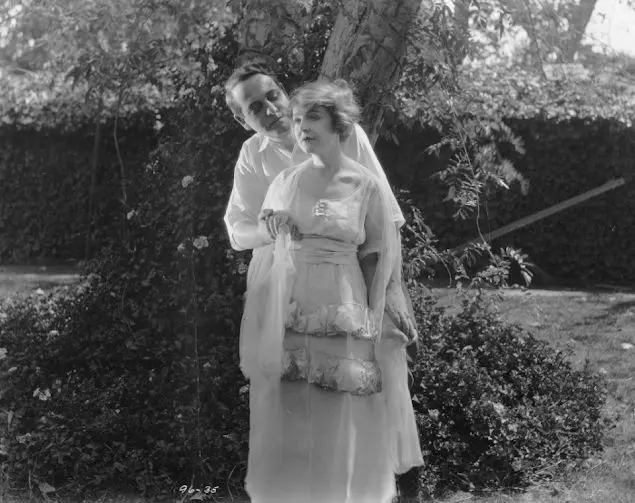
What lingers is not the melodrama but the residue of unspoken economies: the way affection is laundered through financial obligation, the manner in which women’s anger must be routed through vehicular self-destruction before it earns legitimacy. Compare this to The Case of Becky where split identity offers escape, or to A Pair of Pink Pajamas where marital farce is played for laughs. Here, the tone is autumnal: every laugh line feels like a leaf about to detach.
Visually, the film hoards surprises. A double-exposure dream sequence superimposes Billy’s spectral silhouette over Judith’s sleeping face, the opacity dialed so low he seems etched in cigarette ash. The estate’s night exteriors are shot day-for-night, the sky a sulfurous yellow that makes the hydrangeas glow like irradiated lace. Meanwhile, interior scenes favor chiaroscuro: faces half-swallowed by shadow, as though the frame itself were conducting an affair with obscurity.
Enid Bennett’s performance is a ledger of micro-movements: the way her gloved finger rubs the velvet nap of a sofa arm when learning of Billy’s bankruptcy, a gesture that stands in for the scream she refuses to release. Pearce counterbalances with stillness—his Hadley is a man who has learned that survival sometimes requires the camouflage of furniture. Together they generate the hush that precedi confession, a silence more erotic than any clinch.
The screenplay, triangulated among Carol Kapleau, Marjorie Benton Cooke, and Agnes Christine Johnston, flirts with didacticism yet repeatedly swerves into ambiguity. When Judith races her roadster toward the railway abyss, is she fleeing Hadley’s benevolent patriarchy, or is she auditioning for her own extermination? The intertitle offers no comfort: “If trust is payment, I default.” The line reverberates across the decade, echoing the credit bubbles that would burst into the Great Depression.
Compared to the continental nihilism of Opfer or the sun-scorched fatalism of El block-house de alta luz, Her Husband’s Friend is uniquely American in its conviction that reinvention is always one honest conversation away—provided that conversation occurs under morphine’s benevolent haze. The film’s final shot—a slow fade on Judith and Hadley clasped hands, wedding bands glinting like shackles polished for gala use—offers closure so tidy it feels subversive. We are not comforted; we are warned.
Yet perhaps the greatest thrill lies in the film’s present absence. Prints languish in vaults or have been melted for their silver, leaving only lobby cards and this critic’s fevered recall. To write about Her Husband’s Friend is to conduct an autopsy on a ghost, to project onto nitrate shadows the phantoms of our own matrimonial math. In that act of projection, the movie lives—an alimony paid not in currency but in collective memory, compounding interest with every retelling.
So seek it, dear reader, in basement archives or in the flicker of a YouTube fragment uploaded at 240p. Let its brittle silence speak to your most secret ledger of betrayals and bounties. And when the train whistle blows on that fateful crossing, ask yourself: which debt are you still paying, and whose hand are you clutching in the hospital of your own making?
IMDb 5.9
1936
Community
Log in to comment.