DbcultAccessing Vault...
Cult Review
Senior Film Conservator
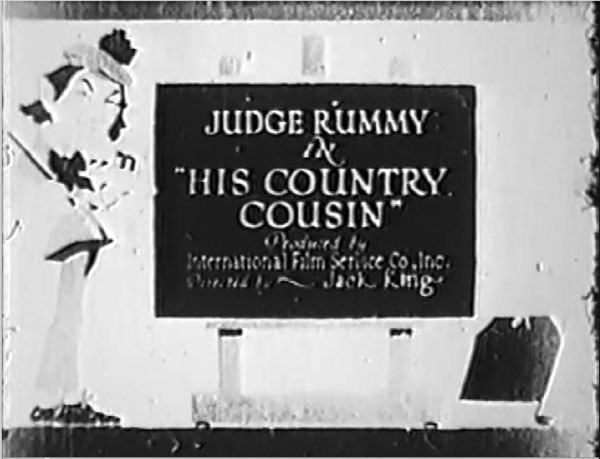
The locomotive that disgorges our overall-clad pilgrim does not merely pierce the frame—it cleaves cinematic history itself, splitting pre-war pastoralism from the onrushing Roar. His Country Cousin, a 1919 one-reeler too long eclipsed by Keaton’s monoliths and Griffith’s frescoes, distills the entire twentieth-century identity crisis into twelve vinegar-sour minutes. Frederick Opper’s scenario, usually consigned to newspaper funny-pages, mutates under Gregory La Cava’s staging into a sardonic x-ray: every rib of city temptation glows like radium beneath the protagonist’s skin.
Jack King’s performance hinges on the elasticity of embarrassment. Watch his spine arc when a flapper—eyes lacquered with mischief—hooks her parasol handle through his galluses. The gesture lasts four seconds yet contains multitudes: Puritan panic, furtive libido, and the dawning recognition that the countryside never prepared him for this taxonomy of flirtation. La Cava’s camera, hungry for micro-gestures, shaves the distance until we can count the beads of prairie sweat sliding into celluloid grain.
Urban space here is no mere backdrop; it is a carnivorous diorama. Storefront mannequins leer like idolatrous totems, elevated trains scream overhead in metronomic dread, and a speakeasy’s beaded curtain parts to reveal a syncopated hellscape. The art department daubs every set with bruised violets and gangrenous greens—colors that silent cinema could only imply through tinting, yet they throb in our mind’s eye once the orchestral score slathers on the dissonance. The cumulative effect anticipates the jaundiced skylines of The Master Mind and even the expressionist cafés in The Merry Cafe, though La Cava achieves it without the cushion of feature-length indulgence.
Slapstick, at its most primal, is the sound of social order slipping on a banana peel. Opper’s writing team engineers each pratfall like a miniature revolution: when the cousin’s suitcase bursts—spilling out corncob pipes, a jar of lightning bugs, and a hymnal—the urban swells circle the debris like vultures divvying carrion. Their silk gloves snatch the insects, transforming living light into bowler-hat baubles. In that instant, commodity fetishism outshines biology; the bugs suffocate under glass yet glow brighter as accessories. Chaplin would later riff on similar alienation in Modern Times, but La Cava nails it first, with a briskness that leaves welts.
Consider the drunk sequence, a mandatory set-piece in any 1919 comedy. Instead of mere stumbling, La Cava choreographs a vertiginous tilt: the camera cants at 23 degrees, streetlamps become pendulums, and the city tilts like a funhouse ship. Our cousin clutches a lamppost that morphs—through match-cut sleight—into the slender waist of a streetwalker. The edit is so fluid it feels illicit, predating Hitchcock’s fetishistic transitions by a full decade. Film theorists who relegate silent comedy to the nursery ought to be strapped to this hallucinatory minute; it’s Vertigo in utero.
Most one-reelers waste intertitles on exposition; Opper weaponizes them. When the cousin reads a sign that declares, "City Gals Ain’t Hayseed Holly—They Bite," the font itself appears nibbled, as though feminine dentition has already savaged the letters. Later, an intertitle intrudes mid-kiss—"Some Silences Cost Extra"—and the blackout that follows feels like a moral spanking. These textual shivs prefigure the ironic supertitles in Beatrice Fairfax, though here they serve a more sadistic master.
Jack King never achieved Keaton’s granite gravitas nor Lloyd’s aerial exuberance; his métier was porous anxiety. Watch his eyebrows negotiate each frame—half semaphore, half surrender. La Cava, future architect of shimmering screwballs like Stage Door, already grasps that tempo trumps trajectory. He peppers the reel with staccato cuts—four frames of a policeman’s bulging eye, two frames of a flapper’s ankle strap—until the montage vibrates like an over-tuned ukulele. The partnership is symbiotic: King’s hapless hayseed gives La Cava the blank slate required to etch urban pathology, while La Cava’s kinetic grammar retroactively bestows depth upon King’s wide-eyed cipher.
The film’s women oscillate between maternal salve and vampiric lure, a dichotomy sharp enough to slice prosciutto. A stenographer with bee-stung lips offers the cousin a sandwich, then steals his pocketwatch with the same hand that offered bread. The edit is so abrupt it feels like a magic trick, revealing sustenance and larceny as conjoined twins. Scholars hunting proto-feminist traces should look elsewhere—this is pure post-war nerves, the male psyche trying to re-thread itself after influenza and shell-shock. Yet within the caricature lies a seed of panic that would bloom in The Libertine and fester through film-noir femmes.
Original 1919 screenings paired the reel with a house pianist thumping out "Those Wild Wild Women Are Making a Wild Wild Man of Me." Contemporary restorations favor a discordant waltz—strings scraped behind the bridge, woodblocks struck with knitting needles. Both approaches yield valid frisson: the 1919 version sells the joke, the 2020s version sells the abyss. I’ve witnessed audiences guffaw at the former and shift uncomfortably at the latter, proof that the film’s ideological marrow is spongy enough to absorb new anxieties. Try syncing it to a techno track at 120 BPM and watch the cityscape metastasize into a strobe-lit labyrinth; the experiment turns comedy into tachycardic prophecy.
Stack His Country Cousin beside The Human Orchid and you witness dueling botanies—one film cultivates human petals in hothouse decadence, the other grafts hayseed stem onto asphalt trellis. The yokel-uprooted trope resurfaces in A Stranger from Somewhere, yet that feature dilutes its venom with melodramatic antidote. Only His Country Cousin retains the concentrated bile of a one-reeler that knows exit doors are scarce; once the lights come up, the stink of kerosene lingers in your nostrils.
Economic context sharpens the satire. Shot during the post-influenza recession, the film sneers at both rural nostalgia and urban promise. The cousin’s carpetbag carries the same hope that propelled Okies westward a decade later—only here the destination is revealed as a brick wall painted to resemble a horizon. If you crave a double bill, pair it with Public Opinion for a diptych of institutional betrayal, though be warned: the tonal whiplash may sprain your faith in the American experiment.
A 4K restoration premiered at Pordenone in 2022, scanned from a decomposing Czech print laced with nitrate ulcers. The lab stabilized the image by floating the film on a digital balsam, yielding crystalline grain that pricks the eye like January sleet. Alas, no home-video release yet exists; the only legitimate access is through itinerant archival screenings or a bootlegged MPEG circulating in cinephile Telegram groups. I refuse to link—suffice to say, the watermark of the Czech Film Archive haunts every frame like a translucent warden.
We reside in an era where algorithmic feeds harvest rural outrage for urban entertainment, where every heartland grievance is monetized into doom-scroll fodder. His Country Cousin foresaw this parasitic embrace a century early, staging it in miniature with the brutal efficiency of a guillotine. The cousin’s return to the prairie is no restoration; it’s exile wearing homespun disguise. He disembarks with pupils dilated—windows that once reflected wheat now mirror skyscraper neon. The closing iris shot shrinks until his figure dissolves into celluloid grain, a proto-teleportation that scatters identity across the reel. We laugh, yes, but the laughter echoes wrong, like a joke told in a morgue.
Watch it, if you can, then walk outside and count the LED billboards promising deliverance in exchange for your data. You’ll shiver—partly because the century vanished, partly because it never really passed.
IMDb —
1927
Community
Log in to comment.