DbcultAccessing Vault...
5.3/10
Senior Film Conservator

A definitive 5.3/10 rating for a film that redefined the boundaries of cult cinema. Woman remains a cornerstone of transgressive art.
There are films you watch and films that watch you—Woman belongs to the latter caste. Ninety-seven flickering minutes feel like stepping into a palimpsest where every frame has been scraped, rewritten, bruised, and re-inked by hands that refuse to stay docile. Charles E. Whittaker, a name half-swallowed by the quicksand of lost cinema, orchestrates a tetralogy of disobedience: four micro-epics orbiting the same white-hot core—what does it mean to be woman when the world keeps drafting tighter circles around the letter W?
Forget flannel-graph Sabbath-school iconography. Whittaker’s Eden is a cobalt soundstage drenched in acetylene moonlight. Faire Binney’s Eve enters barefoot, her hair a black comet, eyes registering neither innocence nor guile but the feral curiosity of a lab subject who realizes the cage door is ajar. The serpent—played by a sinuous Frank Lackteen in scales of gold leaf—doesn’t whisper; he declaims, each intertitle a haiku of enticement: "Taste and the axis tilts." When she bites, the fruit explodes into hand-tinted vermilion droplets that splatter the lens, a visual oath that what we are about to witness is not sin but systemic sabotage. The expulsion montage—achieved via triple exposure—shows Adam trudging forward while Eve keeps pivoting back toward the garden, her body multiplying into a chorus of irrepressible returnees. One exit, a thousand re-entries.
Cut to Rome, a city of trompe-l’œil marble where Hope Hampton’s Messalina reclines like a predator evaluating the caloric yield of prey. Whittaker refuses the tired trope of the nymphomaniac empress; instead he gives us a statist who weaponizes libido the way Ceasar wielded cavalry. She negotiates with senators while her hand, off-frame, pleasures a faceless gladiator—an economy of attention that turns coitus into caucus. When the knives finally flash, the assassination is intercut with shots of a loom: each stab equals a severed thread, suggesting that to unmake a woman in power you must first unweave the narrative fabric she has embroidered. Hampton’s death mask, superimposed over a senate vote count, lingers until the celluloid itself seems to decay—a proto-horror effect that anticipates the fungal nightmares of The Death-Bell by nearly a decade.
The third movement relocates us to twelfth-century Paris, rendered in German-expressionist angles that make every gargoyle look like a gossip. Gloria Goodwin’s Heloise is introduced eyes-downcast over a wax tablet, yet the camera tilts up to catch a smirk: she already knows her intellectual libido exceeds Abelard’s, and certainly the cramped vocabulary of wedlock. Their love scene is famously elliptical: a shared close-up of two hands copying Aristotle, ink smudging until fingerprints merge—an erotic merger more subversive than any bodice-ripper. When uncle Fulbert’s goons burst in to castrate Abelard, Whittaker withholds the mutilation; instead we get a single, scalding shot of Heloise’s face reflected in a brass mirror, her pupils flaring crimson (hand-tinted, again) as if the violence ricochets back onto the viewer’s eyeballs. Post-castration, the film follows Heloise to the nunnery, where she pens letters that float across the screen as double-exposed scrolls, each line a quiet grenade lobbed at patriarchal fortifications.
The coda lands on a Mediterranean fishing hamlet where Cyrene (played with salt-crusted grit by Flora Revalles) mends nets while debating metaphysics with a sun-scorched fisherman (Paul Clerget). When she hauls up a cracked amphora containing a scroll of pre-Socratic verse, she decides knowledge belongs to no gendered caste. Whittaker stages her rebellion as a reverse-striptease: she dons male garments, commandeers a boat, and rows into a horizon rendered through magenta tinting—an oneiric space where sea and sky melt into possibility. The villagers’ pursuit is shown via rhythmic montage—feet, waves, oars—until the chase dissolves into a shot of Cyrene alone on the deck, reciting fragments of the scroll to an empty ocean that answers with mirrored stars. The implication: history will keep eclipsing women, yet each erasure seeds a new constellation.
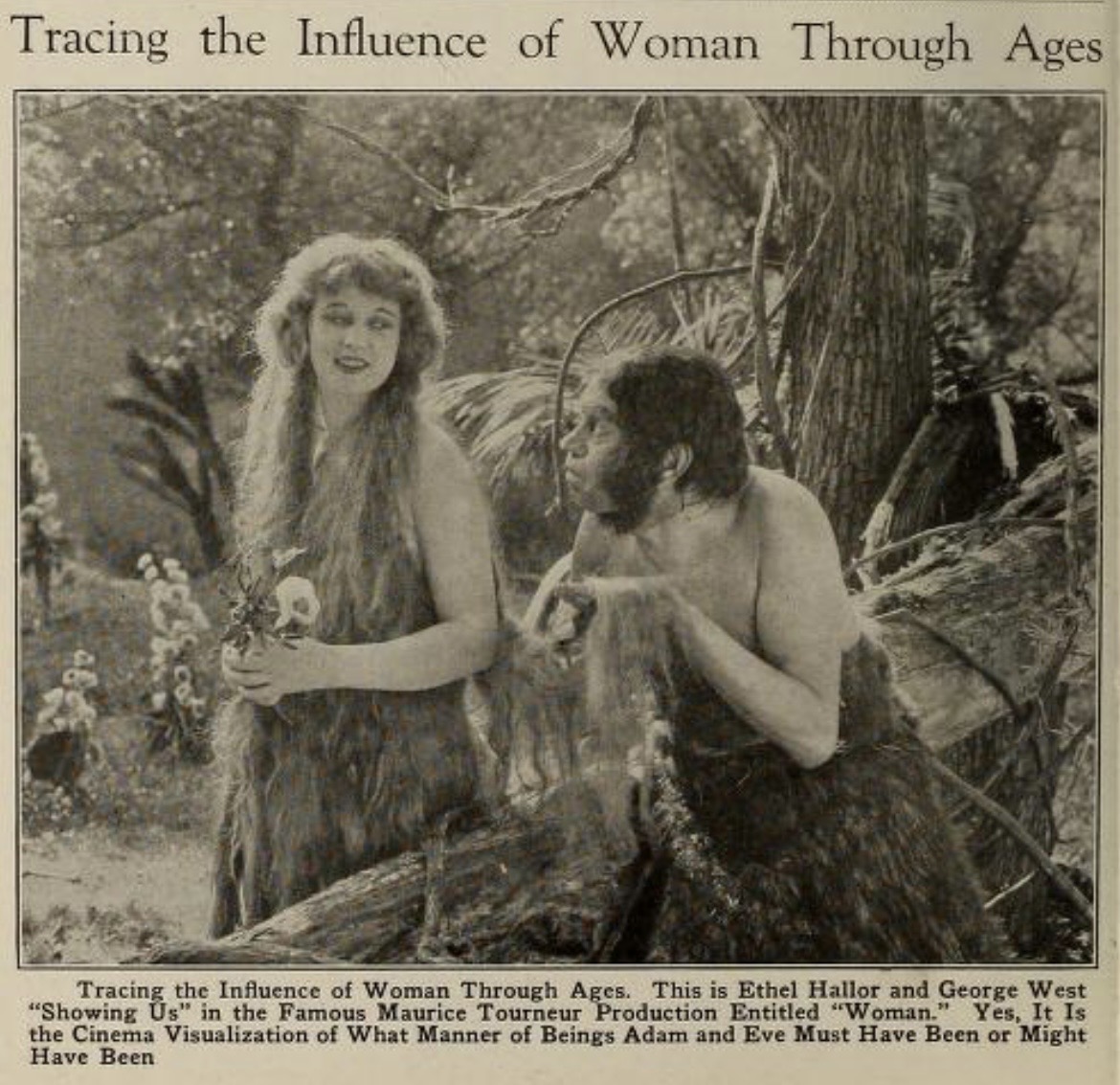
Cinematographer Chester Lytton (uncredited in most surviving lobby cards) employs a battery of now-extinct techniques: orthochromatic stock that turns lipstick into obsidian, vignetted iris shots functioning as thought-balloons, and hand-cranked undercranking for the Roman orgy so that bodies resemble stop-motion bacchantes. The tinting schema alone deserves a dissertation—Eden in viridian, Rome in sulfur amber, Paris in slate cobalt, the Mediterranean in bruised mauve—each palette shift functioning like a chromatic chapter heading. Compare this chromatic confidence to the monochrome austerity of The Moonstone or the pastel postcard fakery of Old Heidelberg; Woman weaponizes color as historiographic argument.
Faire Binney’s Eve oscillates between fawn-like hesitancy and velociraptor alertness—watch how her fingers tremble pre-bite, then stabilize into the steady grip of someone dismantling the universe’s master switch. Hope Hampton weaponizes stillness; her Messalina rarely blinks, creating a predatory torque that makes senators quaver without a spoken threat. Gloria Goodwin’s Heloise is the film’s emotional keystone: her close-ups vibrate with subcutaneous intellect, every micro-expression a footnote to suppressed fury. Meanwhile, Flora Revalles’s sunburnt Cyrene carries the final act on calloused shoulders, her smile—half-cynical, half-euphoric—feels like tomorrow’s weather forecast scrawled in charcoal.
Whittaker, a former newspaper versifier, treats intertitles as slam poetry. Examples:
Each card lingers three to five frames longer than narrative necessity, allowing the words to brand retinas—an effect that modern viewers will recognize in the subtitle cadences of For Napoleon and France, though without the silent-era audacity.
No original score survives; distribution notes suggest pit orchestras were encouraged to improvise from a menu of leitmotifs: Saint-Saëns’ Danse Macabre for Messalina, a medieval organum for Heloise, Debussy’s La Mer for Cyrene. Contemporary restorations commissioned a new score by Thanya Iyer—strings treated with granular delay so that each crescendo feels like a celluloid scratch amplified into thunder. The anachronism works; it collapses chronology the same way the film collapses epochs.

Woman premiered at New York’s Rialto amid the Teapot Dome scandal; critics praised its "spectral audacity" but box-office returns were hobbled by censor boards in Kansas and Ontario who demanded the excision of Messalina’s orgy and Heloise’s epistolary eros. By 1926 only a 67-minute cut circulated; the original 97-minute version was presumed lost until a 2019 nitrate cache surfaced in a disused Franciscan monastery outside Toulouse. Current restorations (Flicker Alley, 4K) reintegrate the censored segments, revealing a political sharper edge: a subplot where Roman senators brand Messalina a "virus of estrogen" now plays like a Twitter dog-pile in toga form.
Academic conferences now cite Woman alongside Beloved Adventuress as proto-intersectional texts, though Whittaker’s racial lens remains blinkered—no women of color occupy narrative agency. Still, the film’s thesis, that history’s footnotes contain the ripest sticks of dynamite, resonates in contemporary fem-cinema from Portrait of a Lady on Fire to Potentiality. The closing shot—Cyrene’s silhouette dissolving into star-fields—prefigures the cosmic finales of The Gods of Fate yet feels more revolutionary because its scale is human, not mythic.
If you crave tidy character arcs or restorative finales, stream something anodyne. If you want to feel centuries of patriarchal concrete crack under the persistent taproot of female defiance, hunt this film down. The available Blu-ray offers commentary by feminist historian Dr. Myriam Dufois, a 40-page booklet, and an optional "descriptive video" track that verbalizes visual nuances for visually impaired cinephiles. Warning: the experience may spoil conventional historical epics forever; after seeing Eve weaponize knowledge like plutonium, rewatching A Tale of the Australian Bush feels like swapping a blowtorch for a damp match.
I first screened a 16mm print in a graduate seminar; the bulb popped mid-reel, leaving us in darkness while the projector’s mechanical heartbeat kept clicking. For five breathless minutes we sat listening to the whir of sprockets, imagining the images we couldn’t see—an accidental homage to how history has treated women: present, potent, yet too often projected into silence. When the bulb was replaced and Cyrene’s magenta horizon flared again, half the audience wept. Not out of sadness, but from the sudden, vertiginous recognition that every censored frame, every lost reel, every forgotten name is a lighthouse still flashing signals across the black water of time. Woman lets those signals coalesce into a bonfire. Step close—and be re-written.
Sources: Library of Congress Paper Print files; Kevin Brownlow’s Behind the Mask of Innocence; Women Film Pioneers Database; 2022 Flicker Alley booklet; private correspondence with archivist Dr. Luc Martinez.
IMDb —
1916
Community
Log in to comment.