DbcultAccessing Vault...
6.1/10
Senior Film Conservator
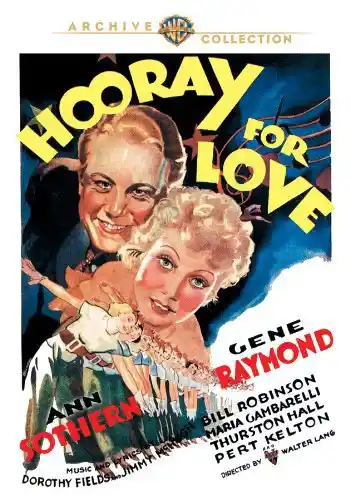
A definitive 6.1/10 rating for a film that redefined the boundaries of cult cinema. Hooray for Love remains a cornerstone of transgressive art.
You should watch this if you love old-school tap dancing or if you just want to see Fats Waller be the coolest person in the room. If you hate movies where the plot is just a flimsy excuse to show musical numbers, you will probably be bored out of your mind.
I sat down with this one on a Tuesday night when I didn't want to think too hard. It’s a 1935 musical called Hooray for Love, and honestly, the title is the most generic thing about it.
The story follows Doug (Gene Raymond), who has a lot of money and a dream to produce a Broadway show. He meets Pat (Ann Sothern), who can sing, and they fall in love almost immediately because that is just what people did in movies back then.
The the problem is Pat’s father. He is played by Lionel Stander and he is a total con artist who spends the whole movie trying to squeeze money out of everyone.
I found the father character really annoying. He talks too loud and his schemes aren't even that clever, but everyone in the movie just goes along with it for some reason.
Gene Raymond is fine, I guess. He has that very specific 1930s blonde hair that looks like it was carved out of wood and never moves an inch.
He doesn't have a ton of chemistry with Ann Sothern, but she is so charming that it doesn't matter much. She has this very soft, sincere way of speaking that makes you actually root for her, even when the script is giving her nothing to work with.
There is a secretary in the movie played by a very young Lucille Ball. It is so weird to see her before she became the Lucy everyone knows.
She doesn't do any of the big slapstick stuff here. She’s just sort of... there, being professional and looking sharp in a hat.
The movie really drags whenever the white leads are talking about their feelings or their money problems. I found myself checking how much time was left during a few of the dialogue scenes in the middle.
But then, the movie suddenly remembers it’s a musical. And that is when things get actually good.
The sequence with Bill "Bojangles" Robinson and Fats Waller is easily the highlight. It feels like it belongs in a much better, more expensive movie.
Fats Waller is sitting at the piano and he has this massive grin that just makes you want to smile back at the screen. He plays like the piano is an extension of his own hands.
Then Bill Robinson starts dancing on these big white stairs. The sound of his feet is so crisp and perfect.
It’s one of those moments where you realize how much talent was packed into these old studio films. They didn't need special effects when they had guys who could move like that.
There is also a group called The Cabin Kids who show up. They are these little kids who sing in harmony, and while it’s a bit of a weird diversion, they are actually incredibly talented.
I noticed the sets look a bit empty sometimes. Like they spent all the budget on the big staircase and forgot to put furniture in the other rooms.
One scene has Doug walking through an office that is so large it feels like a hangar for airplanes. It makes the actors look tiny and sort of lost.
The pacing is very strange. It feels like the movie is rushing to get to the next song, but then the songs go on for a long time.
I don't mind that, though. I'd much rather watch Bill Robinson dance for five minutes than listen to Doug talk about his bank account for another ten seconds.
Compared to something like King of Jazz, this feels much more like a standard Hollywood story. It doesn't have that wild, experimental energy, but it has a lot of heart in the performances.
There’s a bit where the characters are on a boat and the background looks so fake it’s almost funny. You can see the edges of the screen where the water is supposed to be.
It adds a certain charm to it, I think. You know you’re watching a stage play that just happened to be filmed.
The "show within a show" trope is used here, which is the most tired plot device in history. Every single musical from this decade seems to end with a big opening night where everything goes wrong and then suddenly goes right.
This one is no different. You know exactly how it’s going to end the moment it starts.
But the music is the reason to stay. The song "I'm Livin' in a Great Big Way" is a total earworm.
I’ve been humming it all morning while making coffee. It’s catchy in a way modern songs rarely are.
I wish the movie had more of Fats Waller. He’s on screen for maybe ten minutes total, but he’s the only one who feels like a real person with a sense of humor.
Everyone else is playing a "type." The lover, the grifter, the ingenue.
Fats is just Fats. He looks like he’s having a private joke with the audience the whole time.
If you’re looking for a deep exploration of anything, you won't find it here. It’s light as air and just as forgettable once the credits roll.
Except for those dances. I’ll probably go find the clips of Robinson on YouTube later just to see them again without the boring plot in the way.
It’s a pleasant way to spend an hour and a half, but don't expect it to change your life. Just enjoy the rhythm and try not to get too mad at the dad character.
The ending feels very abrupt, too. It’s like they ran out of film and just decided to stop.
One minute they are singing, and the next, it’s over. No real wrap-up for half the characters.
I guess that’s just how they did things back in '35. People had places to be.
IMDb 3.8
1934
Community
Log in to comment.