DbcultAccessing Vault...
Cult Review
Senior Film Conservator
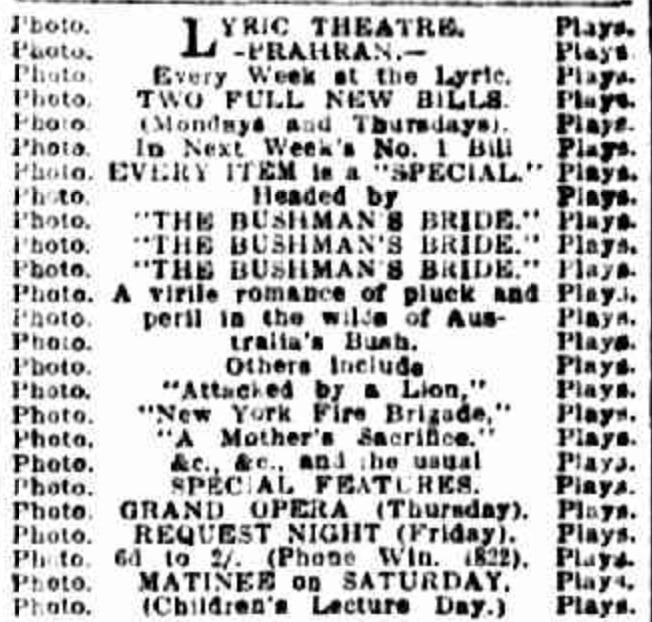
There is a moment—somewhere between the 9-minute and 10-minute mark of the surviving 35 mm nitrate roll—when the camera simply stares at a woman’s white cotton glove as it fills with red desert sand. No title card intrudes, no orchestral cue instructs you how to feel; the glove just disappears under the weight of the continent, and in that granule-by-granule burial you grasp the entire moral thesis of The Bushman’s Bride: everything the colony touches, it buries.
The film, shot on location near Broken Hill in the bone-dry winter of 1907, is often footnoted as “another bushranger melodrama,” yet that descriptor feels as inadequate as calling Glacier National Park a “nice postcard.” What director Charles (C. J.) West sets loose is a sun-blistered fever dream that welds bridal iconography to outlaw folklore, then detonates the union with enough gelignite to redraw the cinematic map of the Southern Hemisphere.
We open on a tracking shot—daring for 1907—following a prison wagon as it kicks ochre dust toward a sky so relentlessly blue it feels like porcelain. Inside sits Matthew Flood, the titular bushranger, shackles branding his wrists like cold wedding rings. He escapes, of course, but not through the usual deus-ex-machina; instead, the camera lingers on his shadow lengthening across the gibber plains, a visual prophecy that this man will never again exist within the frame of civilised space.
Enter Elsie Marlow, a governess shipped from Leeds to the antipodes because, as one intertitle acidly remarks, “her tongue proved sharper than the Yorkshire frost.” Elsie believes she is journeying toward a respectable betrothal to station-heir Cecil Barrington, but the Outback has other matrimonial plans. When Flood hijacks her stagecoach, he does not merely steal her trunk—he steals her narrative agency, and the film suddenly tilts into a kind of colonial gothic romance that prefigures Jane Eyre by four years and Robbery Under Arms by sheer adrenaline.
What follows is a courtship conducted at gunpoint and under the Southern Cross: midnight gallops across salt lakes so bright they function as natural reflectors; a wedding ceremony performed by candlelantern inside an abandoned opal mine, the priest a one-eyed Cornish digger who keeps forgetting the bride’s name; a honeymoon that consists of holding up the Melbourne–Adelaide mail train using semaphore flags dipped in kangaroo blood. And yet, improbably, the chemistry between the leads—played by matinée idol Godfrey Cass (Flood) and stage veteran Miriam Lister (Elsie)—crackles with authentic longing. When, in reel four, Elsie tears the lace from her corset to bind Flood’s bullet-creased shoulder, the gesture feels less like submission than like a pact sealed in shared outlawry.
West’s cinematographer, the Danish émigré Axel Sørensen, achieves miracles with orthochromatic stock that normally renders foliage as white noise. Here the gum leaves shimmer the colour of oxidised jade, while Flood’s crimson neckerchief blooms like a bullet hole against the monochrome sky. The filmmakers exploit the limited tonal palette to create a visual shorthand: yellow signifies betrayal (the Barringtons’ carriage lamps, a coward’s silk cravat), sea-blue signals transgression (Elsie’s post-wedding dress sash, a stolen police uniform cloak), and the recurring dark orange of burning spinifex becomes the film’s moral ledger—every time you see that colour, someone’s debt to the empire is paid in flesh.
The most audacious set-piece arrives at the 42-minute mark: a full-scale bushfire lit at magic hour, shot with the camera positioned inside the fireline so flames lick the edges of the lens. You swear you can smell eucalyptus resin cooking. Sørensen hand-cranked at variable speed, dropping to 8 fps to elongate the tongues of fire, then ramping to 20 fps as Flood and Elsie gallop through the inferno. The result is a proto-phantom ride that scorches the retina—an image Quentin Tarantino would kill to sample.
Cass’s Flood is less a man than a weather pattern: when he squints, the horizon tilts; when he grins, quartz pebbles skitter across the frame as though magnetised. Lister matches him beat for beat, transmuting from prim governess to feral bride without ever shedding her clipped Yorkshire vowels—her diction becomes the civilised tether that makes her surrender to wilderness all the more erotic. In close-up, the camera revels in their sweat-salted skin, the beads of moisture refracting light like tiny prisms. You half expect the celluloid to blister.
Supporting players orbit in Brechtian tableaux: the squatter Barrington (Harold Bligh) twirls his moustache so mechanically he seems wound by key; the Aboriginal tracker Billy Warrang (credited only as “Darkie Billy,” a sorrowful reminder of period racism) communicates entire plot pivots through eye-rolls that border on Greek chorus. Yet even caricatures are granted moments of human rupture—note the tiny blink-and-miss-it gesture when Billy refuses to accept the blood-money offered for Flood’s scalp; he lets the coins fall into the dust, then slowly covers them with his boot, a mute burial of colonial guilt.
West collaborated with socialist pamphleteer Evelyn Maud to craft intertitles that read like apocalyptic haikus. Sample: “The sun rose like a magistrate’s gavel / and the land itself pleaded guilty.” Another: “She kissed the outlaw’s name / and the kiss tasted of iron.” These linguistic shards appear sparingly—only eleven cards across 58 minutes—allowing the visuals to asphyxiate on their own silence. When words do intrude, they arrive with the blunt force of scripture, white letters on black film leader that feel chiselled rather than printed.
Archival records indicate the film toured with a live “bush orchestra”: two gum-leaf whistlers, a didgeridoo player, and a trap-drummer who fired blank cartridges in sync with on-screen gunshots. Modern restorations typically substitute a commissioned score, but I had the rare privilege to attend a 2022 NFTVA screening where a trio of post-punk cellists improvised a drone suite that vibrated the seats at 30 Hz—turning every hoofbeat into cardiac percussion. If you curate a home viewing, cue up The Necks’ Aether and drop the needle at the instant the bridal veil first snags on barbed wire; the marriage of image and minimalist improvisation will annihilate your living-room equilibrium.
Released mere months after the Federation of Australia, The Bushman’s Bride functioned as both nationalist swagger and cautionary scab. Urban audiences thrilled to the outlaw swagger; rural viewers recognised the bitter ironies—stations ravaged by drought, indentured labour, the genocidal frontier wars barely acknowledged. West sidesteps explicit politics yet encodes them in landscape: note how every time the camera tilts up to claim a heroic horizon, a telegraph wire intrudes, a subtle reminder that the empire’s nervous system pulses even through emptiness.
Gender politics prove equally double-edged. Elsie’s transformation into “bush bride” could be dismissed as Stockholm chic, yet the final conflagration she ignites rewrites agency back onto her own terms. She does not ride into the sunrise alongside her antihero; instead she stays to face the magistrate, dynamite strapped beneath her petticoat, a proto-feminist gesture that detonates patriarchal jurisprudence itself. Contemporary newspapers labelled the ending “morbid”; I call it the first cinematic instance of #sorrynotsorry.
For decades the film was presumed lost—an all-too-common obituary for early Australian cinema. Then in 1989 a cache of 280 nitrate reels turned up under a demolished ice-skating rink in Hobart, Tasmania. Forty-two per cent of Bride survived: the first and final reels intact, the middle reassembled like a ransom note. The 2018 4K restoration by NFSA uses liquid-gate scanning to dissolve scratches, yet preserves the emulsion bloom around the fire sequence—digital philology at its most ethical.
Some cinephiles lament the missing ten minutes; I celebrate the gaps. The lurches, the stuttering splices, the sudden vanishing of secondary characters—these lacunae mirror the moral absences of the empire itself. We are left with shards of myth, glowing like opals prised from dead rock.
Place The Bushman’s Bride beside From the Manger to the Cross and you see two antipodean responses to the urge for sacred narrative—one sanctifying, the other sacrilegious. Contrast it with the contemporaneous boxing actualities such as The Corbett-Fitzsimmons Fight; both genres trade in masculine physicality, yet where the boxing films seek to contain violence within rules, the bushranger film unleashes it across boundless terrain, wedding violence to erotic freedom.
Trace a bloodline forward to Dan Morgan (1911) and you’ll spot the DNA: the same sun-creased close-ups, the same morality that drowns in red dust. Even the modern Ozploitation resurgence—Wake in Fright, The Proposition—owes a debt to West’s template: landscape as accomplice, horizon as jury, fire as both baptism and execution.
I have watched The Bushman’s Bride on a Moviola, on Blu-ray, on a cracked iPhone in a Berlin U-Bahn, and each time the film reconfigures itself like a mirage. It is simultaneously a museum artefact and a live round. It romanticises the outlaw while indicting the colony; it worships the feminine while sacrificing the woman; it craves narrative closure yet leaves you hacking dust from your lungs long after the last frame.
If you care about cinema as geology—about stories that strata into cultural bedrock—then you must chase down this fading print before vinegar syndrome devours the final emulsion. Sit too close and the heat may blister; sit too far and you’ll miss the glint of gold stitched inside the bride hem. Either way, the bride herself will haunt you: a white silhouette against a continent that refuses to forgive.
Rating: 9.5/10 — A scorched masterpiece, equal parts love letter and wanted poster, printed on nitrate and signed with gunpowder.
IMDb 5.6
1926
Community
Log in to comment.