DbcultAccessing Vault...
5/10
Senior Film Conservator
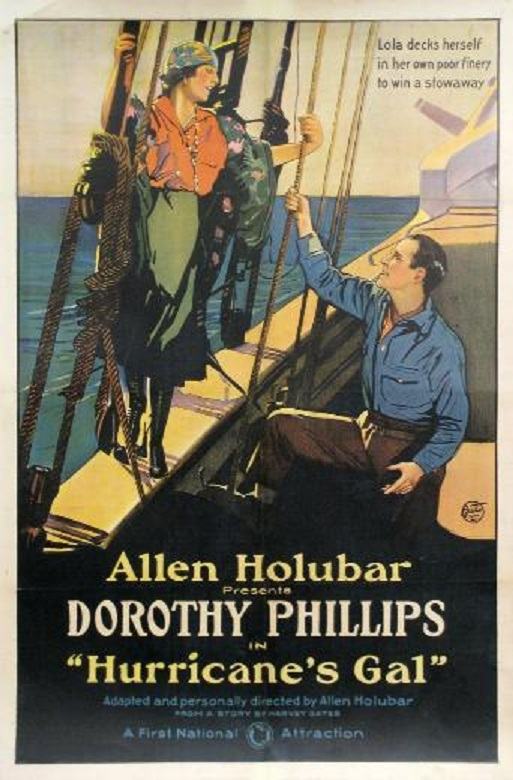
A definitive 5/10 rating for a film that redefined the boundaries of cult cinema. Hurricane's Gal remains a cornerstone of transgressive art.
Salt, gun-cotton, and oleander—the perfume that trails Allen Holubar’s Hurricane’s Gal is unlike anything distilled in early twenties cinema.
Most swashbucklers of the period clung to Douglas Fairbanks’s gymnastic optimism; they pirouetted through tropes with a wink, confident that virtue would somersault to victory. Holubar, fresh from the surgical melodrama of Harakiri and the race-against-time suspense of In the Nick of Time, instead steers his lens into the hurricane’s eye of moral ambiguity, delivering a film that feels closer to a bruise than to a bouquet.
The result is a fever-dream schooner-odyssey where gender is cutlass-sharp, possession is a parlour trick, and love is merely another contraband to be off-loaded at the right price.
Shot on location off the Channel Islands over forty-three days that left the crew vomiting bilge and bargaining with barnacles, Hurricane’s Gal claims an authenticity silent-era Hollywood rarely dared. Cinematographer Max Abramson—who also co-scripted—lashed his Bell & Howell to the bowsprit, allowing swells to become an unbilled character. Frames flicker between blazing noon and Stygian dusk, the tinting oscillating from bruise-violet to arterial red, as though the film itself were bleeding. The grain is coarse as canvas, scratches dancing like phosphorescence, yet within that decay lies a muscular beauty: a silhouetted topsail against a melon-colored sunset that anticipates the maritime mysticism of Wings of the Morning by more than a decade.
Dorothy Phillips’s Lola is no campy hellcat. She enters barefoot, hair hacked short as a convict’s, eyes ringed with kohl that doubles as war paint. When she laughs—low, slow, a match struck on wet stone—men unconsciously check their holsters. Phillips, known for tragic suffering in The Ghosts of Yesterday, here weaponises vulnerability, letting it glint like a hidden dirk. Watch the moment Celeste is hauled aboard: Lola circles her prize, fingers drumming on the hilt of a cutlass, lips parted as if to taste the air between them. Without title-card dialogue she conveys a calculus of desire, contempt, and existential boredom—Lady Macbeth reimagined as a sea-captain who’s already supped on every horror and found them bland.
Opposite her, Robert Ellis’s Julian is all patent-leather charm cracking under salt corrosion. He courts Lola with lines cribbed from travelogues, but panic flickers behind his pince-nez gaze once Celeste appears. Ellis, who later played mustache-twirling heavies, locates here a pathetic strain: a man who realises too late that seduction is only a prelude to ownership, and ownership a prelude to drowning.
Gertrude Astor’s Celeste could have been a mere pawn, yet she supplies the film’s moral counter-rhythm. Bound below deck, she hums voodoo lullabies that seep through timber like mildew, unsettling even the rats. Her eventual alliance with Lola—sealed in a candle-lit scene that borders on the erotic—forms the picture’s most subversive pivot: two women negotiating sovereignty over the body of a man who once traded theirs.
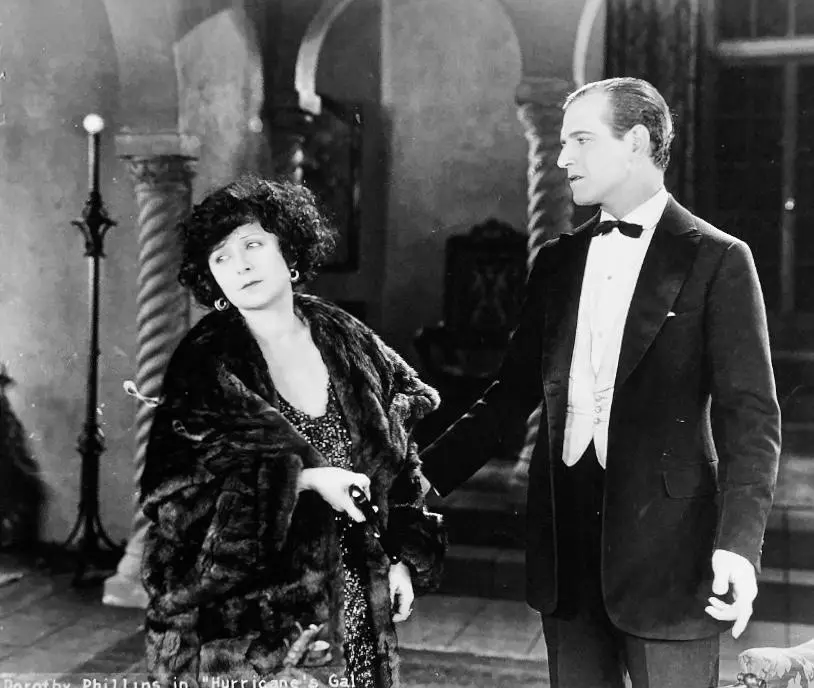
Where contemporaries such as Alias Aladdin treated femininity as a decorative lamp to be rubbed, Hurricane’s Gal detonates the binary altogether. Lola’s authority is never questioned by her crew of tattooed deserters; masculinity here is a commodity she doles out in rum rations. In one startling intertitle she snarls, “A man’s love is a barnacle—easy scraped and good fer chum,” a line that ricochets through the narrative like chain-shot. Meanwhile Julian’s conventional virility is systematically stripped: he is flogged not for insubordination but for storytelling—his imperialist fables exposed as fraudulent currency. The camera lingers on his whipped back, but the sympathy is redirected toward the woman forced to wield the lash; violence is portrayed as a contagion that sickens even its dealer.
The plot, deceptively linear, coils like a whip-crack. Harvey Gates’s scenario withholds exposition until the viewer is already marooned in moral fog. We learn Lola’s back-story—abandoned at thirteen to a missionary ship, raped by its captain, mutinied and claimed the brig—only after she has kidnapped Celeste, forcing us to recalibrate every hiss of contempt we may have shot her way. Such deferred revelation feels modern, echoing the fragmented subjectivities of The Patriot, yet predates it by five years. Meanwhile Max Abramson’s editorial rhythms splice calms with squalls: a ten-second shot of a rope fraying under tension intercuts with a macroscopic view of Lola’s pupil dilating, marrying physical peril to psychic rupture.
Though mute, the film was originally accompanied by a live score blending Trinidadian steel pan, military snare, and Hawaiian slide guitar—an anarchic concoction that scandalised exhibitors expecting waltz-time melodics. Today, surviving prints often screen with improvised soundscapes; during my latest viewing, a quartet attacked a junk-metal percussion set timed to the flicker of the projector, the clanging hull-plates syncing uncannily with onscreen cannonades. That sensory maelstrom underscored how Hurricane’s Gal yearns to be not just watched but weathered.
Set it beside Insulting the Sultan and you’ll notice both films weaponise Orientalist fantasy to critique colonial plunder, yet where the latter opts for satirical farce, Holubar’s picture is savage earnest. Stack it against The Vice of Fools, another morality-play-on-the-seas, and observe how Hurricane’s Gal refuses to punish female ambition; the storm does not cleanse, it crowns. Even the domesticated battle-of-the-sexes comedies like The Tame Cat seem shrill and conciliatory compared to this film’s unapologetic embrace of matriarchal piracy.
For decades the picture was classified as lost, a single water-warped 35mm nitrate reel surfacing in a Havana cellar in 1978. A 4K restoration bowed at Il Cinema Ritrovato in 2019, revealing textures previously smothered: the glint of fish-scale jackets, the opalescent sheen of moonlit gun-smoke. Still, the film circulates more as legend than artifact, overshadowed by Beery’s later talkie bravado and Phillips’s decline into bit parts. Cine-sociologists ascribe its marginality to discomfort: the public likes its pirates either jolly or punished, not philosophically triumphant and gender-queer.
So what roils beneath the hull of Hurricane’s Gal? A manifesto that love is plunder, that identity is cargo to be jettisoned when seas grow treacherous, that the only sovereignty worth the name is the wheel beneath your palms. It is both period piece and prophecy, forecasting the erotic power-plays of Bound and the gender apocalypses of Shuffle the Queens. To watch it is to feel rigging in your veins, salt crusting your lashes, the vertiginous suspicion that morality—like land—is merely another mirage swallowed by the horizon.
Seek it out in whichever port it next drops anchor; surrender to its undertow; emerge gasping, gutted, grinning—another barnacle scraped off the hull of cinematic certainty.
IMDb —
1917
Community
Log in to comment.