DbcultAccessing Vault...
Cult Review
Senior Film Conservator
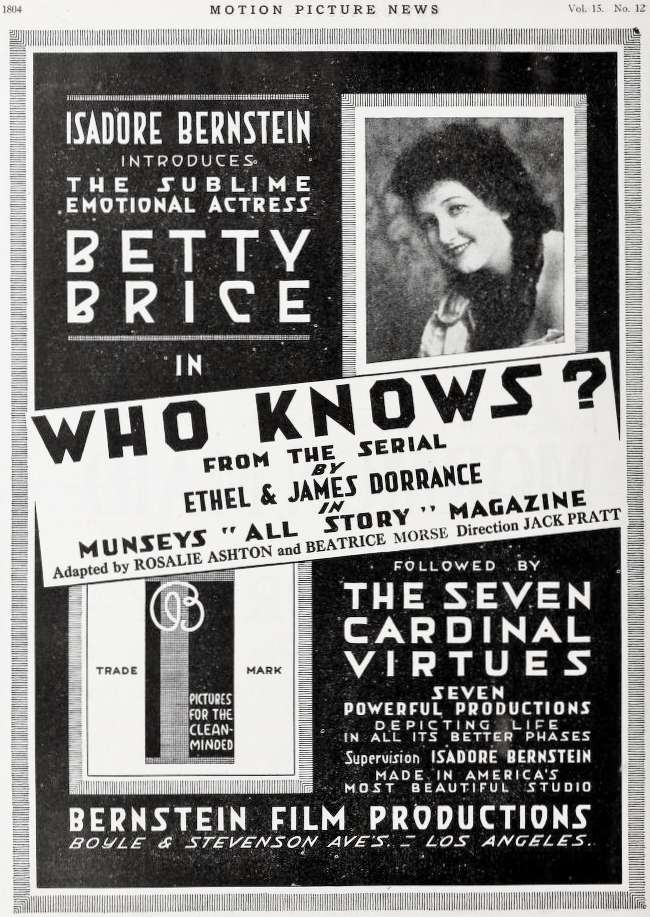
In the sprawling tapestry of early cinematic narratives, where moral quandaries and the relentless march of fate often dictated the dramatic pulse, "Who Knows?" (1918) emerges as a compelling, if occasionally melancholic, exploration of reputation, sacrifice, and the circuitous path to redemption. This film, a product of an era still grappling with the nascent language of visual storytelling, manages to weave a surprisingly intricate web of human folly and profound benevolence, leaving an indelible mark on the viewer's contemplative faculties. It’s a story that transcends its silent-era origins, speaking to universal anxieties about integrity and the burdens of a past misconstrued.
At its core, the narrative orbits around Dr. Raymond Pratt, portrayed with a poignant gravitas by Jay Morley. Pratt, a county treasurer entrusted with public funds, finds his world irrevocably shattered when these monies are pilfered by shadowy political machinations. The film masterfully portrays his immediate descent into a maelstrom of self-recrimination. He doesn't question the external forces; instead, he internalizes the loss as a personal failing, a profound breach of honor that demands an equally profound penance. His subsequent disappearance, marked by a solemn vow to his steadfast friend, Tom Hammond, to return only when every last cent is restored, sets in motion a chain of events that will ripple through decades and irrevocably alter multiple lives. This initial act of self-imposed exile isn't merely a plot device; it's a deep dive into the psychological landscape of a man utterly consumed by perceived disgrace, a thematic resonance that echoes in later, more celebrated works exploring the weight of reputation, such as certain melodramas of the period or even the moral dilemmas found in films like "The Man Who Could Not Lose", where characters wrestle with their perceived standing in society.
The true emotional anchor of the film, however, lies in the character of Tom Hammond, a figure of almost saintly selflessness. Upon discovering Pratt's despairing note, Hammond, rather than allowing his friend's name to be dragged through the mud of public scandal, undertakes an astonishing act of personal sacrifice. He quietly, without fanfare or expectation of recompense, replenishes the entire treasury from his own pocket. This monumental gesture, executed in silence, forms the tragic heart of the story. Hammond's subsequent demise in the anonymity of a poorhouse, completely unaware that his extraordinary generosity had shielded Pratt from public ignominy, is a narrative beat of devastating power. It's a stark commentary on the often-unseen sacrifices that underpin societal stability and personal loyalty, a theme that, while perhaps less explicitly explored in other films of the era, certainly resonates with the quiet heroism often lauded in features like "Her Maternal Right", which similarly delves into the profound, often unacknowledged, sacrifices individuals make for those they love. The pathos here is palpable, a silent scream against the injustices of a world where noble deeds can go tragically unrewarded and even unnoticed by those they benefit most.
Years later, the narrative gracefully pivots, transporting us from the somber tones of past tragedy to the rugged, sun-drenched landscapes of the American West. Here, a new protagonist emerges: Dr. Thomas Rawn, played by the earnest Charles Arling. Rawn, Hammond's nephew, arrives on the desolate Quien Sabe ranch, tasked with unraveling the perplexing mystery of the "Blue Death," a malady that casts a pall over the region. His arrival isn't merely a shift in setting; it’s the catalyst for the eventual unraveling of Pratt's prolonged penance. The ranch itself is owned by none other than the self-exiled Pratt, now living under the unassuming pseudonym of Hank Weaver. This dual identity, a common trope in silent cinema, is handled with a delicate touch, allowing Morley to convey the deep-seated weariness and quiet dignity of a man carrying a secret burden for decades.
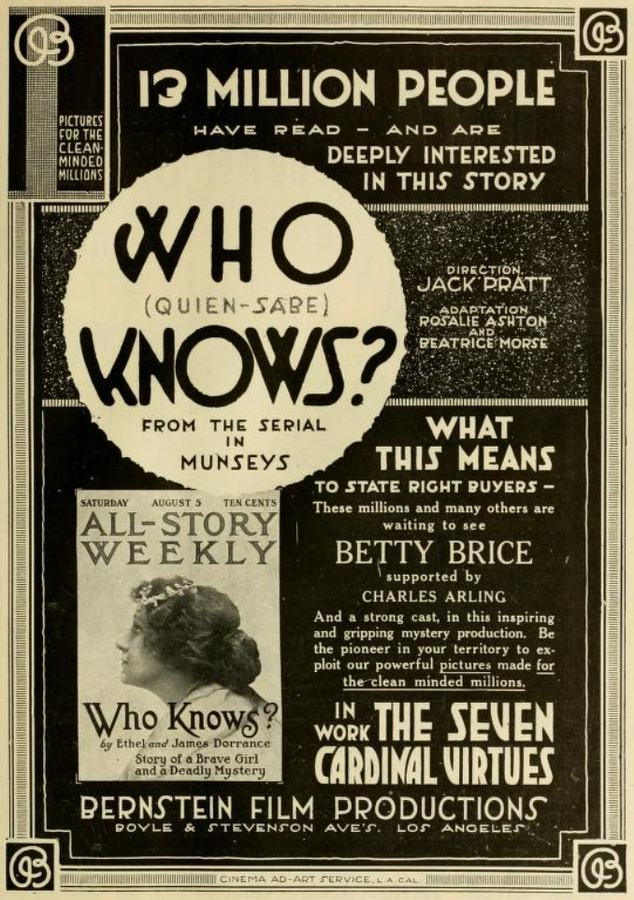
The interplay between Thomas and Weaver’s spirited daughter, Jenny, portrayed with vivacious charm by Edna Mae Wilson, injects a much-needed spark of romance and youthful idealism into the unfolding drama. Their initial encounters are fraught with misunderstandings, a classic romantic comedy setup within a more serious narrative framework. Jenny, fiercely protective of her father and the ranch, mistakenly believes Thomas to be an industrial spy, an agent of rival interests seeking to exploit their vulnerabilities. This initial resistance, however, only serves to heighten the eventual impact of their burgeoning affection. Wilson brings a delightful blend of stubbornness and underlying warmth to Jenny, making her transformation from suspicious rancher's daughter to trusting beloved entirely believable. The slow burn of their romance, punctuated by moments of tension and eventual mutual respect, is a testament to the writers'—Beatrice Morse, James Dorrance, Rosalie Ashton, and Ethel Dorrance—ability to craft engaging character dynamics even within the constraints of silent film storytelling. Their collective effort ensures that the emotional stakes of the romance feel as significant as the larger mystery at hand.
The "Blue Death" itself functions as more than just a plot device; it’s a crucible, a trial by fire that forces characters to reveal their true mettle. Thomas's dedication to his medical calling, his unwavering commitment to alleviating suffering, is showcased vividly as he battles the mysterious ailment. It is through his tireless efforts, his scientific rigor, and ultimately, his success in combating the disease that he earns Jenny’s trust and, perhaps more importantly, the respect of Hank Weaver. This resolution of the medical mystery is not merely a triumph of science but a symbolic cleansing, paving the way for the greater emotional and moral revelations that are to follow. The disease, with its ominous name, serves as a metaphor for the lingering shadows of Pratt's past, a malaise that must be cured before true peace can be found.
The grand reveal, the moment Weaver discovers that his decades of self-imposed penance were utterly unnecessary, that his name was never publicly disgraced thanks to Hammond's incredible sacrifice, is handled with a delicate balance of emotional restraint and profound impact. Jay Morley's portrayal of this shattering realization—a lifetime of guilt suddenly lifted—is a masterclass in silent film acting, conveying a maelstrom of emotions through subtle facial expressions and body language. It's a moment of catharsis not just for Pratt but for the audience, who have witnessed his long, arduous journey. This revelation isn't just about clearing a name; it's about the liberation of a soul, the restoration of an individual to their rightful place in the world. The film smartly avoids overt melodrama, opting instead for a more nuanced depiction of profound relief and gratitude.
The resolution sees Weaver, now free from his self-imposed shackles, embracing a significant post in Washington, a testament to his inherent capabilities and renewed sense of purpose. This return to public life symbolizes a complete arc of redemption, far beyond merely replacing lost funds. It's about recovering lost honor, not just in the eyes of others, but within himself. Simultaneously, the blossoming romance between Jenny and Thomas culminates in a tender affirmation of their love. Their union, forged in the fires of shared adversity and mutual respect, provides a hopeful counterpoint to the earlier tragedy, suggesting that even from the depths of misunderstanding and sorrow, new beginnings can flourish. The ending, while neatly tying up all narrative threads, feels earned, a just reward for the characters' perseverance and inherent goodness.
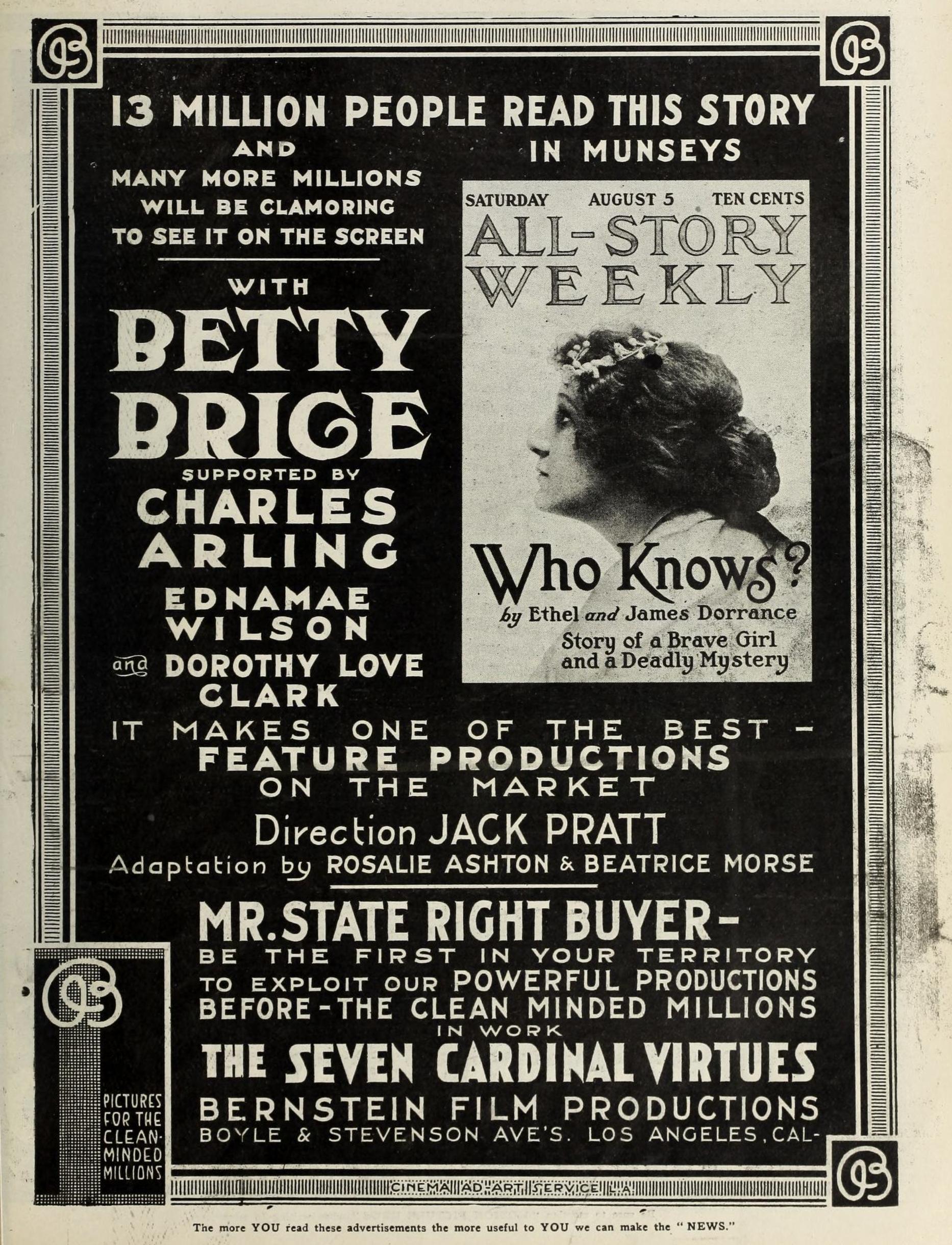
From a technical standpoint, "Who Knows?" showcases the evolving artistry of silent film. While perhaps lacking the grand scale of some contemporary epics, its strength lies in its intimate character studies and well-paced narrative. The direction, though uncredited in the provided information, skillfully guides the audience through emotional shifts, utilizing effective close-ups to highlight critical expressions and intertitles that are succinct yet impactful. The cinematography captures both the somber urban environments of the initial tragedy and the rugged beauty of the Western landscapes, creating a vivid backdrop for the unfolding drama. The performances across the board, particularly from Morley as the burdened Pratt/Weaver and Wilson as the feisty Jenny, are commendable, conveying complex emotions without the aid of spoken dialogue. Supporting players like Sam Wood, Dorothy Clark, and Stella Wilson contribute to a rich ensemble, each adding texture to the film's world, even in their often-brief appearances.
The writing team of Beatrice Morse, James Dorrance, Rosalie Ashton, and Ethel Dorrance deserves particular commendation for crafting a narrative that, despite its melodramatic underpinnings, avoids becoming overly sentimental. They skillfully balance the heavy themes of guilt and sacrifice with moments of genuine affection and intellectual curiosity, particularly in the unfolding of the Blue Death mystery. The plot's intricate design, with its long-delayed reveal and the unexpected connections between characters, speaks to a sophisticated understanding of dramatic tension and resolution. It’s a testament to their collective vision that the film maintains its grip on the audience, building towards a satisfying, albeit bittersweet, conclusion. The structure of the narrative, moving from a deeply personal tragedy to a broader, more expansive story of discovery and romance, demonstrates a thoughtful approach to storytelling that was quite advanced for its time. This multi-layered approach distinguishes it from simpler morality tales, giving it a depth that invites re-examination.
Comparatively, "Who Knows?" stands as a strong example of silent cinema's capacity for complex character development and thematic depth. While it might not possess the overt spectacle of a historical epic like "Mariano Moreno y la revolución de Mayo" or the pure romantic escapism of "The Chocolate Soldier", its strength lies in its poignant human drama. It delves into the quiet suffering of a man wrongly burdened by guilt, a theme that resonates profoundly. The film's exploration of mistaken identity and the eventual triumph of truth could find thematic kinship with other mystery-laden features of the era, such as "The Mystery of the Black Pearl" or even the dramatic reveals in "The Lost Express", though "Who Knows?" grounds its mystery in deeply personal, rather than purely criminal, stakes. It's a film that asks us to consider the long-term consequences of our actions, or in Pratt's case, his inaction based on a false premise, and the redemptive power of truth, however belatedly it arrives.
The enduring appeal of "Who Knows?" lies in its timeless themes. The struggle for honor, the weight of a secret, the selfless act of friendship, and the blossoming of unexpected love—these are narrative elements that continue to captivate audiences regardless of the technological advancements in filmmaking. It serves as a powerful reminder that the human condition, with all its frailties and triumphs, was as compelling a subject for early cinema as it remains today. The film challenges us to reflect on the nature of guilt and forgiveness, the profound impact of individual choices, and the often-unseen threads of connection that bind us. It's not just a historical artifact; it's a vibrant, emotionally resonant piece of storytelling that speaks volumes about the early 20th century's fascination with moral rectitude and the pursuit of justice, even when justice means simply recognizing an injustice never truly occurred. The emotional depth achieved through the visual medium of silent film, relying heavily on the nuanced performances of its cast and the evocative power of its narrative construction, is truly remarkable.
In conclusion, "Who Knows?" is far more than a period piece; it is a meticulously crafted drama that showcases the narrative sophistication achievable in the silent era. It offers a poignant exploration of how perceived disgrace can haunt a lifetime, how selfless sacrifice can prevent ruin, and how, eventually, truth will out, bringing with it both liberation and new beginnings. For enthusiasts of classic cinema and those interested in the evolution of storytelling, this film provides a rich and rewarding viewing experience, a silent testament to the enduring power of human drama. Its blend of mystery, romance, and moral philosophy makes it a compelling watch, demonstrating that the foundational elements of captivating storytelling were firmly in place even in the earliest days of the silver screen. The film's ability to evoke such strong emotional responses without a single spoken word is a testament to the sheer artistry involved in its creation, solidifying its place as a significant, albeit often overlooked, gem of silent cinema.
IMDb —
1916
Community
Log in to comment.