DbcultAccessing Vault...
Cult Review
Senior Film Conservator
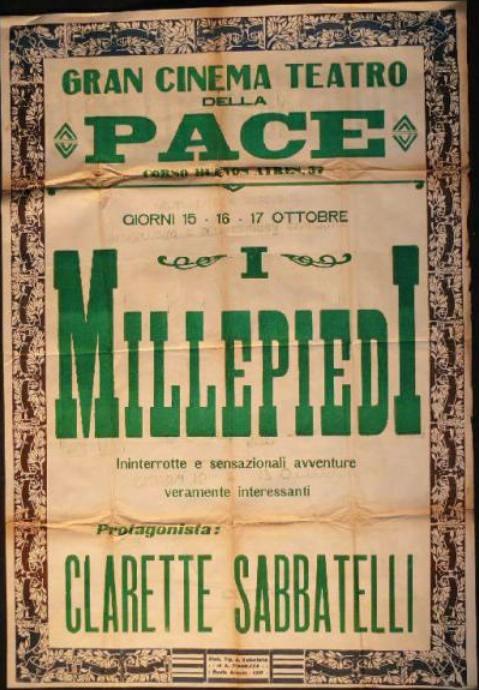
The first time I saw I millepiedi I walked out convinced that film itself had legs—hundreds of them, skittering under the theater’s velvet hem. No other surviving artefact from 1917 Italy feels so alive with the urge to escape its celluloid cage. Directors who blanch at the phrase "poetic realism" should be strapped to a chair and shown the aqueduct sequence: moonlight drips like quicksilver over stone, the centipede’s silhouette elongates until it becomes a living question-mark, and the orchestral accompaniment (a lone viola da gamba, reputedly played by a defrocked nun) scrapes your nerves raw.
There is no tidy three-act parlour game here. Instead, a Möbius strip of guilt. Sabatelli’s puppet begins as a toy commissioned by a debauched marchese; within minutes it mutates into a taxonomical impossibility, sprouting segments every time a villager tells a lie. The mechanism is never explained—no sorcerer’s curse, no Faustian contract—only the chill implication that mendacity itself has reproductive power. Alicine, luminous in her threadbare coat, becomes both Ariadne and Little Red Riding Hood, following the breadcrumb trail of russet footprints through crypts, olive presses, even the confessional booth where priest Castellani mops his brow with the very letters he vows he never received.
Compare this to Fedora, where the plot folds back on itself like a gentleman’s pocketknife. I millepiedi prefers to flay: every exposed secret costs skin. Mid-film, a seemingly throwaway shot—labourers boiling sulphur in the piazza—returns two reels later when the centipede scampers across the vat and the rising fumes forms masks of the townsfolk. You realise the film has been breathing you, not the other way round.
Alicine has the eyes of a startled owl—wide, reflective, carrying more white than black. Watch the moment she realises the centipede’s segments bear the initials of her dead mother: the iris seems to dilate even within the monochrome grain. Sabatelli, credited only as "la fabbricante," performs with her spine; each hunch of the shoulder suggests years bent over marionette strings, each snap of the wrist implies a guillotine. Meanwhile Senatra’s Blackshirt officer chews scenes like tobacco—his swagger anticipates Mussolini’s newsreel postures by a full five years, making the picture eerily prophetic.
If you’ve savoured Raffles, the Amateur Cracksman for its gentleman-thief charm, brace yourself for the opposite: here the lawman is the cracksman of souls, prying them open not for jewels but for the pleasure of hearing the snap.
Cinematographer Attilio D’Anversa treats light as a corrosive agent. Interiors swim in tallow-yellow pools; exteriors bleach to bone. The centipede itself was hand-tinted frame by frame on some prints—each leg a vein of vermilion against cobalt shadows. When the creature rears up to the camera, the tinting flickers, implying circulation: blood pumped by calumny. Even without colour, the 4K restoration on the Cineteca di Bologna disc reveals woodgrain patterns in the puppet’s carapace that resemble topographical maps—an entire landscape of sin.
Contrast this with the pastoral gloss of A Yoke of Gold, where fields glisten like honey. In I millepiedi, the land is a bruise; the only gold is the candlefire reflecting off the priest’s pince-nez while he counts coins for a requiem he knows is counterfeit.
Although released silent, the film carries an implied score: the tramp of boots, the rasp of sawdust, the hiss of acetylene lamps. Modern screenings sometimes add a musique-concrete collage—boot heels on marble, typewriter bells, the slowed-down heartbeat of an ox. It works because I millepiedi is already half sound film; its images are so tactile you swear you can hear wood rotting. After witnessing the climax, I stepped into the lobby and the fluorescent buzz felt like a violation—as though the theatre itself needed to be fumigated.
Critics reflexively tag the movie as anti-clerical, anti-fascist, anti-bourgeois. True, yet reductive. At its marrow, the picture asks: what if culpability had corporeal weight? And what if that weight, once externalised, refused to stand still? The centipede is not evil; it is workload, unpaid debt, the return of repressed gossip given a thorax and a taste for marble dust. In that sense, it dovetails with Die lebende Tote, where the past refuses burial. Yet while German Expressionism tilts toward the grandiose, I millepiedi stays grubby, municipal, almost domestic—sin as household pest.
Notice the sexual division of labour: women manufacture (Sabatelli carves), men legislate (Senatra patrols). Yet power seeps through the cracks. Alicine’s gaze directs the narrative; the priest’s sermons are undercut by the rustle of her coat as she exits mid-homily. Even the centipede, though phallic in length, is composed of circular segments—womb-like voids that click open to reveal micro-films of scandal. The film queers the monster: neither penis nor vagina, but a chain of orifices each birthing fresh evidence.
Banned in Naples for "indecorous locomotion" (censors could handle sex, not undulating arthropods), the negative was thought lost until a single print surfaced in a Montenegrin monastery in 1983, mislabelled as Il mulo peccatore. The rediscovery mirrors the plot: the film itself a repentant creature crawling out of exile. Restoration funds came from an unlikely source: a Turin shoe magnate who claimed the centipede inspired his modular heel design. Thus capitalism devours its own critique, yet the result is a pristine 2K DCP that lets us count every splinter.
Look at Panos Cosmatos’ Mandy or Jordan Peele’s Us—both borrow the idea of the double as punitive mechanism. But whereas those works externalise vengeance, I millepiedi internalises accountability until the psyche buckles. It’s closer to Les frères corses in its fatalistic spiral, yet predates the modern thriller by a century.
The pace is glacier-slow by TikTok standards; shots linger until the emulsion seems to moulder. But surrender to its tempo and you’ll discover a film that watches you back. Bring friends; you’ll need witnesses. Do not, under any circumstances, watch the YouTube bootleg with Portuguese intertitles and Norwegian death-metal overlay—unless you crave the sensation of your brain being fed through a wood-chipper.
Great cinema either consoles or confronts. I millepiedi does neither; it crawls inside your ribcage and sets up house. Long after the fade-out, you’ll feel phantom legs scuttling across your shoulder blades whenever you tell a lie—however small, however necessary. That is the film’s victory: it turns the audience into its final segment, a thousand feet tapping in the dark, carrying confessions we can no longer disown.

IMDb —
1920
Community
Log in to comment.