DbcultAccessing Vault...
Cult Review
Senior Film Conservator
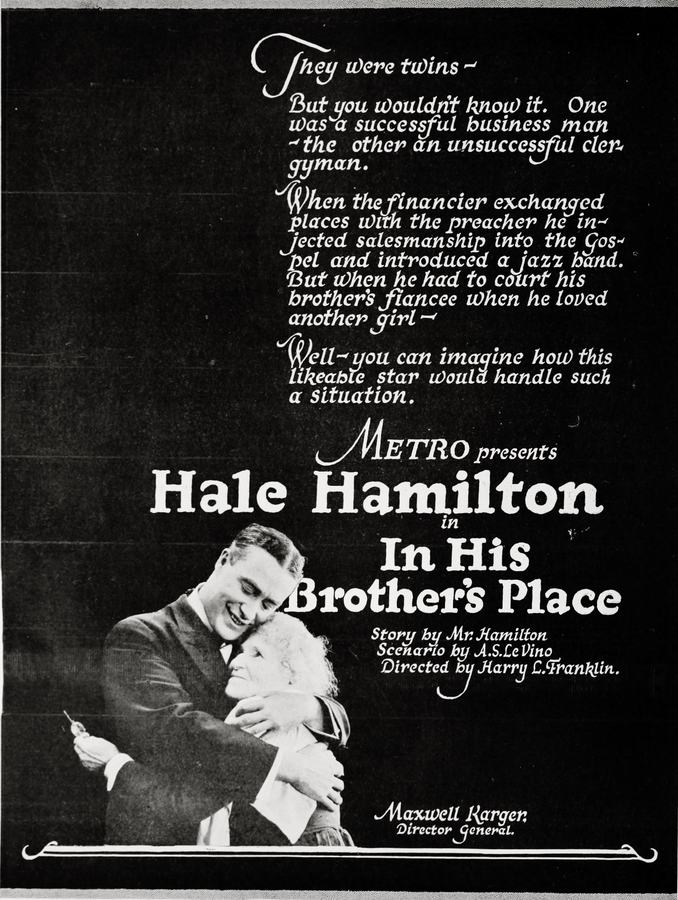
From the moment the opening credits unfurl for In His Brother's Place, viewers are ushered into a narrative rich with fraternal discord, spiritual yearning, and the perennial clash between piety and pragmatism. This cinematic offering, penned by the collaborative talents of Albert S. Le Vino and Hale Hamilton, and featuring a robust ensemble including Ruby Lafayette, Emmett King, and Ward Wing, transcends mere melodrama to present a poignant examination of identity, ambition, and the treacherous undercurrents that can disrupt even the most sacred of institutions. It’s a film that asks profound questions about what truly constitutes faith and how easily it can be commodified or, worse, corrupted, all while maintaining a gripping narrative pace that belies its age. The film’s power lies in its ability to dissect universal human struggles through a remarkably specific, yet relatable, lens.
At its heart, the film orchestrates a compelling reunion. Twins Nelson and J. Barrington Drake, separated by vocation and philosophy, converge upon their familial homestead to commemorate their parents' golden wedding anniversary. This celebratory backdrop, however, quickly becomes a stage for stark contrasts. Barrington, portrayed with a certain swagger by Ward Wing, embodies the zenith of material success—a magnate of the oil industry whose very presence exudes an aura of calculated power and worldly attainment. His antithesis is Nelson, brought to life with understated earnestness by Emmett King, a pastor navigating the challenging waters of a rural ministry, his congregation dwindling, his spiritual coffers seemingly as depleted as his financial ones. The initial setup masterfully establishes the divergent paths these brothers have trod, setting the stage for an inevitable clash of ideologies.
The spark of conflict ignites when Barrington, ever the shrewd businessman, perceives his brother's pastoral predicament through the lens of market strategy. He confidently asserts that Nelson's faltering flock is not a spiritual crisis but a salesmanship problem, a challenge that can be overcome with the right 'pitch.' This audacious proposition, delivered with the characteristic confidence of a man accustomed to manipulating markets, sets in motion a meticulously crafted plan designed to revitalize Nelson’s church using secular, almost corporate, tactics. The irony is palpable: a man of God is advised to adopt the methods of Mammon to save his sacred calling. This juxtaposition immediately forces the audience to ponder the ethics of such an approach, questioning where the line between pragmatic survival and spiritual compromise truly lies.
However, the meticulously laid plans of Barrington, born of a perhaps well-intentioned but fundamentally misguided desire to 'fix' his brother, are swiftly derailed by a confluence of unfortunate events. A critical case of mistaken identity—a classic narrative device, yet one deployed here with fresh tension—plunges the narrative into disarray. This confusion, rather than being a mere comedic interlude, serves as a potent catalyst, exposing the vulnerabilities of both brothers and the precariousness of their respective worlds. Simultaneously, a more sinister undercurrent emerges: a nefarious scheme orchestrated by two of the church’s own deacons. These supposed pillars of the community harbor ambitions far removed from spiritual guidance, plotting instead to seize control of the church's valuable property. This dual threat—external confusion and internal betrayal—creates a vortex of dramatic tension that propels the film forward with relentless momentum, making for a truly captivating viewing experience.
The strength of In His Brother's Place lies significantly in its compelling performances. Emmett King’s portrayal of Nelson is a study in quiet desperation and moral fortitude. He imbues the struggling pastor with a palpable sense of vulnerability, a man genuinely committed to his faith but ill-equipped to navigate the transactional world his brother inhabits. His internal struggle to reconcile his spiritual calling with the pragmatic, almost cynical, advice of Barrington forms the emotional core of the film. King masterfully conveys Nelson’s discomfort with these new, alien methods, even as he grapples with the potential salvation they might offer his dying congregation. His performance is a nuanced exploration of a man torn between his principles and the harsh realities of survival.
Ward Wing, conversely, delivers a performance brimming with confident charisma as Barrington. He is the embodiment of turn-of-the-century entrepreneurial spirit, a man who believes every problem has a solution if approached with the right business acumen. Wing avoids making Barrington a caricature; instead, he presents a figure whose intentions, while perhaps misguided from a spiritual standpoint, stem from a genuine, if blunt, desire to help his brother. The dynamic between King and Wing is truly the film’s anchor, showcasing a nuanced exploration of sibling rivalry and affection. Their scenes together crackle with an unspoken tension, a testament to their acting prowess and the script's ability to create complex, believable characters. It’s a compelling dance between two distinct forces of nature.
Ruby Lafayette, a distinguished presence in the era’s cinema, adds a layer of maternal warmth and wisdom, likely as one of the Drake parents, though the plot summary doesn't specify her role. Her presence grounds the fraternal conflict in a familial context, reminding the audience of the foundational bonds being tested. The supporting cast, including Howard Crampton, Jessie De Jainette, and Mary McIvor, contribute to a rich tapestry of small-town life, each character adding texture to the unfolding drama, from the conniving deacons to concerned parishioners. Their collective efforts create a believable community backdrop against which the central drama unfolds, enhancing the film's immersive quality.
The thematic depth of In His Brother's Place is considerable. At its forefront is the stark dichotomy between spiritual devotion and material pursuit. Nelson's struggles highlight the challenges faced by religious institutions in an increasingly secular or at least commercially-minded world. Barrington’s 'solution' epitomizes the encroaching influence of capitalist ideology into every facet of life, questioning whether faith itself can be 'sold' or if its essence is irrevocably compromised by such an approach. This tension is not merely academic; it drives the core conflict and raises questions pertinent even today about the purity of belief when confronted by the demands of the marketplace. One might draw parallels to the moral quandaries presented in films like The Chosen Path, which similarly grappled with individuals navigating difficult moral landscapes.
The mistaken identity plotline, while a familiar trope, is masterfully employed here to explore themes of perception versus reality. Who is truly seen? Is it the man, or the role he plays, or the wealth he possesses? This aspect of the narrative resonates with earlier works that toyed with identity and social standing, such as The Countess Charming, where appearances often dictated destiny. Here, however, the stakes are higher, involving not just social maneuvering but the very spiritual livelihood of a community. The film cleverly uses this confusion to strip away pretense and reveal the true character of those involved, highlighting how easily one can be judged by superficial markers rather than intrinsic worth.
Furthermore, the insidious plot by the deacons introduces a layer of moral corruption from within. This internal betrayal underscores the film's cynical view of human nature, suggesting that greed can fester even in the most sacred of spaces. It’s a powerful commentary on hypocrisy and the dangers of allowing personal gain to supersede communal well-being. This element of internal treachery can be seen echoing in other narratives of the era where trust is broken from within, perhaps less overtly than in a film like The Lost Express, but equally impactful in its betrayal of expectations. The film doesn't shy away from depicting the darker side of human ambition, even within a religious setting, which lends it a surprising depth and realism for its time.
Albert S. Le Vino and Hale Hamilton’s screenplay is a testament to the era’s storytelling prowess, balancing dramatic tension with thoughtful character development. The dialogue, though perhaps sparse in silent film, is effectively conveyed through intertitles that capture the essence of each character’s motivations and reactions. The pacing is deliberate, allowing the audience to fully grasp the moral quandaries and the escalating stakes. The narrative structure, beginning with a celebratory occasion and gradually descending into chaos and revelation, is expertly handled. This methodical unfolding of events ensures that every plot point feels earned and contributes meaningfully to the overall dramatic arc, preventing any sense of narrative contrivance.
The direction, which can often be overlooked in the analysis of early cinema, clearly guides the viewer through the complexities of the plot. The visual storytelling, through blocking and shot composition, enhances the character dynamics, particularly the contrast between Nelson's humble parsonage and Barrington's implied opulent world. There’s a certain efficiency to the filmmaking, characteristic of the period, yet it never feels rushed or underdeveloped. The filmmakers understand the power of dramatic irony and deploy it effectively, especially in the scenes surrounding the mistaken identity, creating moments of both tension and wry observation. The visual language speaks volumes, often more eloquently than any intertitle could.
Released during a time of significant social and economic flux, In His Brother's Place captures anxieties about modernity, the role of religion, and the ethics of wealth accumulation. It reflects a society grappling with the burgeoning power of industry and the changing landscape of community life. The film's exploration of these themes grants it a timeless quality, making it more than just a historical artifact. Its questions about authenticity, the nature of faith, and the corrupting influence of power remain disturbingly relevant today, resonating with contemporary discussions about corporate influence and ethical leadership. In a period where many films focused on simpler narratives, this one dared to delve into complex societal criticisms.
In an era where films like Marriage explored societal norms and expectations, In His Brother's Place delves deeper into the internal and external pressures that define an individual's path. While not as overtly political as some contemporary works, its commentary on the intersection of faith and finance is undeniably sharp. The film subtly critiques the notion that all problems can be solved with a business mindset, particularly when dealing with matters of the spirit. It offers a fascinating glimpse into the moral compass of an evolving society, one that was beginning to question the unquestioned ascent of industrial capitalism.
The intricate dance between personal integrity and worldly success is a theme explored with great sensitivity. The film avoids facile judgments, instead presenting characters who are products of their environments and their inherent natures. This nuanced approach allows the audience to empathize with both brothers, even as their methods and beliefs diverge. It’s a testament to the sophisticated storytelling of Le Vino and Hamilton that they manage to imbue such a seemingly straightforward plot with layers of psychological and sociological insight, making it a compelling study not just of its time, but of perennial human dilemmas. The narrative complexity far exceeds what might be expected from a film of its vintage, marking it as a significant piece of cinematic history.
In His Brother's Place stands as a compelling, albeit perhaps lesser-known, entry in early cinema that deserves renewed attention. It’s a film that deftly weaves together elements of family drama, moral dilemma, and a touch of suspense, all while offering incisive commentary on human nature. The performances are solid, the narrative engaging, and its thematic explorations are remarkably prescient. It avoids easy answers, instead presenting a nuanced portrayal of characters caught between their ideals and the harsh realities of a world increasingly driven by material concerns. This refusal to simplify complex issues is one of its greatest strengths, inviting viewers to engage deeply with its message.
For those who appreciate classic cinema that dares to delve into the complexities of the human spirit and societal pressures, this film is a rewarding experience. It reminds us that the struggles of faith, identity, and the siren call of wealth are not new phenomena, but enduring challenges that cinema has long sought to illuminate. The film’s ability to remain engaging and thought-provoking after all these years is a testament to its craftsmanship and the universal resonance of its themes. It is a quiet triumph, challenging viewers to consider what truly holds value, both in their own lives and in the broader fabric of community and belief. Its narrative echoes the timeless struggles found in stories ranging from The Ploughshare, which often depicted the trials of common folk, to more intricate character studies. This film, in its own right, carves out a significant place in the annals of early cinematic storytelling, proving that depth and drama were not exclusive to later eras.

IMDb 5.6
1922
Community
Log in to comment.