DbcultAccessing Vault...
Cult Review
Senior Film Conservator
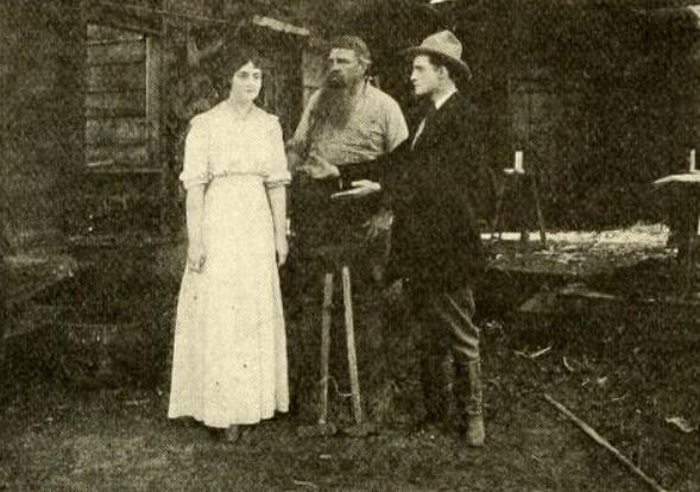
A rusted rail, a lover’s ledger, a single envelope soaked in lamplight—Augustus Thomas’s 1919 one-reel marvel compresses frontier myth into a diamond-hard parable of trust betrayed and honor reclaimed.
There is a moment, roughly two-thirds through In Mizzoura, when the screen itself seems to inhale: the blacksmith’s daughter, collarbone glistening with August humidity, lifts her gaze toward the window where dusk bleeds into kerosene. We do not hear the cicadas, yet we feel them rattling the ether, just as we feel the impossible weight of a handwritten promise sliding from her gloved fingers. That wordless beat—pure cinema before the adjective was fashionable—distills the entire picture: passion colliding with consequence inside a town too small for either.
Thomas, adapting his own 1894 stage play, pares the narrative to its sinew: education purchased in secret, a robbery conceived in daylight, a redemption stumbled upon while mending a puppy’s paw. Each pivot feels pre-ordained, yet the film keeps us leaning forward, not because we fear the unknown, but because we dread the inevitable. When Travers—part snake-oil charmer, part angel of death—struts into Bowling Green, the intertitles curl like cigarette smoke: "A man may outrun the law, but never the echo of his own swagger." That line, equal parts warning and prophecy, could headline every subsequent western from On the Fighting Line to Anthony Mann’s psychologically fissured landscapes.
Raymond Bond’s Jim Radburn carries the stoic magnetism of a young Gary Cooper minus the later star’s marble façade; his shoulders communicate the exhaustion of a man who has read every page of tomorrow. Opposite him, Francesca Rotoli’s Kate vibrates at a higher frequency—her pupils dilate like those of a nocturnal creature caught between porchlight and wilderness. Their chemistry is not the polite brush of hands customary in 1919 programmers but the raw static that crackles when opposing weather fronts collide. Meanwhile, William Conklin’s Travers exudes the lethal velvet of a riverboat gambler: every smile a calculated risk, every compliment a coin clipped for later spending.
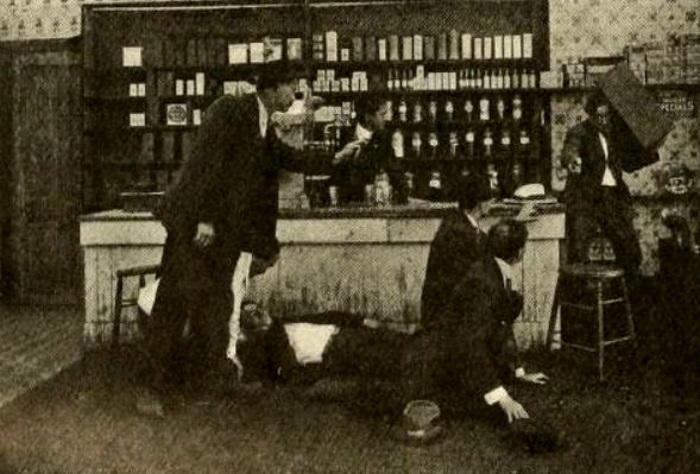
Cinematographer Harry W. Gerstad—later to lens Capra’s It’s a Wonderful Life—captures Missouri’s red clay as though it were still-wet sanguine pigment. Notice how the same soil that cakes the sheriff’s boots reappears, baked into terracotta ballast, beneath the iron horses he hopes to finance. The chromatic echo transforms geography into character, a trick modern epics like Das Tal des Traumes would replicate with digital grading a century onward.
At its core, In Mizzoura stages a debate older than American letters: is justice a universal constant or a malleable currency? Jim’s decision to free Travers—trading public virtue for private mercy—anticipates the ethical quicksand of Schuldig and the later guilt-caked noir cycle. The film refuses to sermonize; instead, it lets the townsfolk’s torches flicker across our hero’s face until we realize absolution must be self-authored.
Kate’s agency—her willingness to discard the sure-footed sheriff for the railway vagabond—reads as proto-feminist, yet Thomas complicates the triumph: her rebellion is framed not as liberation but as naïve cosmopolitanism. The film’s final tableau, her gloved hand slipping into Jim’s calloused palm, suggests that wisdom lies in domestic continuity. Modern viewers may bristle, yet the moment feels honest to 1919’s tug-of-war between Progressivism and post-war retrenchment.
Surviving prints at MoMA reveal handwritten cue sheets calling for “Missouri Waltz” variations during pastoral interludes and snare-drum rattles for the fist-through-window climax. Contemporary festivals have paired the film with bluegrass ensembles; the juxtaposition works because the narrative itself is a kind of mountain ballad—fatalistic, repetitive, haunting.
Where Traffic in Souls wields urban paranoia like a cudgel, In Mizzoura opts for pastoral claustrophobia; where Rebecca the Jewess interrogates ethnic otherness, Thomas interrogates moral otherness. Both strands converge in the recognition that America, vast as it pretends to be, is often just a cramped room where conscience bumps into expediency.
Watch Kelly Reichardt’s Meek’s Cutoff after seeing In Mizzoura and you will detect the same forensic attention to wagon-wheel ruts, the same intuition that landscapes punish aspiration. The lineage is indirect but unmistakable: Thomas’s nickelodeon fable quietly seeded tropes that sprouted across a century—horse as moral ledger, letter as smoking gun, woman as contested territory.
Is the film without flaw? Hardly. Intertitles occasionally over-season the stew; a day-for-night train sequence borders on inscrutable. Yet these blemishes feel like creases in a love letter—evidence of urgency, of human handling. In Mizzoura endures because it trusts the audience to intuit subtext: that every act of kindness carries an unspoken invoice, that forgiveness is simply revenge deferred by better angels.
Verdict: A compact, quietly devastating relic that rewards patient eyes with the metallic taste of moral paradox. Seek it out on 35 mm if you can; the projector’s mechanical heartbeat syncs with the film’s pulse until you swear you smell coal smoke and river mud.
IMDb 6.8
1916
Community
Log in to comment.