DbcultAccessing Vault...
Cult Review
Senior Film Conservator
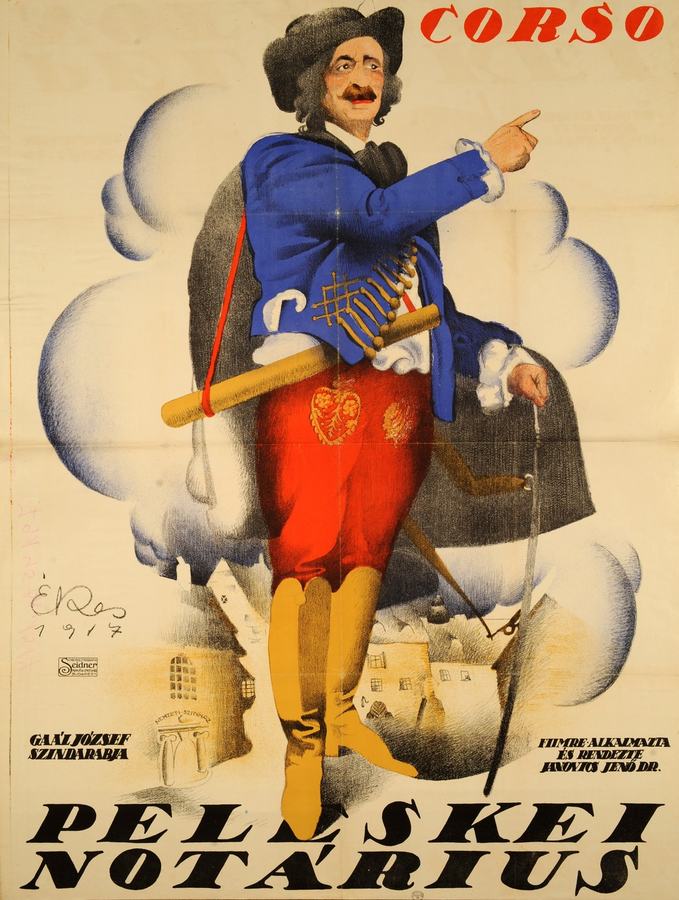
The year 1916 stands as a monumental epoch in the evolution of global cinema, a time when the visual language of the medium was shedding its theatrical chrysalis to emerge as an independent art form. In the heart of Transylvania, at the legendary Kolozsvár studios, Jenő Janovics was orchestrating a cultural revolution. His production of A peleskei nótárius (The Notary of Peleske) remains not merely a relic of silent-era comedy, but a sophisticated exploration of the Hungarian zeitgeist during a period of profound transition.
At its core, the film is a study in contrasts. The narrative follows the titular notary, Zajtay—portrayed with a delightful mixture of gravitas and bewilderment by Ödön Réthely—as he leaves the familiar, dusty lanes of Peleske for the grand boulevards of the capital. Unlike the gritty realism found in contemporary Westerns like Hell's Hinges, where the frontier is a site of moral reckoning, A peleskei nótárius treats the journey as a satirical odyssey. The cinematography captures the pastoral beauty of the Hungarian countryside with a reverent eye, only to disrupt this tranquility with the chaotic, kinetic energy of the city.
The visual storytelling here is remarkably advanced for its time. Janovics, alongside his cinematographer, employs a depth of field that allows the background characters—played by a robust ensemble including Vanda Berlányi and Rózsi Fajk—to inhabit a living, breathing world. This isn't the claustrophobic, stage-bound artifice often associated with early cinema; it is a sprawling, atmospheric endeavor that rivals the scale of international hits like Graustark. While The Aryan focused on the stark, often harsh realities of racial and social identity in the American West, Janovics’ work focuses on the internal cultural friction within the Austro-Hungarian Empire.
The performances in A peleskei nótárius require a specific analytical lens. In an era where histrionics often substituted for depth, the cast manages to find a balance between the broad requirements of folk comedy and the subtle demands of the camera. Katinka Papp and Marcsa Simon provide a feminine counterpoint to the notary's bumbling masculinity, their expressions conveying a world of social commentary without a single spoken word. This mastery of silent expression is perhaps more nuanced than the melodrama seen in Should a Mother Tell, where the emotional beats are often telegraphed with heavy-handed intensity.
"The notary is not merely a character; he is a vessel for the anxieties of a nation watching its traditions dissolve into the acid of modernity."
Consider the scene where Zajtay encounters the theatrical troupe. The meta-narrative layer—actors playing characters who are bewildered by actors—is handled with a deftness that foreshadows later cinematic deconstructions. It lacks the somber, brooding atmosphere of Lost in Darkness, opting instead for a bright, almost luminous clarity that emphasizes the absurdity of the situation. The presence of veteran actors like István Szentgyörgyi and Aranka Laczkó ensures that even the minor roles possess a weight and history, contributing to the film's sense of lived-in reality.
The strength of the film lies heavily in its literary pedigree. The collaboration between József Gaál, József Gvadányi, and Jenő Janovics resulted in a screenplay that is both linguistically rich (even in its intertitles) and structurally sound. While many 1916 films, such as A London Flat Mystery or The Clue, relied on the tropes of the burgeoning detective genre to maintain momentum, A peleskei nótárius finds its rhythm in the episodic nature of the picaresque. It is a journey of discovery rather than a puzzle to be solved.
This narrative fluidity allows the film to touch upon a variety of social critiques. The notary’s interactions with the urban elite highlight the pretension and vapidity of the upper classes, a theme also explored in Brother Officers, albeit with a more dramatic tone. Janovics uses humor as a scalpel, dissecting the social hierarchy with a precision that avoids the cynicism often found in modern satire. There is a palpable affection for Zajtay, a sense that his simple honesty is a virtue that the city has long since discarded.
Technically, the film is a marvel of its era. The lighting, while constrained by the technology of the time, is used effectively to differentiate between the warm, naturalistic tones of Peleske and the sharper, more artificial lighting of the city’s interiors. This creates a psychological landscape that mirrors the protagonist’s internal state. In comparison to the often static compositions of Gatans barn, Janovics’ camera feels remarkably mobile, capturing the bustle of the streets and the intimacy of the notary’s quietest moments with equal skill.
The editing, too, deserves recognition. The pacing of the comedic sequences relies on a rhythmic cutting that was quite sophisticated for 1916. While it may not have the tragic cadence of The Lost Chord or the brooding tension of The Discard, its energy is infectious. The film understands the importance of visual timing, allowing a gag to breathe before moving on to the next beat of the notary's increasingly complicated life.
To watch A peleskei nótárius today is to witness a crucial moment in the formation of Hungarian national identity on screen. The film arrived during the Great War, a time of immense upheaval, yet it chose to look inward at the soul of the people. It lacks the overt propaganda of some contemporary works, focusing instead on the enduring archetypes of the Hungarian spirit. The inclusion of cast members like Aladár Ihász and Endre Kertész, who were staples of the Transylvanian theatrical scene, lends the film an authenticity that resonates through the decades.
When compared to international contemporaries like the Russian Zagadochnyy mir or the Australian The Life of a Jackeroo, Janovics’ work stands out for its unique blend of folk tradition and cinematic innovation. It doesn't shy away from the complexities of its characters. Zajtay is not just a clown; he is a man of principle in a world that is quickly losing its moral compass. This depth of characterization is what separates a mere comedy from a lasting work of art.
The film’s journey concludes not with a grand resolution, but with a sense of cyclical return. Zajtay’s experiences have changed him, yet his core remains unshaken. This thematic choice is far more satisfying than the melodramatic endings of films like Bristede Strenge or the moralistic conclusions of On Dangerous Paths. Janovics understands that life is a series of encounters, many of them absurd, and that the true measure of a man is how he navigates them without losing his sense of self.
In the pantheon of silent cinema, A peleskei nótárius deserves a place of honor. It is a testament to the power of regional filmmaking and the vision of Jenő Janovics. The film captures a world that was on the verge of disappearing, preserving it in a flicker of light and shadow for future generations to study and enjoy. It is a vibrant, funny, and ultimately touching exploration of what it means to be a stranger in a strange land—even when that land is your own country.
Cast Overview: Vanda Berlányi, Rózsi Fajk, Katinka Papp, Ödön Réthely, Aladár Ihász, Endre Kertész, Hugó Kozma, Marcsa Simon, Elemér Hetényi, Ilonka Nagy, Margit Miklóssy, Lajos Ujváry, Gyula Dezséri, István Szentgyörgyi, Aranka Laczkó. Directed by Jenő Janovics.
IMDb 7.2
1915
Community
Log in to comment.