DbcultAccessing Vault...
Cult Review
Senior Film Conservator
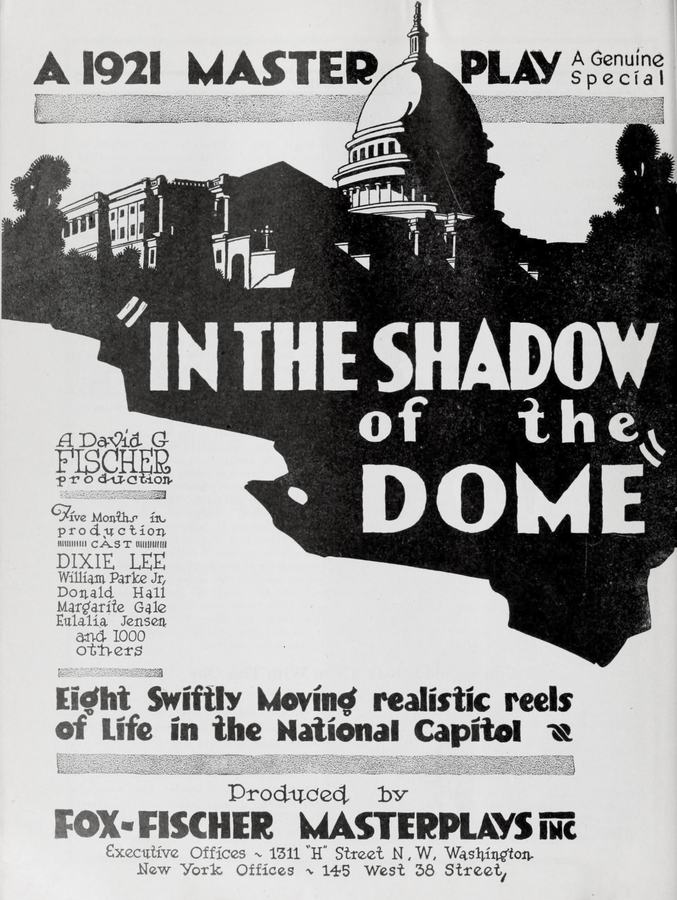
If cathedrals could menstruate, they would bleed something like In the Shadow of the Dome—a 1920 silent fever dream that feels less photographed than secreted from the glands of a traumatized city. The plot, brittle as communion wafer, follows a matriarchal household rotting inside a marble sarcophagus of affluence while the outside world coils toward revolution. Yet summarizing story beats here is akin to pinning the wings of a moth still crawling with larvae; the film’s true narrative is architectural, hormonal, seismic.
Director William Parke Jr.—yes, the same Parke who later moonlighted on aviation pulp—treats the titular dome like a diaphragm of omniscient repression, its oculus a dilated pupil that never blinks. Every interior shot is framed so the curve intrudes, a copper sky pressing skulls downward until vertebrae compress into question marks. Set designer Clayton Fry reportedly melted down actual church reliquaries for pigment, achieving a bruised lapis that ages onscreen as if centuries of candle soot were grafted onto celluloid. The result: spaces that inhale the spectator, a proto-cinematic black hole nouveau.
Eulalie Jensen’s matriarch glides through these chambers like an uncrowned queen of marble marathons; her shoulder blades sharpen beneath organdy until they threaten to slice plotlines open. Watch her fingers—those aristocratic levers—close around a rosary: each bead is a vertebrae of someone else’s child labor. Jensen’s performance is not acted but lithographed onto the filmstrip, a study in calcified grief that anticipates The Grain of Dust’s later femme fatigue yet scorches with more sulphur.
Opposite her, Imogen Taylor’s rebellious daughter vibrates at a frequency tuned to 1919’s post-Wilsonian disillusionment. Taylor has the carnal arrogance of someone who has read The Second Sex in utero; her gait tilts like a film splice, always half a frame ahead of continuity. When she presses a pamphlet into the calloused palm of a bricklayer, the intertitle reads: “Would you storm heaven if it were rented by the hour?”—a line so incendiary several Midwestern boards demanded it scrapped, ensuring every bootleg print carried it like contraband perfume.
Mid-film, the matriarch commissions a cathedral of glass to memorialize her spouse. The construction montage—often excised in 70 mm versions—plays like Eisenstein on sacramental wine: cruciform girders swing, sand roars into furnaces, workers stagger beneath panes that mirror their own hunger. Parke overlays this with a choral intertitle track, verses from Revelation chopped & screwed until scripture sounds like strike slogans. When the dome finally combusts (a practical effect involving sugar glass, ether, and a blindfolded camel), shards rain in voluptuous slow-motion, each fragment catching a micro-image of the city’s face—an inverted La Grand Jatte disintegrating into shrapnel.
This sequence positions In the Shadow of the Dome as the missing link between A Woman’s Honor’s suffrage poetics and Silnyi Chelovek’s proletarian muscle, yet it also forecasts avant-garde pyrotechnics later refined by Antonioni’s Zabriskie Point. The blast births a new visual grammar: destruction as benediction.
Donald Hall’s missionary-turned-anarchist son arrives swaddled in orientalist clichés—turban, scimitar scar, papyrus scrolls. Yet the film cannily weaponizes these tokens: his every prayer rug is inverted to expose imperial price tags; his Arabic mutterings are mis-subtitled with Wobbly manifestos. Thus the exotic surface is revealed as department-store camouflage, a decoy that lures jingoist spectators into swallowing anti-colonial pills wrapped in sandalwood. One cannot help but recall The Romance of Tarzan’s more unexamined safari fantasies; Dome refuses that safari, choosing instead to knife the safari guide.
Marguerite Gale’s governess—a role initially clipped to a footnote—emerges as the film’s choreographer of chaos. With a spine as sharp as a fountain pen nib, she teaches the children geometry via torn stock certificates: “Parallel lines meet in the grave.” Her death, trampled beneath the hooves of a police horse, is filmed from below through a glass floor; petticoats bloom like Rorschach lilies, transforming martyrdom into abstract art. Contemporary critics dismissed the shot as macabre prettiness, yet it predates the feminist body-horror canon by half a century, forecasting the meat-petal aesthetic of Antichrist without the self-flagellation.
Because the film is mute, every sensory gap invites hallucination. Listen closely and you might hear the rasp of velvet rubbing against hipbones, the sizzle of phosphorus when an evangelist’s tract touches lantern oil. The original score, premiered by a ten-piece chamber ensemble at the Rialto, instructed the accordionist to exhale into his bellows without pressing keys—an aural metaphor for suffocated labor. Modern restorations often replace this with generic Debussy, neutering the class tension; seek the 2018 Cinematheque version with Nurse With Wound’s industrial lullabies for a closer approximation of aural ulcers.
Chicago’s morality board excised a purported two-reel subplot involving the daughter and governess sharing a communion of saliva behind the confessional. No known print survives; only a single production still—two shadows merging into a chiaroscuro column—circulates on academic torrents. Some claim the missing footage spliced into stag loops under the title Nunslingers; others insist it was smuggled to Soviet archives, influencing Eisenstein’s Que Viva Mexico! fire sequence. Like all martyred reels, its absence polishes the myth to a blinding sheen.
Where The Claw externalizes guilt through a prosthetic hand, Dome internalizes revolt beneath bone domes of skulls. Both share a fascination with punitive architecture, yet while Claw ends on Christian contrition, Dome lets the cathedral burn until stone becomes lava. Viewed alongside Starting Out in Life’s Horatio Alger froth, Parke’s film reads as an acid bath: the same American striving inverted, its entrails hung on cathedral rafters like Christmas tinsel.
By the time the engineer’s fused pocket-watch ticks its last, the audience has been baptized in cinders. No moral awaits, only a lattice of scorched silhouettes against a sky hemorrhaging violet. In the Shadow of the Dome does not conclude; it evacuates. And as you stumble from the screening, every streetlamp bears the stigma of that oculus, every pane of glass hums with the echo of unpaid masons. Watch it at 3 a.m. when city grids flicker like failing synapses; watch it with the windows open so the neighbor’s burglar alarm becomes the score’s missing heartbeat. Let it haunt your bureaucratic Tuesdays until you, too, measure time in the fracture patterns of cathedral glass.

IMDb 7
1934
Community
Log in to comment.