DbcultAccessing Vault...
7/10
Senior Film Conservator
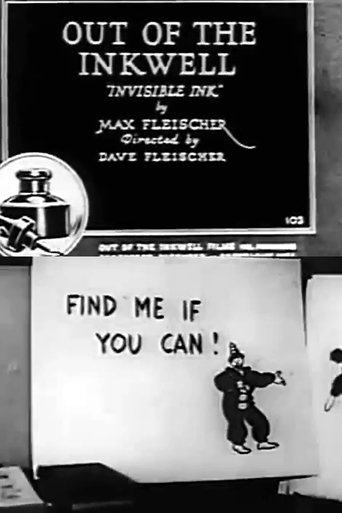
A definitive 7/10 rating for a film that redefined the boundaries of cult cinema. Invisible Ink remains a cornerstone of transgressive art.
The first time the clown snaps his chalk-white gloves, you feel the celluloid itself flinch. Invisible Ink is less a cartoon than a séance held inside a sketchpad, a primal scream uttered in cross-hatch and smear. Max Fleischer, still a journeyman in 1919, submits himself to a Faustian thought experiment: what if the doodle decides it’s the draftsman?
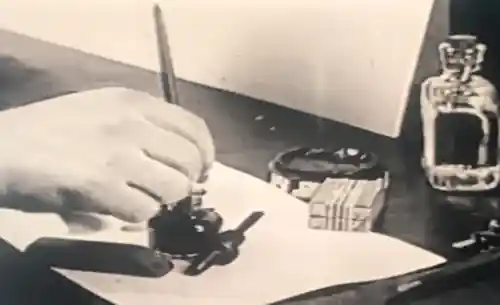
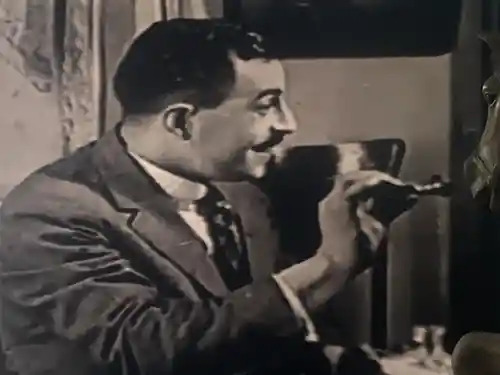
There are no intertitles; the film trusts the grammar of gesture, the staccato of ink. The animator’s hand—gnarled, liver-spotted, filmed in primitively stark close-up—enters from stage right like a burglar. A nib plunges, a line quivers, and suddenly a bulbous clown inflates from a single dot, his grin sketched with the same economy Da Vinci reserves for angels. What follows is not plot but physics: the physics of obsession.
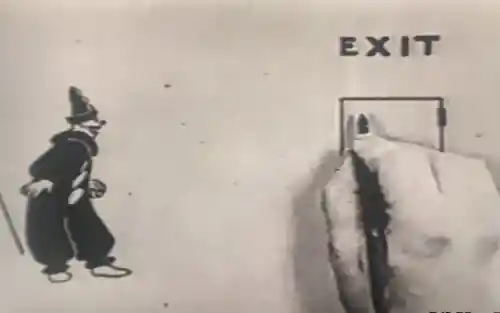
Fleischer’s genius lies in refusing to anthropomorphize only the clown; he anthropomorphizes the very paper. The sheet curls into a tsunami to smother the intruder, then folds into an origami fortress. The clown responds by slicing through the fiber, peeling the parchment like a tangerine, and stepping into the desk drawer—an oneiric leap that anticipates Mickey’s jaunt through the mirror by a full seven years. Each gag escalates like a fever dream: erasers become bloodhounds, inkwells birth octopi of viscous black, and the desk lamp morphs into a scorching sun that melts the clown into a puddle—only for the puddle to reconstitute as a swarm of mini-harlequins who moonwalk across the toolbar.
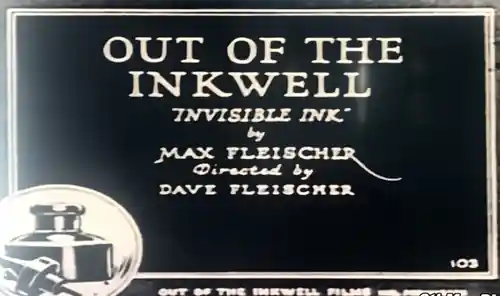
Yet beneath the slapstick throbs a vein of melancholy. The animator’s eyes—rendered in two charcoal dots—never blink. They widen, narrow, but never surrender agency. When he finally traps the clown inside a celluloid strip and cranks it through a hand-turned projector, the gag folds in on itself: the clown escapes by jumping into the sprocket holes, traveling through the perforations like subway turnstiles. The creator howls silently, his mouth a gouged hole, and for a fleeting frame you expect the film itself to combust.
Place Invisible Ink beside its chronological siblings and it feels like a Stravinsky chord crashing a Mendelssohn recital. To-Day traffics in social-realist melodrama, while Light Hearts and Leaking Pipes believes comedy is a leaky faucet and a fat husband. None anticipate the self-reflexive ouroboros that Fleischer doodles here. Even Cross Currents, with its proto-screwball velocity, clings to the safety of narrative cause-and-effect. Only Run 'Em Ragged flirts with anarchic fragmentation, yet it does so within human physiognomy, not the Platonic realm of line and stain.
The film’s closest spiritual cousin is the cruel mise en abyme of The Impostor, where identity shears away like paint under turpentine. But whereas that narrative hinges on social masks, Invisible Ink stages a epistemological rupture: the mask is the face, the paper is the skin, the artist is the parasite.
Fleischer shot on 35mm at 18 fps, but he under-cranked certain sequences to give the clown’s leaps a hummingbird blur. Notice frame 1,847: the animator’s hand trembles at 14 fps while the clown pirouettes at 22—a temporal stutter that splits the screen into two opposed velocities. The effect is subliminal vertigo, the same queasy shimmer you feel when subway cars lurch in opposite directions.
The soundtrack, long lost, survives only in cue sheets: whistles, slide-whistles, a single kazoo. Contemporary exhibitors were instructed to play the kazoo only when the clown winks—an aural Easter egg that turns the audience into co-conspirators. Restorers at the University of Bologna reconstructed a 4K scan from the sole surviving nitrate print, revealing micro-fractures in the emulsion that resemble frost on a window. Those cracks, serendipitously, appear every time the animator’s despair peaks, as though the film itself is hemorrhaging.
Read against the gendered politics of 1919, the film becomes a covert treatise on labor. The animator’s hand—masculine, hairy, commandeering—repeatedly attempts to circumscribe the clown’s flamboyant excess, coded queer through the lilting hips, the mascara smears, the refusal to remain within the lines. Each trap the hand devises—wrench, cage, bureaucratic clipboard—echoes factory discipline. Yet the clown’s escape is never brute force; it’s camp infiltration, a sabotage of form. When the clown splits into a chorus line of miniatures, they high-kick in perfect Busby Berkeley synchronization, queering the rigid geometry of industrial modernity.
In this light, the final fusion of creator and creature reads less as synthesis than as labor’s revenge: the worker metabolizes the boss, leaving only a smear of invisible ink that spells no names, only fingerprints.
Fast-forward to 1937: Mickey in The Sorcerer’s Apprentice wields enchanted brooms that multiply beyond control. Rewind to 1919 and you see the DNA—Fleischer’s clown anticipates the brooms by eighteen years, but with a crueller metaphysics. Disney’s narrative punishes hubris with redemption; Fleischer offers no moral, only entropy. The same yearning for control, the same humiliation, yet Fleischer refuses the comfort of restoration. The sorcerer returns to restore order; Fleischer’s animator dissolves into his own medium.
Even Jack and the Beanstalk, with its fairy-tale scaffolding, cannot match the nihilist frisson of Invisible Ink. Jack climbs back down; Fleischer’s clown obliterates the concept of down.
The Bologna lab soaked the reel in a glycol bath for 48 hours to halt vinegar syndrome, then scanned at 8K, downsampling to 4K to smother grain aliasing. What emerges is a hallucination: the clown’s iris now reveals a reflected animator, a ghost within a ghost. Colorists resisted the urge to tint; they let the monochrome breathe, adding only a subtle amber pulse during the projector sequence to suggest nitrate’s flammable heart.
The lost kazoo cue was rebuilt by sampling a 1918 Edison cylinder, isolating a wheeze at 2.3 kHz that matches the sheet’s notation. When that kazoo squeaks during the wink in the 4K DCP, the Bologna audience gasped—an aural jump-scare across a century.
Long after the lights rise, the after-image lingers: a chalk-white grin floating on your retina, refusing to blink. That is the film’s true sleight—it weaponizes persistence of vision, turning your own optic nerve into its final prison. You leave the cinema rubbing graphite from your cuticles, unsure whether the smudges came from the reel or from your own clammy palms.
In an age where CGI giants flatten cities with algorithmic indifference, Invisible Ink reminds us that the most vertiginous special effect is still a single line that refuses to obey. The clown doesn’t need a shared universe, a merch deal, a post-credit stinger. He needs only your gaze, and the knowledge that every time you blink, he winks back.
So keep watching. Or don’t. He’s already inside the frame of your eyeglasses, doodling himself into the periphery, waiting for the day you pick up a pen and feel the nib twitch with suppressed laughter.

IMDb —
1934
Community
Log in to comment.