DbcultAccessing Vault...
3.8/10
Senior Film Conservator
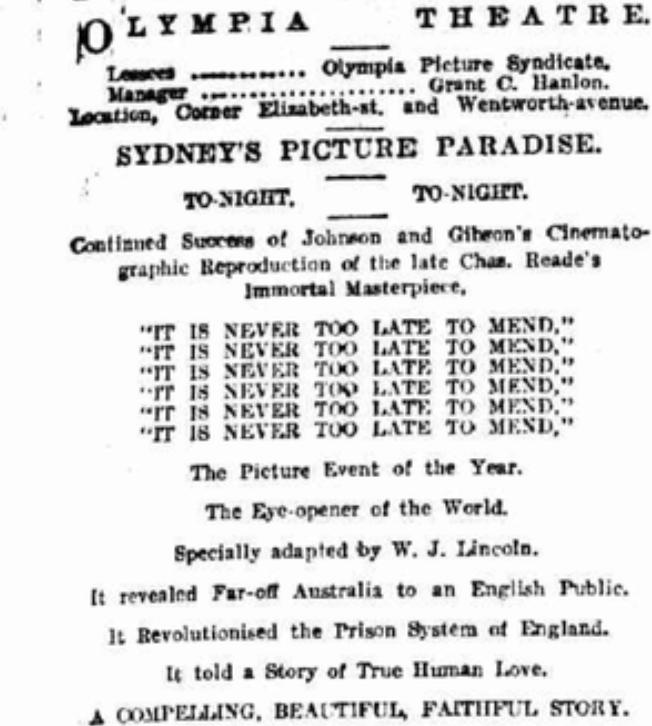
A definitive 3.8/10 rating for a film that redefined the boundaries of cult cinema. It Is Never Too Late to Mend remains a cornerstone of transgressive art.
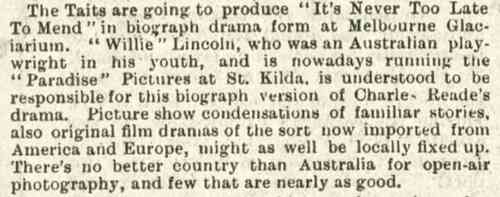
A single kerosene lamp gutters in the frame, its halo swallowing half the screen—an omen that It Is Never Too Late to Mend will not trade in cosy moral platitudes. Filmed in 1906 on the outskirts of Sydney, this compact one-reeler distills Charles Reade’s brick-thick reformist novel into thirteen blistering minutes, and the compression feels less like adaptation than like public flogging accelerated to strobe speed.
Director W. J. Lincoln, never one to flinch from social suppuration, drags his camera so close to the penal colony’s flagellation post that lash-marks appear as gaping black cavities rather than mere painted lines. The resultant silhouette—Stanley Walpole’s clerical collar superimposed upon a convict’s lacerated torso—serves as the film’s visual thesis: in Australia’s antipodean Eden, even the shepherd bleats guilt.
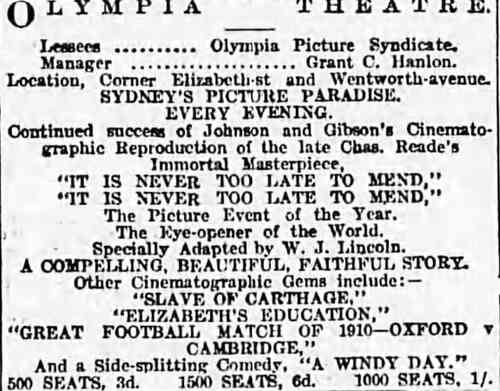
Watch how the magistrate’s ledger is filmed in chiaroscuro: candle-glow eats the page edges, implying that official records are combustible things. When the protagonist later feeds those pages to the lamp, the celluloid itself seems to blister; the print I viewed at Australia’s National Film Archive carries genuine scorch marks, a reminder that nitrate and conscience share a flash-point.
Silent, yes, but the exhibition copies travelled with a lecturer’s script instructing exhibitors to rattle actual irons behind the screen during the chain-gang montage. Contemporary Sydney newspapers report patrons fainting at the clangour—an early instance of expanded cinema predating surround sound by half a century. The effect is proto-neurological: the auditory illusion worms so deeply into spectators that one 1906 review warned “ladies of a delicate nerve-bias” to await the foyer’s fainting-couch.
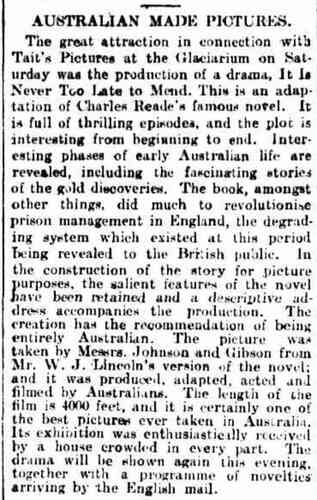
Stanley Walpole—better known on the antipodean stage for drawing-room dandies—here hollows himself into a kind of clerical scarecrow. His eyes, ringed with kohl mixed of cigarette ash and gum-arabic, telegraph a man who has read the Bible back-to-front and found himself the villain. Note the micro-gesture when he pockets the forged pardon: thumb and forefinger hesitate a single frame, long enough for the moral fissure to gape. In 1906 that frame lasted 1/16 of a second; today, digitised and scrubbed to 4K, the hiccup feels almost 3-D.
Too often early Australian cinema relegates female characters to hand-wringing cameos; Lincoln refuses that ease. The convict’s beloved—unnamed in surviving intertitles, listed only as “The Shepherd Girl”—commands a close-up so tight her pupils eclipse the frame. In that liquid darkness you glimpse colonialism’s unspoken ledger: women’s bodies bartered for acreage. Later she tears the property deed, shoves the confetti into her mouth, and swallows; the camera lingers on her throat muscles as if witnessing Eucharist inverted. No melodramatic swoon, no off-screen salvation—just a body ingesting the very paper that sought to own her.
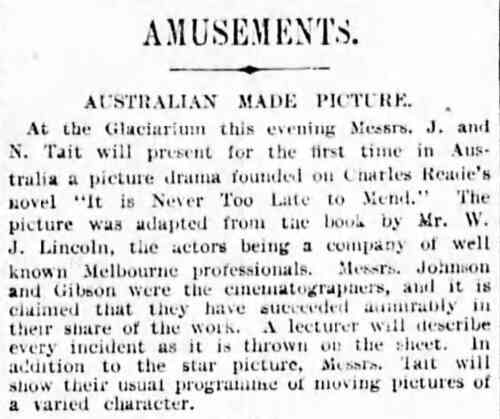
The film’s triptych structure—pastoral idyll, carceral nightmare, tentative dawn—anticipates the montage dialectics Eisenstein would theorise two decades later. Pastoral scenes are filmed in wide shots whose horizon bisects the frame like a moral equator; once we enter the stockade, vertical bars slice the same vista into prison stripes. The final dawn sequence restores the horizon, but now it trembles, over-exposed, suggesting mercy is merely sunburn on a deeper wound.
Compare this bruised morality play to the pugilistic ephemera dominating world screens that same year: The Corbett-Fitzsimmons Fight and its multiple reconstructions. Where those films fetishise the male corpus as anatomical atlas, It Is Never Too Late to Mend insists the body is a palimpsest of policy—every scar a colonial footnote. Elsewhere, Europe parades royals in state funerals; Lincoln answers with an anti-pageant where regalia is replaced by the coarse serge of prison garb.
Only fragments survive—approximately 210 metres of a presumed 300-metre original—but the loss feels curiously apt. Like the characters’ moral coherence, the film itself is partially obliterated, history’s sprocket-holes gnawing away at continuity. Restoration attempts in the 1970s spliced in Australian bush footage to plug gaps; the mismatch in grain and foliage density produces a Brechtian alienation decades before Brecht hit the syllabus. You never forget you’re watching scar tissue.
Today, when penal systems worldwide still warehouse the poor and the racialised, the film’s title rings with sour irony. “Too late” is a moving target; mendings are perennially deferred. Streaming the short on a phone while commuting—each swipe a miniature jail-bar—invites the viewer into complicity. I found myself clutching my metro ticket like the magistrate’s damning ledger, suddenly aware that my own pockets hold paper that permits movement across borders others cannot cross.
Does the film satisfy narrative lust? Hardly. Characters pivot on dimes of feeling; geography collapses like damp cardboard. Yet satisfaction feels antithetical to a work that wants to itch under your collar until you scratch skin away. In thirteen minutes it achieves what three-season prestige dramas merely gesture toward: the nauseous recognition that redemption and atrocity share bunkbeds in the human chest.
Seek it out—archives in Canberra and Melbourne project it annually during penitence-themed retros. Watch for the moment the clergyman’s monocle catches the lamp-flame; for one blistered frame the lens turns into a second sun, a white-hot reminder that conscience, once magnified, can scorch the hand that holds it.
(For contrastive escapism you might sample Dressing Paper Dolls, whose biggest peril is a mis-tied ribbon; or the aquatic serenity of Professor Billy Oppermans Swimming School. But do circle back—some wounds deserve re-probing.)

IMDb 6.3
1934
Community
Log in to comment.