DbcultAccessing Vault...
Cult Review
Senior Film Conservator
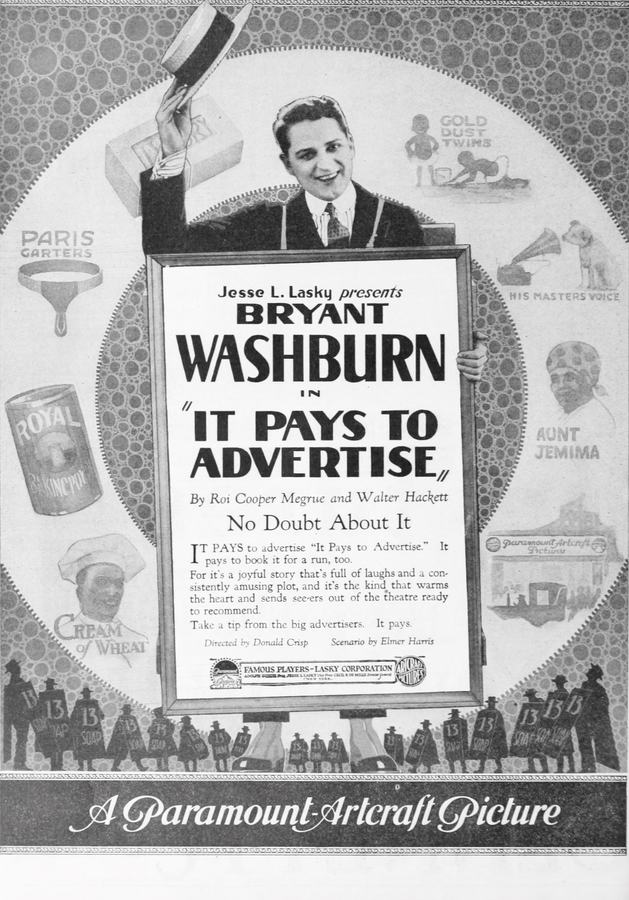
Stepping back into the cinematic landscape of 1919, one encounters a peculiar delight in 'It Pays to Advertise,' a film that, despite its vintage, resonates with a surprising modernity, particularly in its astute observations on ambition, love, and the nascent, yet undeniable, power of marketing. This silent-era gem, penned by the collaborative talents of Walter C. Hackett, Elmer Harris, and Roi Cooper Megrue, unfolds as a charmingly intricate fable, weaving together a classic narrative of generational conflict with an almost prescient understanding of consumer psychology. It’s a testament to the enduring appeal of clever storytelling that a film from the immediate aftermath of the Great War can still offer such pointed commentary on the human condition, all wrapped in a package of lighthearted comedic drama.
At its core, 'It Pays to Advertise' is a delightful subversion of expectations, beginning with the well-worn trope of the prodigal son. Here, we meet Rodney Martin, portrayed with a captivating blend of nonchalance and latent potential by Bryant Washburn. Rodney is the scion of Cyrus Martin (Frank Currier), a man whose very name, 'the soap king,' denotes his towering status in the industrial world. Cyrus, a patriarch of formidable will and considerable means, is exasperated by Rodney's seemingly incurable aversion to anything resembling gainful employment. His son's life is a perpetual vacation, a leisurely drift through the gilded cages of inherited wealth. The stage is thus set for a classic paternal intervention, albeit one with a distinctly Machiavellian twist. Cyrus, rather than directly confronting Rodney, devises a scheme as elaborate as it is cunning: he employs the bright and attractive Mary Grayson (Lois Wilson) as his stenographer, with the express, unspoken directive that she should captivate Rodney. The logic is simple, yet elegantly manipulative: if Rodney falls for Mary, he will be compelled to seek honest work to prove himself worthy of her hand, thereby fulfilling his father's desire for him to become a productive member of society – and, by extension, the family business.
The beauty of this setup lies in its unpredictable outcome. What begins as a calculated maneuver blossoms into genuine affection. Mary, far from being a mere pawn, possesses an inner strength and charm that naturally draws Rodney in. Their connection transcends the initial artifice, evolving into a sincere love that culminates in a decision to marry. This, ironically, shatters Cyrus's carefully constructed plan. His intention was to motivate Rodney, not to see him forge an independent path fueled by a love he inadvertently fostered. The 'soap king,' a man accustomed to controlling every aspect of his domain, reacts with predictable fury. The disinheritance of Rodney is swift and absolute, a dramatic pronouncement that severs the ties of wealth and privilege, plunging Rodney into an unfamiliar world where his wits, rather than his father's fortune, will be his sole currency. This moment, while seemingly a setback, is the true catalyst for Rodney's transformation, forcing him to confront the realities of self-reliance. It’s a narrative beat that echoes the dramatic stakes found in films like The Perils of Divorce, where personal relationships become the crucible for profound life changes, albeit with a comedic rather than tragic lens in 'It Pays to Advertise'.
Stripped of his inheritance, Rodney, alongside Mary and the resourceful theatrical agent Ambrose Peale (Guy Oliver), embarks on an audacious entrepreneurial adventure. Their initial gambit is nothing short of revolutionary for its time: they decide to advertise without a tangible product. This concept, seemingly absurd, is a stroke of genius within the film’s narrative, highlighting the burgeoning understanding of branding and public perception in the early 20th century. It underscores the idea that a compelling message, a captivating narrative, can precede and even create demand for a product yet to exist. The sheer chutzpah of this approach is where much of the film’s comedic and thematic brilliance lies. It’s a proto-startup story, a testament to the power of pure marketing savvy in an era just beginning to grasp its potential. The ensemble cast, including Walter Hiers, Clarence Geldert, and Julia Faye in supporting roles, contribute to the comedic tapestry, their reactions often mirroring the audience's own astonishment at Rodney's audacious plans.
Rodney's advertising campaign, initially a bluff, soon demands substance. His solution is both poetic and pragmatic: he procures his father's soap, repackaging it under his own distinctive label. This act is a brilliant narrative turn, a direct challenge to his father's empire using the very foundation of that empire. The irony is palpable, and the dramatic tension escalates as Cyrus, witnessing the unexpected success of this new, mysterious competitor, attempts to buy out the burgeoning company for a hefty $50,000. This offer is a tacit acknowledgment of the efficacy of Rodney's methods, even if Cyrus remains unaware of the product's true origin. However, the deal unravels dramatically when Cyrus discovers that the 'new' soap is, in fact, his own, cleverly rebranded. His pride, wounded by this audacious act of filial rebellion and commercial mimicry, leads him to immediately cancel the lucrative deal, setting the stage for further complications.
Unbeknownst to Rodney, who has already committed a substantial $25,000 based on the initial agreement, the deal is off. This precarious financial situation plunges Rodney into a crisis. Cyrus, despite his anger, still harbors a paternal instinct, a desire to protect his son from utter ruin. In a move that reveals the complex layers of his character, he secretly arranges for a representative from the prestigious Marshall Field department store to place a phony order with Rodney. This act of covert assistance is designed to provide Rodney with a lifeline, to allow him to save face and mitigate the financial fallout. Yet, the film masterfully demonstrates the uncontrollable momentum of effective advertising. Rodney's campaign, fueled by genuine ingenuity and a burgeoning understanding of market dynamics, proves so successful that the 'phony' order quickly translates into real consumer demand. The soap sells exceptionally well, prompting Marshall Field to place more, legitimate orders. The artificial lifeline transforms into a genuine surge of commercial success, validating Rodney's unorthodox approach and forcing Cyrus to finally confront the undeniable truth of his son's capabilities.
This climax is a satisfying resolution to the generational conflict, a moment where the father's pride gives way to admiration, and the son's ingenuity is unequivocally proven. The film culminates in Cyrus dealing directly with Rodney, not as a defiant son, but as a respected business rival, now a partner. This reconciliation paves the way for Rodney and Mary to finally marry, their union a testament to love, perseverance, and the unexpected paths to success. The narrative arc, in its comedic exploration of ambition and family, might find a distant cousin in the more frantic matrimonial pursuits seen in The Matrimaniac, though 'It Pays to Advertise' grounds its romantic comedy in a more tangible, business-oriented struggle.
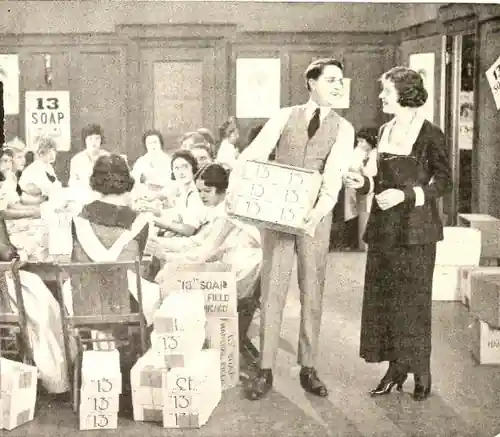
The performances in 'It Pays to Advertise' are particularly noteworthy, given the constraints of the silent era. Bryant Washburn, as Rodney Martin, navigates a challenging transformation from languid playboy to sharp-witted entrepreneur with remarkable grace. His expressions convey the shifts in his character's resolve and ingenuity, making his journey both believable and engaging. Lois Wilson, as Mary Grayson, is the film's emotional anchor and intellectual catalyst. She embodies a modern woman, intelligent and capable, who is not merely a romantic interest but a pivotal force in Rodney's success. Her quiet strength and unwavering support are crucial to the narrative's progression, demonstrating a depth of character that elevates her beyond a simple love interest. Frank Currier, as the imposing Cyrus Martin, perfectly captures the stern, proud, yet ultimately caring patriarch. His journey from rigid control to reluctant acceptance is one of the film's most compelling arcs, showcasing a nuanced performance that transcends the often-broad strokes of silent film acting.
The supporting cast, including Guy Oliver's Ambrose Peale, brings a vibrant energy to the narrative. Peale, as the theatrical agent, provides a crucial bridge between Rodney's initial lack of direction and his eventual foray into the world of marketing. His experience in showmanship subtly influences Rodney's approach to advertising, highlighting the performative aspect of sales. Walter Hiers and Clarence Geldert, alongside Julia Faye, round out the ensemble, contributing to the film's overall comedic timing and character dynamics. Their collective efforts craft a world that feels both familiar and delightfully exaggerated, a hallmark of effective silent comedy.
Beyond its charming plot and commendable performances, 'It Pays to Advertise' delves into themes that remain strikingly relevant today. The film is a fascinating exploration of the burgeoning power of advertising in the early 20th century, a time when mass media and consumer culture were rapidly evolving. Rodney's audacious strategy of advertising 'without a product' is a prophetic commentary on the importance of branding and perception over mere substance, a concept that continues to dominate modern marketing. It suggests that a compelling story, a memorable slogan, and widespread visibility can, in fact, create a market where none previously existed. This aspect of the film feels remarkably contemporary, prefiguring the age of viral marketing and influencer culture.
The film also offers a nuanced look at generational conflict. Cyrus Martin represents the old guard, the established industrialist who built his empire through traditional means and expects his son to follow a prescribed path. Rodney, on the other hand, embodies a new spirit of entrepreneurship, one that values innovation, creativity, and a willingness to challenge the status quo. His success is not merely in selling soap, but in proving that ingenuity and unconventional thinking can triumph over rigid tradition. This dynamic, a clash between established wealth and disruptive innovation, is a timeless narrative that resonates across different eras and cultures, perhaps even finding parallels in the moral dilemmas presented in As Ye Sow, though 'It Pays to Advertise' approaches such conflicts with a lighter, more optimistic tone.
Furthermore, the role of love as a motivator for ambition is beautifully portrayed. Mary Grayson is not just a prize to be won; she is Rodney's partner in both love and enterprise, her presence inspiring him to achieve beyond his father's expectations. Their relationship underscores the idea that true success is often multifaceted, encompassing both professional achievement and personal fulfillment. The film subtly argues that motivation born of genuine affection can be far more powerful than that imposed by paternal decree or the allure of inherited wealth.
As a product of the silent film era, 'It Pays to Advertise' showcases the remarkable storytelling capabilities of a medium that relied solely on visual narrative, intertitles, and the expressive power of its actors. The pacing is brisk, the comedic beats are well-timed, and the emotional arcs are clearly communicated through gestures, facial expressions, and clever staging. The film serves as an excellent example of how early cinema, despite its technical limitations, could craft engaging and sophisticated narratives that explored complex social and personal themes. The visual language of the period, often characterized by exaggerated gestures and clear character archetypes, is utilized effectively here to convey the film's humorous and heartfelt intentions. It stands as a testament to the foundational artistry that paved the way for the cinematic innovations that followed, demonstrating that even without spoken dialogue, a story can be told with profound clarity and impact.
In conclusion, 'It Pays to Advertise' is more than just a historical curiosity; it is a vibrant, intelligent film that offers enduring insights into human nature, the dynamics of family, and the ever-evolving world of commerce. Its clever plot, engaging characters, and forward-thinking themes make it a delightful watch, proving that some stories, much like effective advertising, truly stand the test of time. It’s a film that quietly asserts its relevance, reminding us that ingenuity, love, and a bit of bold marketing can indeed pay dividends, both personal and professional, even a century later.
IMDb 7.8
1932
Community
Log in to comment.