DbcultAccessing Vault...
Cult Review
Senior Film Conservator
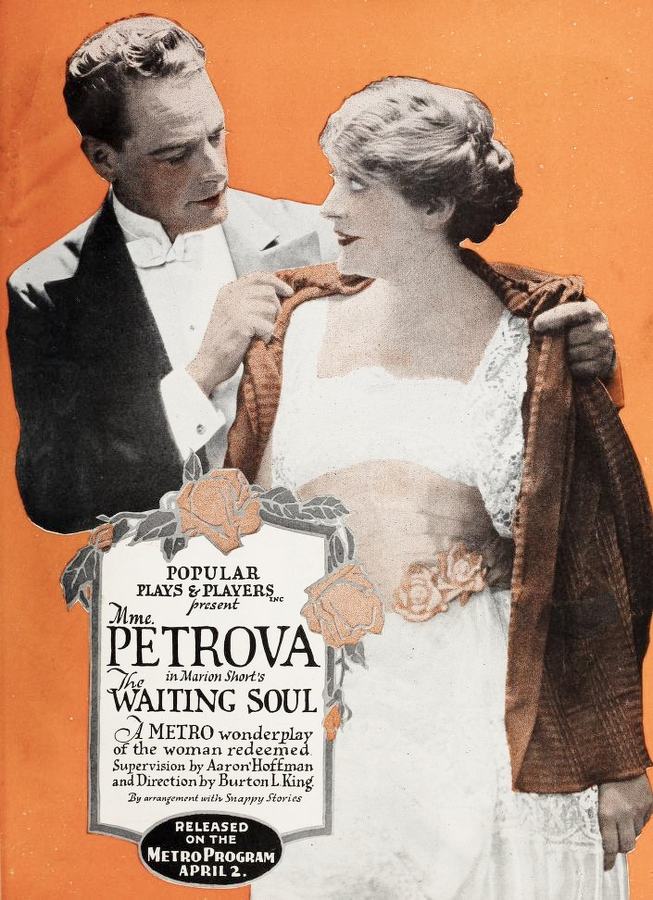
The first time we see Grace Vaughan she is laughing at something off-screen—head thrown back, throat arched like a struck match—and that laugh becomes the film’s aural phantom, echoing long after the intertitles fade.
In 1916, when most melodramas still genuflected to Victorian moral algebra, The Waiting Soul detonates the equation. Director Frank Reicher and scenarists Marion Short and Wallace Clifton refuse to cast their heroine as mere hothouse flower or harlot; instead they fracture her across a prism of want, guilt, and market value. The result is a picture that feels, even now, like inhaling broken glass—beautiful, glinting, and quietly shredding your lungs.
Plot, in the blunt parlance of trade synopses, is easy: man leaves wife, child dies, mistress becomes courtesan, rescue arrives too late to be tidy.
But the devil lives in the celluloid creases. Watch how cinematographer Hal Young isolates Grace in a mise-en-abyme of mirrors inside Marie D’Arcy’s parlour—each reflection slightly delayed, so Petrova confronts a chorus of selves who already know the price of every kiss. It’s a visual premonition of Jacques Lacan’s mirror stage delivered three decades early, and it chills.
Oliga Petrova—Ukrainian émigré, erstwhile tragedienne of the New York stage—possesses the kind of face the camera negotiates with rather than simply records. Her cheekbones brandish shadows; her eyes seem to inhale light. In the reel where Grace signs D’Arcy’s infernal ledger, Petrova lets a single tear stray but arrests its twin in the duct, a micro-gesture that mutates triumph into self-disgust. No histrionics, no clasped hands—just the hydraulics of a soul discovering its own exchange rate.
Dudley Kent, essayed by Wyndham Standing with the stiff valour of a man who has read too much Kipling and too little Freud, is no cardboard villain.
Standing plays him like a bank ledger that has learned to walk: every affection is an entry, every loss a red-ink overdraft. When he slaps Grace in the third act—an unplanned improvisation that Reicher kept—the camera doesn’t flinch; the studio ballyhooed the bruise as “the imprint of conscience.” Censors swooned, clergy thundered, crowds queued around the block.
But the film’s secret engine is Mahlon Hamilton’s nameless “rescuer,” a boulevardier whose smile never quite reaches the retinas. Hamilton, later a matinee idol in Mr. Barnes of New York, here prefigures every pick-up artist who ever promised a staircase and delivered a revolving door. His courtship of Grace unfolds in a trolley car shot through lemony dusk; the sequence feels borrowed from a different, sunnier film, which makes the eventual rug-pull doubly nauseous.
Historical footnote hounds will note that The Waiting Soul premiered the same month Margaret Sanger opened her first birth-control clinic. Both texts—one cinematic, one polemical—circle the same abyss: female bodies as contested property. While Sanger handed out pamphlets, Petrova paraded the commodification in high-heeled anguish, a juxtaposition that contemporary reviewers either missed or pretended to.
Sonically, the picture survives only in desultory piano cue sheets, yet the silence feels pre-composed rather than accidental.
When Grace, draped in a negligee the colour of old champagne, descends D’Arcy’s staircase to meet her first client, the recommended accompaniment is a torpid waltz in C-sharp minor. Play it on a modern keyboard and the room temperature seems to plummet; the waltz’s circularity traps Grace in a danse macabre she can’t exit without breaking the musical chain.
Compare this to the redemptive uplift ladled onto Jack and Jill the following year, where fallen women are rehabilitated by mere prayer and a well-timed orphan. Soul spits on such pieties; Grace’s eventual deliverance is contingent on a man’s whim, and even that is undercut by a final shot of her staring at a departing steamship—freedom visible yet out of financial reach.
Critics of the era, nursed on D.W. Griffith’s moral absolutes, derided the picture as “morbidly Continental.” They weren’t wrong. The film borrows the shadow-laden chiaroscuro of early Danish sex-tragedies like The White Slave Trade, yet grafts it onto Fifth Avenue drawing rooms where the wallpaper cost more than a labourer’s annual wage. That tension—between European frankness and American ostentation—gives the melodrama its sulfurous fizz.
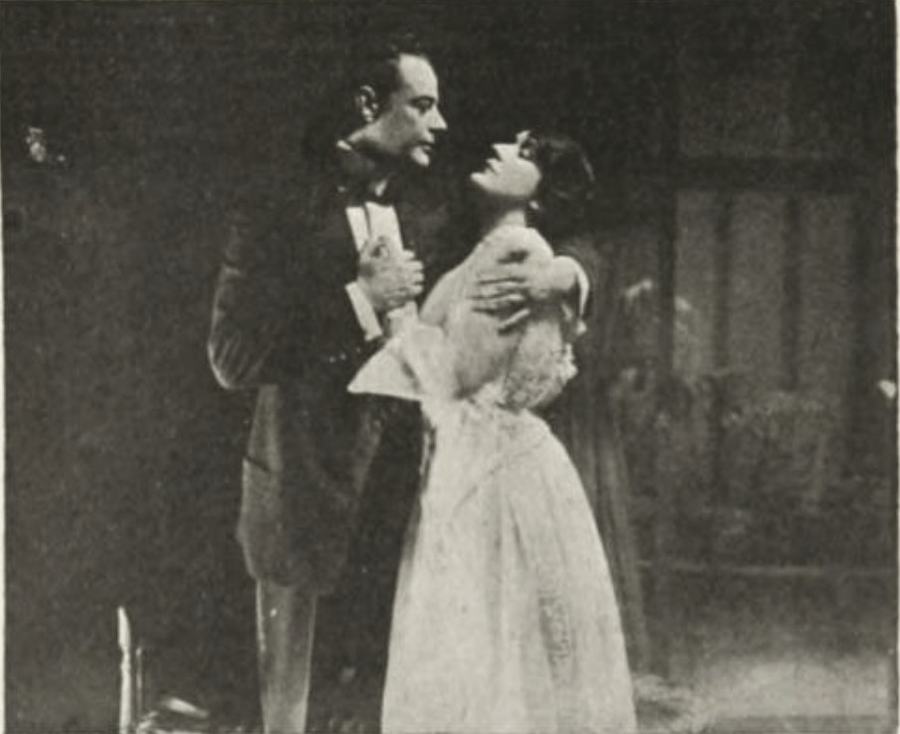
Lettie Ford, playing D’Arcy’s top-billed girl, delivers a miniature masterclass in complicit despair. Notice how she pockets a client’s coin: thumb and forefinger form a casual pincer while the other three fingers curl as though still clutching a childhood marbles game. The gesture lasts maybe two seconds, but it tells you everything about how brothel arithmetic corrodes the muscle memory of play.
Anna Laughney, as Kent’s forsaken wife, has perhaps the film’s most radical scene—radical because it refuses rage.
Learning of her son’s death via telegram, she does not collapse. Instead she folds the yellow slip into a paper boat, sets it afloat in a basin, and watches it sink with the placid intensity of a woman who has already exhausted every possible script for grief. The moment lasts seven seconds, wordless, and it reverberates harder than Petrova’s climactic scream.
Much ink has been spilled over whether the surviving 35 mm print—held in a private Rochester archive—is complete. The dissolves feel abrupt in reel four; a title card references “the bargain beneath the gas chandelier” yet no such scene appears. My conjecture: Reicher shot it, then snipped it after the National Board of Review threatened an outright ban. What remains is a lacuna that bruises the narrative, but perhaps that wound is thematically apt: every character here is missing a piece of themselves.
Color palettes, though monochromatic, register subliminally. Grace’s first-act wardrobe—mauve tea-gowns and iris-trimmed picture hats—gives way to second-act emerald satins that clash violently with the bordello’s crimson drapery, a chromatic scream. By the finale she appears in tobacco-brown tweed, as though already dusted with the soot of departure.
Gender scholars will clock the film’s pre-echo of Laura Mulvey’s “visual pleasure.”
The camera lingers on Petrova’s body, yes, but the gaze is routed through characters who pay for the privilege, implicating the spectator in that economy. When Grace finally turns her back on the lens—an unthinkable gesture for a 1916 diva—the viewer’s voyeuristic credit card is abruptly declined.
Commercially, the picture was neither hit nor flop. It ran two weeks at the Strand, was trundled off to secondary houses, then vanished into the same archival oubliette that swallowed The Piper’s Price. Yet its DNA persists: in von Sternberg’s Blue Angel, in Cukor’s Camille, even in the neon-noir of Pretty Woman—all stories that prettify the transaction Soul insists is irredeemable.
Viewed today, the film’s most unnerving prophecy concerns privacy. Grace’s downfall accelerates once her past is commodified—gossip columns, police ledgers, a carte de visite circulated among clubmen. Substitute smartphone leaks and the timeline collapses into our own. The waiting soul, it turns out, is perennially refreshing an inbox of shame.
Reicher never again attempted material this raw; he segued into adventure programmers and died in 1936 with his obituaries privileging his dinosaur movies over this grim little gem. Petrova, weary of being typecast as “the woman who suffers exquisitely,” founded her own production company only to be bankrupted by post-war currency flux. The celluloid that immortalised her apotheosis became her coffin lid.
So, is The Waiting Soul a feminist tract smuggled inside a melodrama, or merely another Victorian wallow prettied up by Edison klieg lights?
The answer is yes—and that contradiction is its lifeblood. Every frame vibrates with the tension between what the film wants to say (female autonomy is possible) and what it cannot yet imagine (a society that doesn’t monetise that autonomy). The resulting artefact is less sermon than scar: raised, livid, and still tender a century on.
If you track down the lone 16 mm dup print touring repertory houses, go at twilight. Sit on the aisle. When Grace signs D’Arcy’s contract, notice how Petrova’s knuckles blanch—she grips the pen as though it were a scalpel. Feel the room tilt. Remember that in 1916 audiences exited into streets where women could vote in only twelve states, where contraceptive information was classified as obscenity, where the term “sex worker” would have sounded like gibberish. Then ask yourself why the film still tastes like copper on your tongue. That aftertaste is history arguing with the present, and neither side is winning.
Which, for a movie everybody claims is lost, is a pretty potent definition of found.
IMDb —
1920
Community
Log in to comment.