DbcultAccessing Vault...
Cult Review
Senior Film Conservator
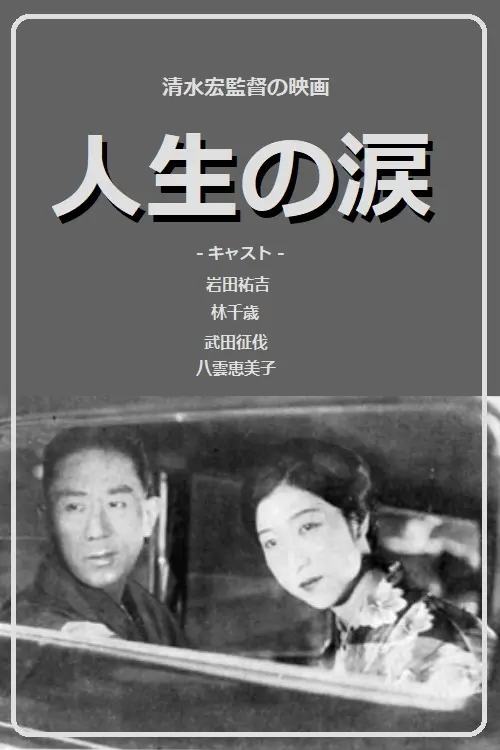
Jinsei no namida, or 'Tears of Life,' is a film best approached with tempered expectations. It is not an undiscovered classic, nor is it a lost gem that will redefine your understanding of early cinema. Instead, it offers a stark, often slow, but occasionally piercing look at a particular strain of Japanese melodrama from a bygone era, making it worthwhile for those with a specific interest in film history and the evolution of narrative forms, but a likely test of patience for casual viewers.
This film works because it provides an unfiltered glimpse into the stylistic conventions and emotional preoccupations of silent Japanese cinema, offering a rare window into performance aesthetics and storytelling techniques that have largely faded. It fails, however, in its often ponderous pacing and an emotional register that frequently feels more dutiful than genuinely affecting, making its drama less impactful than intended. You should watch it if you are a dedicated scholar of silent film, particularly Japanese cinema, or if you possess an unusual tolerance for deliberate, often repetitive, dramatic beats in pursuit of historical insight.
Tokusaburō Murakami’s direction here, while functional, rarely transcends the era’s technical limitations. The camera setups are largely static, a common trait for the period, but they rarely find a compelling angle to elevate the domestic tragedy unfolding. We see a lot of characters framed head-on, delivering their emotional states directly to the lens, which, after a while, begins to flatten the dramatic landscape. There's a rawness to the production, an almost theatrical simplicity, that can be either charmingly authentic or maddeningly primitive depending on your disposition.
The performances, particularly from Chitose Hayashi as the central figure, are steeped in the melodramatic traditions of the time. Hayashi projects an earnest suffering, her expressions often broad and sustained. It’s a style that demands a certain interpretive generosity from the modern viewer, as subtlety was not always the primary goal. There are moments, such as her quiet resignation after a particularly cruel twist of fate, where her stillness communicates more than any exaggerated gesture. But then there are sequences where the sheer volume of gesticulation, the hand-wringing and the wide-eyed despair, feels less like genuine anguish and more like a dutiful performance of it. It’s hard to shake the feeling that the actors are often working against the camera, rather than with it, in an attempt to convey emotion to the back row of a theater.
Tokusaburō Murakami’s script, while aiming for grand tragedy, occasionally veers into overwrought sentimentality. The narrative unfolds through a series of misfortunes befalling our protagonist, each designed to elicit maximum pathos. Her unwavering dedication to her ailing family member, for instance, is hammered home with such insistence that its initial power begins to dissipate. The film seems to believe that repeating a predicament makes it more tragic, when often it merely makes it more tedious.
Pacing is a real issue. Scenes are often drawn out, with lingering shots on characters contemplating their despair, or extended sequences of repetitive action that do little to advance the plot or deepen character. An early scene depicting the protagonist’s silent internal struggle, while initially effective, is allowed to run for what feels like an eternity, draining the moment of its intended poignancy. The film often mistakes slowness for gravitas, believing that a prolonged gaze equals profound emotion. This isn't always the case; sometimes, it's just slow.
Visually, Jinsei no namida is largely unremarkable. The cinematography is functional, capturing the scenes without much flourish. There are few moments of striking composition or innovative framing that stand out. The film relies heavily on its intertitles to convey crucial information and emotional states, almost as if the visual storytelling itself felt insufficient to carry the full weight of the narrative. This reliance highlights a certain primitive aspect of its construction, where the moving images serve more as illustration than as the primary vehicle for expression.
The overall tone is relentlessly somber. While this is expected for a film titled 'Tears of Life,' the lack of even fleeting moments of levity or genuine human connection outside of suffering makes the experience feel monochromatic. The film establishes its tragic premise early and then simply amplifies it, without exploring the nuances of resilience or the small joys that persist even in hardship. It’s a singular note played loudly for over an hour, which can be exhausting.
One of the more debatable aspects of Jinsei no namida is its commitment to an almost punishing level of sentimentality. The film seems to revel in its protagonist's suffering, piling on one misfortune after another with a zeal that borders on the cartoonish. There's a fine line between tragedy and emotional manipulation, and this film frequently crosses it. The sheer volume of tears, both on screen and implicitly demanded from the audience, often feels unearned, a shortcut to pathos rather than a deeply felt exploration of human struggle.
However, in its more restrained moments, the film does hint at a potent emotional core. A particular sequence involving a difficult goodbye, stripped of excessive theatrics, manages to convey a quiet, aching sorrow that genuinely resonates. It's in these brief flashes that one sees the potential for a truly affecting drama, a potential that is too often buried under layers of exaggerated woe. The film struggles to find a balance, swinging between stark realism and theatrical excess, never quite settling into a consistent, persuasive emotional rhythm.
Jinsei no namida is a challenging watch, even for those accustomed to the rhythms of silent cinema. Its value lies primarily in its archival significance, offering a glimpse into a specific moment in cinematic history rather than delivering a universally engaging story. It's a film for the curious, the academic, or the completist. For anyone else, its 'tears' might feel more like a slow drip than a cathartic flood. Approach it as a historical artifact, and you might find something to appreciate; expect compelling drama, and you will likely be disappointed.

IMDb 6.3
1929
Community
Log in to comment.