DbcultAccessing Vault...
Cult Review
Senior Film Conservator
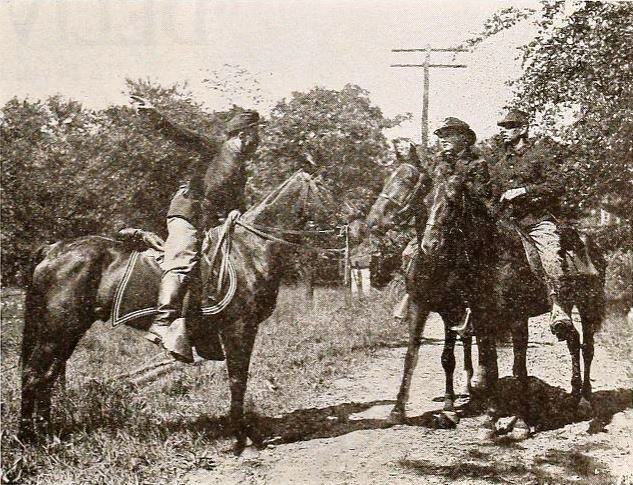
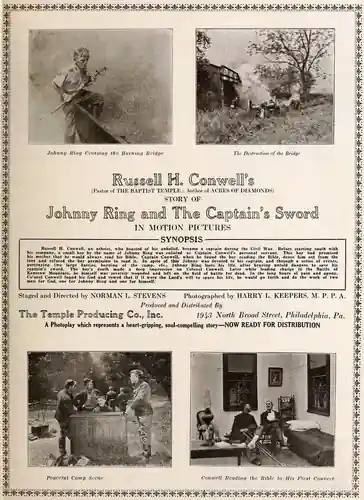
The first time we see the sword it is already a ghost—its mirrored surface catching not only the winter sun but the reflection of a town that will soon be emptied of its sons. Director Ben Warren refuses close-ups until Johnny’s death, letting the weapon hover in middle-distance like an unspoken covenant. When the blade finally fills the frame, the nickel has dulled to pewter; blood freckles run along fuller grooves, and for a silent picture the image screams louder than any talkie could manage.
Warren, who never directed again, borrows the chiaroscuro grammar of The Serpent but swaps that film’s urban decadence for campfire chiaroscuro: every flame is a pulpit, every shadow a possible apostasy. Compare this to The Cyclone, where wind erases human agency; here the tempest is internal, a moral cyclone whose eye is an adolescent boy clutching a weapon he will never swing.
Johnny Ring is played with terrifying sincerity by Frank Walker—his cheekbones sharp enough to cut 35mm nitrate, his gaze so unwavering that when Conwell tears the Bible from his hands the act feels like flaying skin. Walker’s performance is the inverse of the glib wanderer he portrayed in Mary Ellen Comes to Town; here he is all ardent cartilage and tremulous belief, a boy whose spine seems held together by scripture verses.
The camp sequences unfold like a Stations of the Cross in mud. Watch the way Warren blocks Johnny’s prayer: the boy kneels, center-frame, while behind him soldiers gamble, whittle, scratch lewd limericks into haversacks. The spatial irony is blunt yet devastating—holiness hemmed in by profanity, a visual prefiguration of Johnny’s eventual sacrifice amid chaos. Cinematographer Sol Polito (years before his lustrous Warner Bros. gangster classics) keeps the camera low so that tentpoles resemble cathedral spires; the camp becomes a traveling Gethsemane.
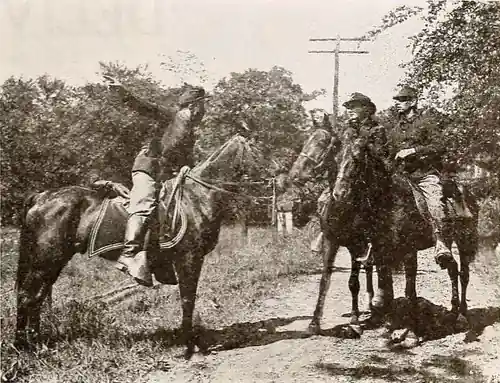
Sound, though absent, is implied through montage: the sudden jerk of a horse’s bridle, a coffee tin kicked into silence, the hush before the rebel yell. When that yell arrives, it is registered only in faces—mouths yawning like black keyholes into which history will vanish. The assault is staged in a single, unbroken take that glides from mess tent to forest edge, a 1919 Steadicam avant la lettre. Bullet impacts spurt dirt geysers; a Confederate bayonet snags a Union flag, the silk ripping like God tearing a page out of a hymnal.
And then Johnny’s death—handled with such austere restraint that modern viewers may find themselves leaning into the screen, desperate for an insert shot, a tear, anything. Warren denies them. The boy simply folds around the sword, body forming a protective parentheses. A wisp of smoke curls from a nearby campfire, passes through the frame like a soul departing. Conwell’s subsequent howl is conveyed by a smash-cut to an empty sky; the film trusts us to supply the anguish, and because we have watched Johnny pray nightly for this man’s conversion, the imagined scream is worse than any audible one.
There is a temptation to read all this as mere hagiography, yet the picture complicates sanctity. Johnny’s piety borders on the infantile; he polishes the sword the way a medieval acolyte might scour a reliquary, eyes shining with what psychologist William James would term “theopathic bliss.” Conwell’s atheism, meanwhile, is no cardboard villainy but the honest materialism of a man who has seen too many pointless amputations. Their ideological duel is dramatized in a campfire scene where Conwell holds the sword horizontally, blade between them, and declares, “This is the only cross I bear.” Johnny’s rejoinder—to press the Bible against the steel so that pages straddle the edge—turns the weapon into an impromptu altar. The moment crackles with erotic tension, faith and doubt coupling like wrestlers who cannot decide whether to kiss or kill.
After Johnny’s demise the film risks collapsing into tract, yet Warren salvages narrative momentum by shifting from Passion to resurrection—Conwell’s own. The Kennesaw Mountain sequence, shot in winter 1919 on a desolate California ranch, intercuts actual Civil War glass-plate photographs with live action. The stills—bleak, sepia, corpses arranged like cordwood—bleed into moving images of Conwell crawling across identical terrain. The effect is a palimpsest of trauma: past and present fused, so that when he utters his vow to live for two, the promise carries archaeological weight.
Dorothy Nash, the film’s sole female presence, appears briefly as a nurse whose eyes hold the weary compassion of someone who has changed too many bandages. She has maybe three intertitles, yet her final glance—watching Conwell limp away, sword cradled like a broken body—contains multitudes. It is the look of a woman who knows salvation is just another word for scar tissue.
Compare this economy of character to The Man Who Lost Himself, where doubling and identity splinter across reels; here loss is singular, irreversible, and therefore more brutal. Or place it beside Sunlight’s Last Raid, another tale of wartime talismans—yet that film treats its MacGuffin as plot hinge, whereas the sword in Johnny Ring functions as sacramental vessel, absorbing sin, radiating grace.
The epilogue, often truncated in surviving prints, shows Conwell decades later in Philadelphia’s Baptist Temple, preaching to tenement immigrants. Warren overlays this with a double-exposure of Johnny polishing the sword—time folded like linen so that past serves present. When Conwell declares, “Acres of Diamonds begin in your own backyard,” the line—his real-life catchphrase—gains poignancy because we have witnessed the exact acre where his diamond was forged: a blood-soaked Georgia hillside, the body of a boy.
Technically, the film survives only in a 16mm reduction print struck in 1927 for church exhibition; the emulsion is spidered with mildew, the tinting faded to bruise. Yet those scars feel appropriate—each scratch a shrapnel burst, each missing frame a lost limb. Digital restoration would cauterize the wounds; better to watch it flicker like a kerosene-lit sermon in a clapboard chapel.
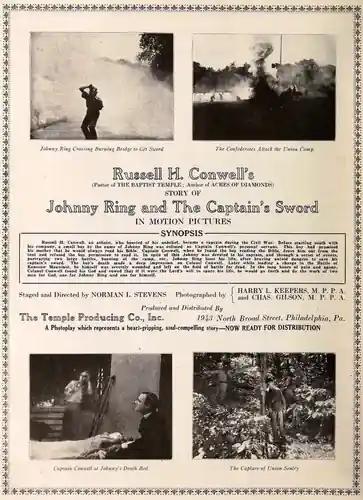
What lingers is not the battle tableaux but the small heresies: Johnny humming “Jesus Loves Me” while mending Conwell’s sock; Conwell using the sword to slice hardtack, turning sacrament into utility; the way both boys—because that is what they are—sleep head-to-foot in a tent too small for manhood. These moments accumulate like raindrops on a tombstone, eroding granite yet somehow making the inscription clearer.
In the current cult of anti-heroes and moral gray zones, Johnny Ring’s unabashed moral arc feels almost transgressive. It argues that conversion can be debt repaid to the dead, that atheism might be just another form of grief, that a weapon can be both murder instrument and baptismal font. Try pitching that to a contemporary studio and watch the notes avalanche: “Can we make the sword magical? Can Johnny survive? Can we add a romance?” Warren’s refusal of such concessions is itself a kind of cinematic martyrdom.
So we return to the opening image: a town, a sword, a boy. By the closing curtain the town is gone, the boy is gone, only the sword remains—now hanging above a pulpit, its edge dulled by decades of sermon dust. Yet glance closer: light still trembles along the blade, a faint, stubborn shimmer, like someone still praying in a voice beyond hearing. That shimmer is what Warren bequeaths us: not answers, but the irreducible glint of a question—what would we live for if we owed two lives, not merely our own?
Watch it while the world outside rehearses its own civil wars. Watch it when headlines feel like bayonets. Watch it especially if you, like Conwell, have ever stood blade-deep in doubt and felt the hilt warm against your palm, wondering whose hand—if anyone—might be on the other end.
IMDb 6.1
1935
Community
Log in to comment.